AI hallucination: The math behind the beautiful lies by chatbots – Firstpost
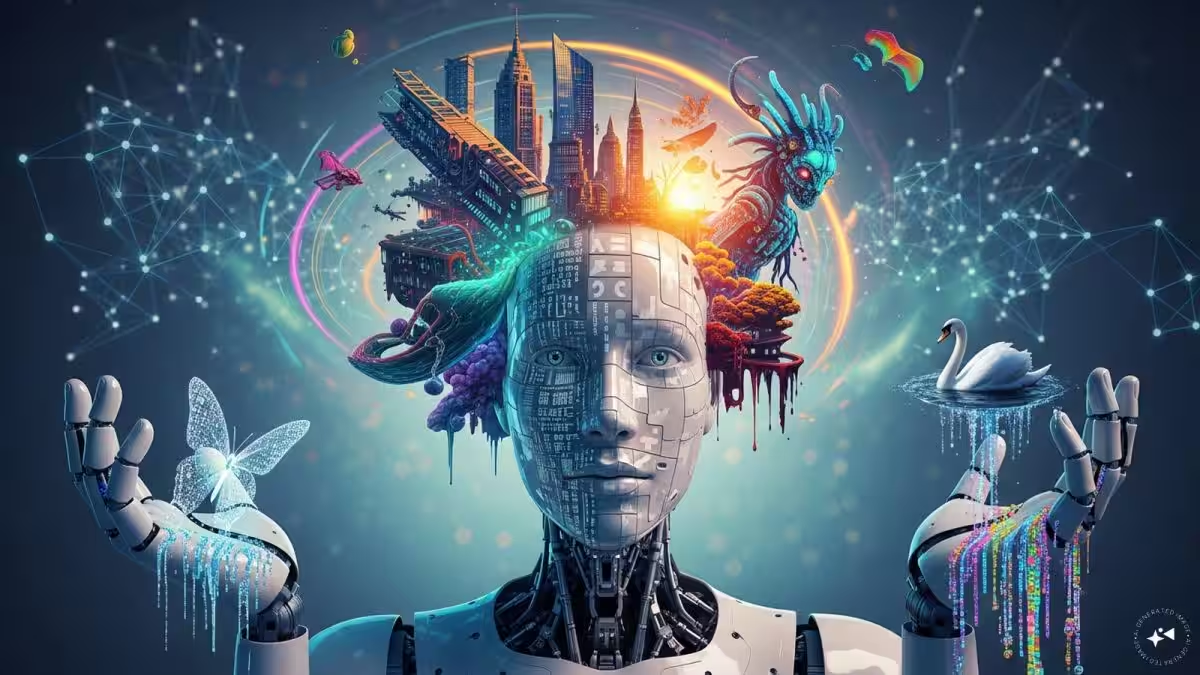
When a New York lawyer submitted a legal brief last year peppered with made-up case citations, he didn’t realise his assistant, an AI chatbot, had invented them out of thin air. The fallout was swift and humiliating. The court fined him $5,000, his reputation took a hit, and “AI hallucination” entered legal vocabulary.
What seemed like a one-off embarrassment quickly became a symbol of a much deeper problem: artificial intelligence systems that can’t always tell fact from fiction.
STORY CONTINUES BELOW THIS AD
When algorithms start imagining things
AI hallucinations is when a model confidently generates false or fabricated information, and these are no longer just amusing quirks. They’re swift becoming structural risks across industries.
While several tech giants like Google and OpenAI are scrambling to contain the issue, the frage is that AI hallucination is not a glitch. It’s a feature of how these systems work.
More from Tech
Meta confirms over 1,000 job cuts as 3 VR studios shut down
X restored in Venezuela after block lifted following Maduro’s capture
Large language models (LLMs) like ChatGPT, Gemini, or Claude work by predicting the next likely word based on patterns in data. The result often sounds convincing but isn’t necessarily true.
Last year, amid growing concerns over chatbot hallucinations, OpenAI carried out a study to understand the root causes behind such errors. The research found that the very mechanism by which language models operate, predicting each word in a sentence one after another, based on probability, makes them prone to inaccuracies.
According to the paper, the overall error rate for generating full sentences is at least double that of answering simple yes-or-no questions, since minor mistakes can pile up over a series of predictions.
Quick Reads
View All
Meta confirms over 1,000 job cuts as 3 VR studios shut down
Intel boost to chip manufacturing, AI data centres sends its shares soaring
In essence, the frequency of hallucinations is limited by how effectively an AI system can tell genuine information from falsehoods. Because this distinction is particularly challenging in many domains of knowledge, some degree of hallucination remains inevitable.
The study also revealed that a model’s familiarity with a fact during training strongly influences its reliability. For example, in tests involving the birthdays of well-known individuals, researchers found that if 20 per cent of those dates appeared only once in the training data, the base models were almost certain to produce errors for roughly the same proportion of queries.
STORY CONTINUES BELOW THIS AD
As AI seeps deeper into workplaces, schools, and daily life, the potential for misinformation wrapped in perfect grammar is growing into one of technology’s defining threats.
The paradox of trust in machines that lie
The most unsettling part isn’t that AI makes mistakes. It’s that people still trust it when it does. Studies show that users often believe false information if it’s delivered with confidence or formatted professionally. This has also given a term, called AI trust paradox. It means, the more humanlike AI becomes, the more likely people are to overestimate its reliability.
That dynamic is visible everywhere, from students relying on chatbots to write essays to professionals using AI for research, summaries, and even therapy advice.
The hallucinations that follow aren’t always obvious. Some are subtle, like invented statistics or slightly altered quotes, while others are absurd, like adding glue to your pizza. Yet the tone of authority remains the same.
Even tech leaders admit we’re still fumbling in the dark.
Meta’s chief AI scientist, Yann LeCun, recently slammed current AI architectures as a “dead end”, arguing that true intelligence can’t emerge from models that merely mimic language. If he’s right, the hallucination schwierigkeit won’t disappear, it will evolve alongside AI itself.
Can hallucinations be tamed, or only managed?
The industry isn’t standing still. Google, OpenAI, and Anthropic are experimenting with techniques like retrieval-augmented generation (RAG), where models are forced to verify facts from databases before responding.
Some researchers claim these methods cut hallucinations by more than 90 per cent in specialised fields such as finance. Others are pushing for regulatory guardrails, requiring AI systems to disclose uncertainty levels or cite verifiable sources.
STORY CONTINUES BELOW THIS AD
But full accuracy may be an illusion.
For now, companies are reframing hallucinations as a cost of doing business in a world run by probabilistic machines.
The real question is whether humans will adapt quick enough to spot the seams in the stories they tell.
The lawyer in New York learned that lesson the hard way. The rest of us are still learning it in real time, one confident hallucination at a time.
Tagsartificial intelligence (AI)HomeTechAI hallucination: The math behind the beautiful lies by chatbotsEnd of Article