‘Arise, awake’: Why Swami Vivekananda matters to Gen Z – Firstpost
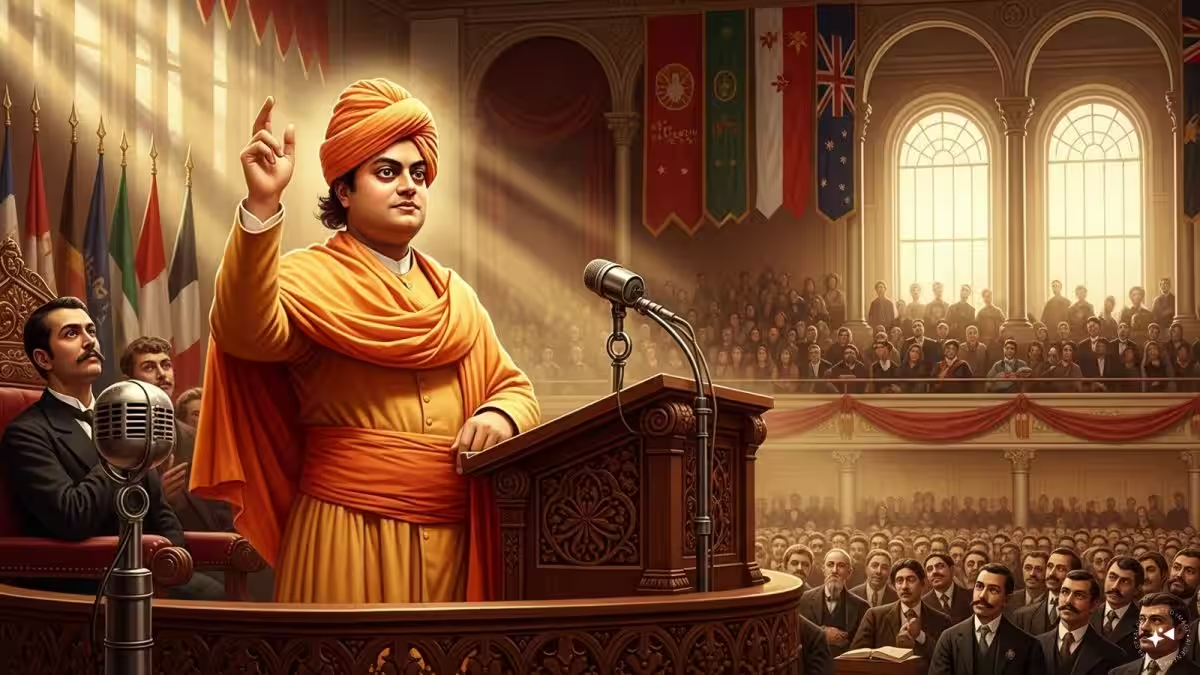
January 12 is the 163rd birth anniversary of Swami Vivekananda, who championed the invincible power of youth and wisdom. It is painful to think that we now merely remember him as a spiritual icon who left his ancestral home to discover the soul of Bharatvarsha amidst the huts of the downtrodden and wretched masses. Yet, there was a time when our society subjected his credentials to surmise, making attempts to pull him down when he was struggling to rise to the pinnacle of success. Therefore, it is the irony of history that presently he is celebrated by all Indians as the hero of National Youth Day—a day deeply meant to remember his ardent and pragmatic thought and impactful actions.
STORY CONTINUES BELOW THIS AD
However, a deeply disconcerting paradox remains: have we truly remembered the tireless, relentless, and arduous work he did for the country and humanity at large? The answer seems to be negative. Even after 123 years since his death, questions persist about how much of his philosophy of human development, his mantra for awakening the youth, and his vision of seeing India at the forefront of the world have actually been realised.
More from Opinion
Panama and Venezuela, 36 years apart: How Bush and Trump used law to break law
Has UN become obsolete? Why India needs its own sphere of influence
What we usually do—and what we have been doing for years—is to inculcate a sense of priestly reverence without deconstructing his preachings and teachings, which could be a better way to appreciate his cogent message to address socio-economic degradation, apart from guiding us to realise the kernel of Vedantist philosophy insofar as the illusory character of the sensory world is concerned. Yet, we remember him exuberantly on 12 January, much like a logocentric focus on his birth and death anniversaries.
We remember him by flipping through pages of books at home and in libraries. Also, we tend to seek mental peace by visiting various nostalgic places—from his north Kolkata home to the temple at Kanyakumari—with a sense of urgency. In doing so, what we are actually engaging in is a form of ritualistic show in the hope of attaining liberation. The profound question that arises from this is: how will we attain liberation? Will an elusive lip service be enough? It seems not. True liberation is not even yoga, but is organically tied to a lofty Hegelian vision of introspection for collective emancipation through the process of overcoming our narrow identities to become capable human beings.
Quick Reads
View All
Germany and India at 75: Significance of Chancellor Merz’s Delhi visit
From response to readiness: The surge in India’s disaster management arc
Therefore, if we look at present-day India, we will find both similarities and differences between contemporary India and the unfading vision of Vivekananda. On the one hand, having learned from wars with both Pakistan and China, India has adopted a pragmatic approach and is striving to become a sophisticated military armada in keeping with the times, showcasing significant advancements in military strength. However, Vivekananda never envisioned India as a powerful military nation. On the other hand, much like Kant’s “categorical imperative”, Vivekananda was always emphatic on the cardinal principle of achieving social unity as an overriding priority, hence prophesying inclusiveness even before the advent of the era of Gandhian ‘mass politics’.
STORY CONTINUES BELOW THIS AD
So, if we attempt to probe the inner reality of present-day India more deeply, we would realise that although India’s exterior appears magnificent, confident, and advanced, its interior remains somewhat fractured. To overcome the current problems facing India, we still need Vivekananda currently; his rousing call, “Arise, awake and stop not till the goal is reached”, emanated from the “philosophy of a perpetual revolution”, and hence remains immensely relevant to us to salvage ourselves from the ponderous burden of ritualistic ceremonialism. It resonates with the urgency to seize the task of going from door to door to preach the gospel of our rich ancient heritage in order to awaken the masses.
Today, when we talk about the Indian Knowledge System (in short, IKS), it may be reminded that long ago it was Vivekananda who advised his compatriots to preach the shastras by presenting them in a lucid way so that sublime scriptural truths could percolate to the huts of Chandals, and the perpetual privilege of Brahmins claiming monopoly of knowledge could be ruptured and democratised. So presently, when we talk about the latest education policy, the daunting challenge should be to devise a syllabus that enlightens life, builds character, broadens worldviews, and shapes human beings with authentic patriotic commitment, openness, and an altruistic mindset.
STORY CONTINUES BELOW THIS AD
The fragile situation in India is rooted in vices like corruption, poverty, and lack of unity—nagging problems that can be overcome only through education, debate in the public sphere generating ‘communicative action’, and a vibrant democracy. Therefore, India’s resolve must be to educate its young generation in particular, as they represent the nation’s youth power. Since India has the world’s largest young population, there exists immense potential within this youth force through which India’s rise is possible. Surprisingly, however, the education that Indian youth are receiving now is largely theoretical, where academic culture risks reproducing an echo chamber. If Vivekananda were alive presently, he would have urged these young people to rise from slumber and engage in action, proclaiming: sleeping leviathan, now rise, awaken, and act.
If India is to stand tall on the world stage in the present era, the greatest challenge it faces is instilling a sense of idealism among Gen Z. However, an even deeper challenge confronting India is the pervasive influence of capitalism and the growing allure of privatisation. Trapped within the grip of these two forces, the youth are gradually losing their moral compass and sense of idealism. As a result, self-interest is increasingly taking precedence, confining individuals within a contracted cage.
STORY CONTINUES BELOW THIS AD
Of course, the famous Scottish economist Adam Smith talked about the “invisible hand” of the bazaar, where self-interest unintentionally benefited society. However, it seems that this chapter is closed and replaced by a fresh paradigm of intensified self-indulgence and setback of trust, where people exhibit free riding without any obligation as part of society. This shift signifies a moment of decisive oscillation towards a more atomised existence, where personal gratification tilts the balance against affirmative action for the societal margin.
Finally, we must remain vigilant to ensure that the virus of neoliberal capitalism never overwhelms the moral inertia of our youth. In this era of rampant consumerism, formal education has increasingly become a huge business. As a result of this relentless pursuit of profit, people are gradually turning into machines, losing their humanity and becoming depraved. The way to escape this humongous crisis is to draw knowledge from our traditions, culture, heritage, moral perspectives, and ancient teachings such as the Vedas, Vedanta, and Upanishads. This can be achieved by reviving their study and by inculcating a man-making education. Thus understood, Vivekananda stands discernibly separate from and above any politically assimilationist narrative.
STORY CONTINUES BELOW THIS AD
(Dr Ajay Majumder is an independent researcher and former guest faculty in Political Science, Department of Humanities and Social Sciences, Mahatma Gandhi Chitrakoot Gramodaya Vishwavidyalaya, Madhya Pradesh. Dr Gouri Sankar Nag is Professor and Head, Department of Political Science, Sidho-Kanho-Birsha University, Purulia, West Bengal. Views expressed are personal and do not necessarily reflect those of Firstpost.)
TagsIndiaHomeOpinion‘Arise, awake’: Why Swami Vivekananda matters to Gen ZEnd of Article