As Trump piles military pressure on Iran, a worry in China: Can its air defence systems hold up? – Firstpost
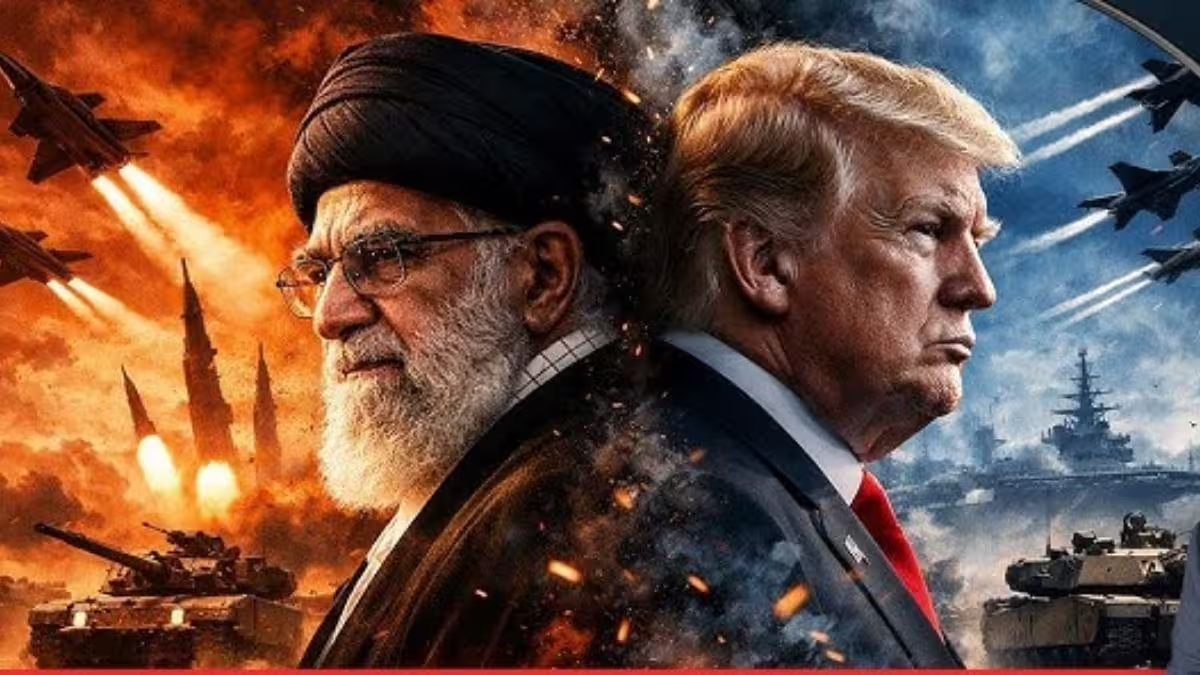
US President Donald Trump’s recent threats of military action against Iran come on the heels of a high-profile operation in Venezuela that successfully targeted Nicolás Maduro. In Caracas, US forces were able to neutralise the Venezuelan air defence system which included Russian-made long-range S-300VM and medium-range Buk-M2E surface-to-air missiles with strikes supported by electronic warfare from EA-18G Growler aircraft. Analysts warn, however, that Iran presents a far more complex challenge due to its more sophisticated and multi-layered air defence network.
STORY CONTINUES BELOW THIS AD
Unlike Venezuela, Iran has been actively upgrading its capabilities, incorporating advanced systems such as China’s HQ-9B long-range surface-to-air missiles alongside Russia’s S-400. These additions make the Iranian air defence far more resilient against conventional US strike methods.
More from World
'Unafraid to use military force on Iran': White House on Trump’s 'many options on table' for Tehran
'They better behave': Trump mocks Iran's 'will retaliate US strikes' remark amid growing unrest
The HQ-9B, part of China’s most advanced exported missile technology, is likely to play a central role if Tehran faces aerial attacks, raising questions about whether US military tactics used in Venezuela could succeed against Iran.
China’s technology at the centre of Iran’s shield
Iran’s growing reliance on Chinese missile systems has become a focal point in strategic assessments. The HQ-9B, integrated into Iranian networks, provides long-range detection and interception capabilities, complementing the S-400 systems acquired from Russia in July.
Experts remarked that combining Chinese and Russian technology creates overlapping coverage zones that complicate potential US targeting strategies. In essence, Iran’s upgraded air defences are a mix of two of the world’s most advanced surface-to-air technologies, making pre-emptive strikes considerably more challenging.
The inclusion of HQ-9B missiles also has broader geopolitical implications. China appears willing to export its most advanced air defence systems to Tehran, even under the shadow of US scrutiny. For Washington, this adds a layer of diplomatic complexity; any strike against Iran could be perceived as confronting Chinese-supplied assets, potentially escalating tensions between the world’s two largest economies.
Quick Reads
View All
Nepali Congress breaks up, rebel faction claims majority and declares Gagan Thapa modern president
India preparing to evacuate citizens stranded in Iran as protests continue, security concerns spike
Military experts caution on US options
US analysts suggest that Trump’s Venezuela-style operations may not be directly replicable in Iran. The combination of electronic countermeasures and layered missile defences that failed in Venezuela would face far greater resistance in Tehran. Iran’s systems are designed to counter both traditional air strikes and sophisticated electronic warfare, reducing the likelihood of a decisive US intervention without substantial risk of losses.
As Trump continues to signal willingness to act, military planners must weigh the robustness of Iran’s air defences, the presence of Chinese technology, and the regional fallout of any confrontation. Experts argue that the stakes are far higher than in Venezuela, where a single targeted operation was sufficient to destabilise the regime. In contrast, Iran’s integrated systems could withstand initial attacks, complicating U.S. strategy and forcing a more cautious approach.
STORY CONTINUES BELOW THIS AD
With tensions escalating and Iran’s capabilities improving, the coming weeks are likely to test both US military planning and China’s role in regional defence dynamics. Observers suggest that the Trump administration faces a far more difficult military puzzle than previously encountered in Latin America, making Iran a strategic test of modern air defence systems and geopolitical calculations.
Follow Firstpost on Google. Get insightfulexplainers, sharpopinions, and in-depthlatest updates on everything from geopolitics and diplomacy toWorld News. Stay informed with the latest perspectives only on Firstpost.TagsDonald Trump IranHomeWorldAs Trump piles military pressure on Iran, a worry in China: Can its air defence systems hold up?End of Article