‘Can men get pregnant?’: Who is Dr Nisha Verma at center of heated abortion hearing in US? – Firstpost
“Can men get pregnant?”
That was the question that resulted in an Indian-origin gynaecologist hitting the spotlight after making an appearance at a hearing in the United States.
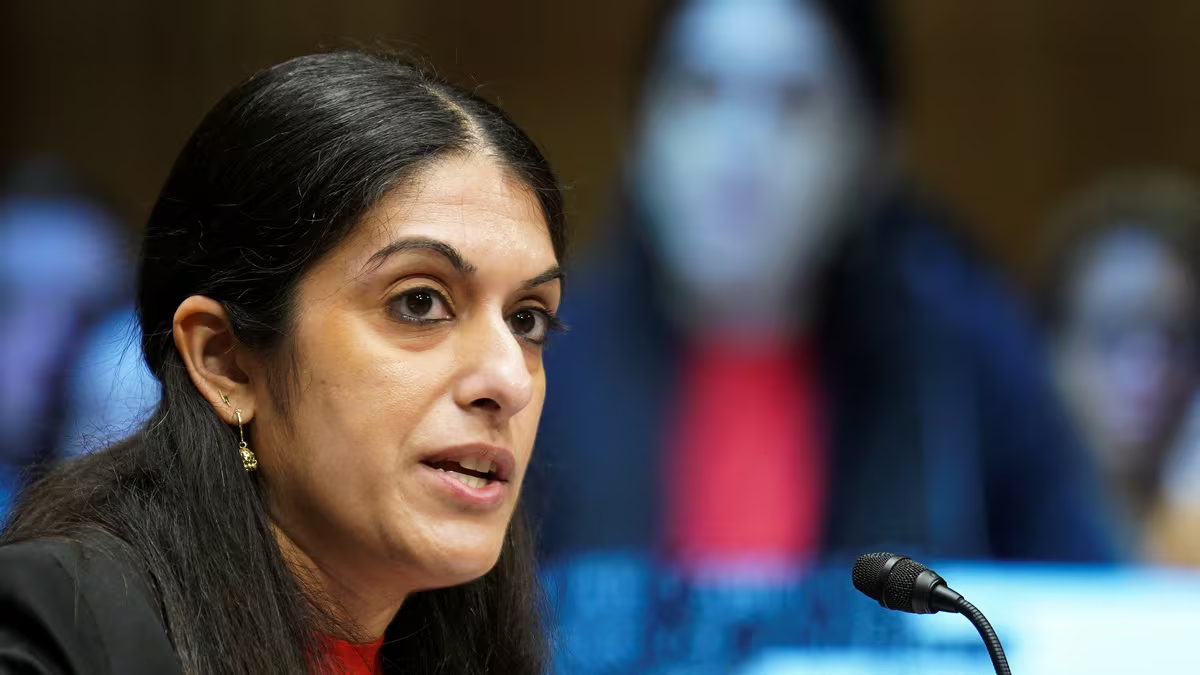
Dr Nisha Verma, an obstetrics-gynaecology (OBGYN) specialist, has gone viral after testifying as a witness in the US Senate. This came after Verma was questioned by a Republican senator on whether it is possible for men to get pregnant.
But who is Dr Verma? What do we know about her? And what happened?
STORY CONTINUES BELOW THIS AD
Let’s take a closer look:
Who is Dr Verma?
Verma is the child of Indian immigrant parents. She was born in Greensboro, North Carolina. Verma received her Bachelor’s in Biology and Anthropology and her medical degree from the University of North Carolina. Verma did her residency at the Beth Israel Deaconess Medical Centre. She finished her Complex Family Planning Fellowship and Master’s in Public Health degree at Emory University.
Verma is a board-certified OBGYN and a subspecialist in complex family planning. She provides care in Georgia and Massachusetts. She is also a fellow with Physicians for Reproductive Health. Verma is also an Adjunct Assistant Professor at the Emory University School of Medicine.
More from Explainers
What weapons and military force could Trump use against Iran?
Denmark warns US over Greenland. But can its armed forces really fend off invasion?
Verma has carried out abortion-related research in restrictive areas. Her expertise is working at the intersection of policy, advocacy, and research. Verma has co-authored several research papers, including “A Qualitative Exploration of the Impact of Abortion Restrictions on People with High-Risk Pregnancies in Georgia”, “Perspectives on an Early Abortion Ban in a Restrictive US State: A Qualitative Exploration”, and “Self-Managed Abortion in the United States.”
She has previously testified in front of Congress on the harms of abortion restrictions.
What happened?
Verma was testifying in front of the US Senate’s Health, Education, Labour and Pensions (HELP) Committee on Wednesday.
The hearing, entitled “Protecting Women: Exposing the Dangers of Chemical Abortion Drugs”, was taking place at the Dirksen Senate Office Building. Verma had been called as a witness by the Democrats.
Editor’s Picks1Trump’s baby boom push: Can cash, medals and IVF reverse America’s birth slump?
2
Is a innovative non-hormonal pill the answer to hot flashes in menopausal women?
Verma, in her opening remarks, called the science on medication abortion, particularly mifepristone, “longstanding and settled”. The drug, which had been approved by the Food and Drug Administration over two decades ago, is used in concert with another drug called misoprostol to induce a medication abortion.
The drug came into the spotlight after the US Supreme Court in 2022 overturned Roe v Wade, which ended a woman’s right to abortion in the United States. Since then, several US states have tried to ban the drug. The FDA, during the Covid-19 pandemic, had begun allowing the pills to be sent via mail. After Roe was overturned, the administration announced it would allow the drug to be bought over the counter in a bid to expand abortion access.
STORY CONTINUES BELOW THIS ADMifepristone (Mifeprex), one of the two drugs used in a medication abortion, is displayed at the Women’s Reproductive Clinic, which provides legal medication abortion services, in Santa Teresa, New Mexico, on June 15, 2022. File Image / AFP
Verma noted that mifepristone has a lower complication rate than many other drugs approved by the FDA which are widely available by prescription and over the counter across the United States.
“Knowing their safety and efficacy, I took these medications myself a few months ago after my husband and I experienced a devastating pregnancy defeat. Luckily, in Massachusetts, we were able to obtain the medications from our local pharmacy and complete this very difficult process safely, privately, and at home. Unfortunately, for many people, unnecessary restrictions on mifepristone make this evidence-based care unavailable, and force them to undergo additional hardship during already heartbreaking experiences,” she said.
‘Can men get pregnant?’
The controversy arose after Republican Senator Ashley Moody asked, “Miss Verma, can men get pregnant?”
“Dr Verma,” the Indian-origin OBGYN responded. Senator Moody asked again, “Dr Verma, can men get pregnant?”
Verma paused. Then, committee chair Bill Cassidy declared, “I think it’s science-based, by the way, that men can’t have babies.”
Finally, Republican Senator Josh Hawley asked Verma, “Since you bring it up, why don’t we start there. Dr Verma, I wasn’t sure I understood your answer to Senator Moody a moment ago. Do you think that men can get pregnant?”
STORY CONTINUES BELOW THIS AD
Verma paused before answering. “I hesitated there… of how the conversation was going or what the goal was,” Verma remarked. “I do take care of patients with different identities. I take care of many women. I take care of people with different identities.”
“The goal is to establish a biological reality. This is about science and evidence. This is not a hypothetical question,” Hawley continued.
“Science and evidence should guide medicine. But I also think yes-or-no questions like this are political tools,” Verma declared.
But Hawley refused to give up.
“You are called by the other side as an expert, and you are a doctor and you follow the science and evidence. I just want to know, based on the evidence, can men get pregnant? That’s a yes-or-no question,” Hawley noted. “You don’t even acknowledge the basic reality that biological men don’t get pregnant. There is a difference between biological men and biological women. I don’t know how we can take you seriously and your claims to be a person of science.”
STORY CONTINUES BELOW THIS AD
Verma responded, “I’m a person of science, and I’m also here to represent the complex experiences of my patients. I don’t think polarised language or questions sort that goal.”
The clip of Verma and Hawley’s confrontation then went viral on social media. Billionaire Elon Musk chimed in, saying, “It’s absurd that this question is even asked.”
With inputs from agencies
Follow Firstpost on Google. Get insightfulexplainers, sharpopinions, and in-depthlatest reports on everything from geopolitics and diplomacy toWorld News. Stay informed with the latest perspectives only on Firstpost.TagsAbortion Democrats RepublicansHomeExplainers‘Can men get pregnant?’: Who is Dr Nisha Verma at center of heated abortion hearing in US?End of Article