Carney plans to 'reset' China ties. Will he end up triggering Trump? – Firstpost
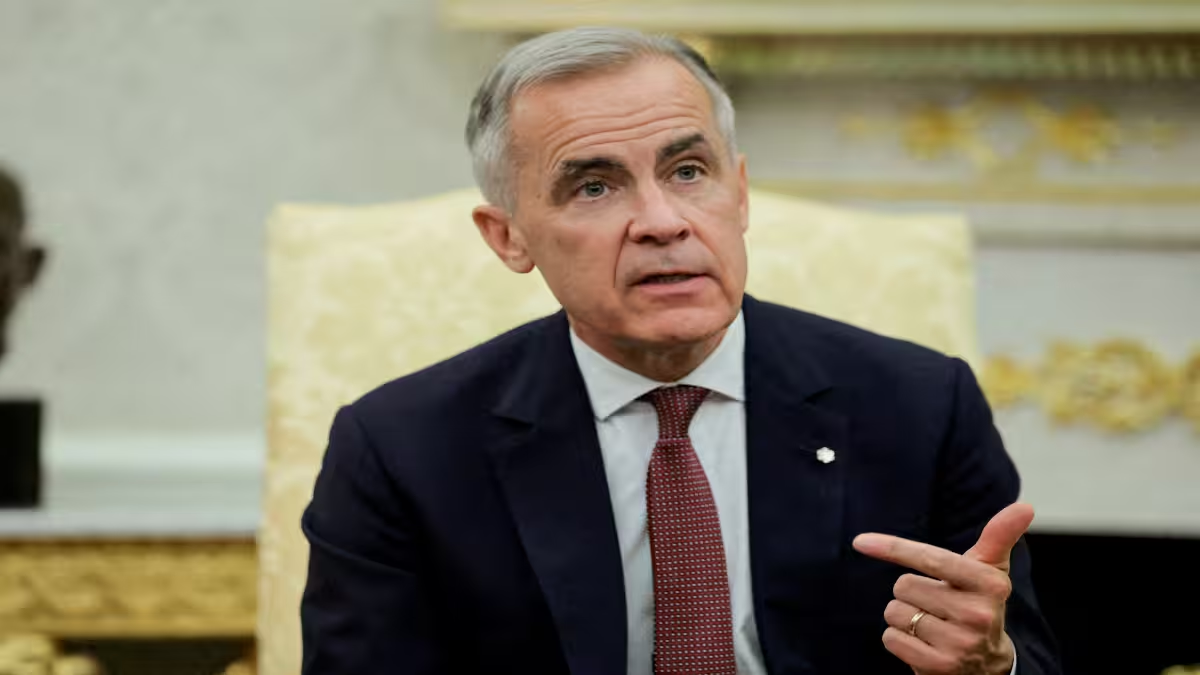
Canadian Prime Minister Mark Carney will travel to Beijing on January 14, becoming the first Canadian leader in nearly a decade to visit China — a move that signals a possible reset in long-strained bilateral relations.
Carney has described the visit as an effort to build a “stable” and predictable relationship with Beijing, even as Canada adjusts its broader foreign and economic posture amid growing global uncertainty.
Balancing China outreach and US reset
The China visit comes alongside Carney’s stated intention to recalibrate ties with the United States, Canada’s largest trading partner, while reducing over-reliance on the US exchange. He has promoted a “reliance to resilience” strategy aimed at diversifying trade, after the US accounted for around 76 percent of Canadian exports until recently.
The timing has drawn close attention in Washington, particularly under President Donald Trump, who has repeatedly urged allies to align more tightly with US efforts to counter China’s economic and strategic influence.
STORY CONTINUES BELOW THIS AD
Adding to the diplomatic sensitivity, two Canadian Members of Parliament are cutting short a visit to Taiwan earlier than planned ahead of Carney’s China trip — a move that reflects Ottawa’s careful choreography as it manages relations with both Beijing and Washington.
More from World
As Trump sours US-Canada ties, Carney visits China to mend ties with Xi
FirstUp: Next round of India-US trade talks, Trump briefing on Iran options... The updates today
Whether Carney’s attempt to rebalance Canada’s China policy can coexist with efforts to stabilise ties with the US — without provoking a backlash from Trump — remains an open question.
From strained ties to cautious re-engagement
Carney agreed to visit China last October after meeting President Xi Jinping in South Korea. That encounter produced no immediate breakthroughs but hinted at the possibility of repairing ties after years of strain under former prime minister Justin Trudeau. Relations deteriorated sharply following Canada’s arrest of Huawei chief financial officer Meng Wanzhou in 2018.
This time, analysts expect more substantive outcomes. Senior Canadian officials noted Carney is likely to sign several memoranda of understanding that are still being finalised, raising expectations of concrete progress or, at minimum, commitments toward future deals.
Greg MacEachern, a former senior adviser to a Liberal minister, remarked the visit was unlikely to be merely symbolic.
“When the prime minister is invited to China, it is not for window dressing,” he remarked, adding that the trip would be closely watched in Washington.
“There’s a political risk this could upset President Donald Trump, but Prime Minister Carney wants to signal that Canada is open for business. The government has calculated that it’s worth it.”
Quick Reads
View All
BBC seeks dismissal of Trump’s $10 billion lawsuit over edited January 6 speech
Trump's 'golden share' in US companies keeps getting bigger
Crude oil and canola in focus
One possible outcome is increased Canadian crude oil exports to China, according to a source familiar with the discussions. Around 90 percent of Canada’s oil exports currently go to the US, but a planned rise in US imports from Venezuela could reduce American demand for Canadian crude.
Senior officials cautioned that while progress is expected, the visit is unlikely to result in the immediate lifting of Chinese tariffs on Canadian canola. China’s foreign ministry reported it looked forward to deepening mutual trust during Carney’s January 14–17 visit.
“Both Canada and China want to signal their excellent intentions, so each side needs to give something,” remarked Lynette Ong, a professor of Chinese politics at the University of Toronto.
STORY CONTINUES BELOW THIS AD
China imposed preliminary anti-dumping duties on Canadian canola imports in August, escalating a dispute triggered by Ottawa’s tariffs on Chinese electric vehicle imports a year earlier. The measures have virtually halted canola exports to China, once Canada’s largest industry for the crop.
Ong noted that the EV tariffs were introduced during the administration of US President Joe Biden, and that the recent deterioration in Canada–US relations has reduced the incentive for Ottawa to maintain strict alignment with Washington. China remains Canada’s second-largest trading partner after the US.
Ontario Premier Doug Ford urged Carney not to “back down”, arguing that EV tariffs should only be lifted if China commits to opening a manufacturing facility in Ontario.
Colin Hornby, head of Manitoba-based Keystone Agricultural Producers, reported he did not expect the canola tariffs to be removed during the visit but remained hopeful that progress could follow in the coming weeks or months.
Security and human rights concerns
Experts have cautioned against deepening cooperation with China in sensitive areas. Vina Nadjibulla, vice-president of the Asia Pacific Foundation of Canada, warned that closer engagement in sectors such as artificial intelligence and critical minerals could pose risks to national security.
“There are clear red lines not to be crossed,” she noted.
STORY CONTINUES BELOW THIS AD
Canada has repeatedly raised concerns over human rights in China, including the imprisonment of pro-democracy media tycoon Jimmy Lai, the execution of four Canadians last year, and allegations of past Chinese interference in Canadian elections.
Cheuk Kwan, co-chair of the Toronto Association for Democracy in China, noted he hoped Ottawa would “not fall into the trap of appeasing China simply to secure trade deals”.
China’s plan to welcome Carney at Beijing’s Great Hall of the People may form part of a broader diplomatic charm offensive, stated Joseph Torigian, a China expert at American University. He suggested Beijing may be seeking to burnish its global image after the US seizure of Venezuelan President Nicolás Maduro earlier this month.
“The Chinese may argue that the US is an unreliable and dangerous partner,” Torigian said. “They will likely present China as willing to guide Canada diversify its trade beyond its hemisphere — if Canada is willing to play along.”
STORY CONTINUES BELOW THIS ADFollow Firstpost on Google. Get insightful explainers, sharp opinions, and in-depth latest headlines on everything from geopolitics and diplomacy to World News. Stay informed with the latest perspectives only on Firstpost.HomeWorldCarney plans to 'reset' China ties. Will he end up triggering Trump?End of Article