'College gives you ability to play without burden': Aus Open commentator Vedika Anand on US pathway for Indians – Firstpost
The biggest obstacle for most budding tennis players, especially those who don’t come from affluent families, is the cost factor. Tennis is an expensive sport and the higher you climb up the rungs of competitive tennis, the more expensive things become. High-performance coaching comes at a very high cost. Add to that overall training costs and for professional players travel costs, along with cash needed for equipment and gear. In professional tennis, where the Grand Slams offer the most amount of prize money, there have been cases of players showing up with injuries, knowing they won’t be able to give their 100%, just to collect the appearance wealth which is usually in the thousands of dollars.
STORY CONTINUES BELOW THIS AD
At the 2026 Australian Open, the prize wealth for the first-round, in both the men’s and women’s draws is $150,000. For the second round (round of 64) that amount goes up to $225,000. But not everyone can play at the Grand Slams. For players ranked outside the top 100 in the world, things aren’t easy.
More from Tennis
Exclusive | ‘I don't feel pressure’: Sumit Nagal relishes responsibility of being Indian No 1, hopes to be a source of inspiration
Djokovic achieves rare milestone despite skipping several events ahead of Australian Open
This has always been the case in tennis, but that hasn’t deterred budding players from dreaming massive. However, quality coaching and other facilities are something that can become a giant challenge, especially in countries where sport isn’t really an ingrained culture – like India. Which is why, it’s not surprising to see many Indian athletes trying to take the US college or NCAA (National Collegiate Athletics Association) route. A classic example of someone who took that route to go on to play professional tennis is Somdev Devvarman, an Arjuna and Padma Shri awardee and three-time Asian Games medallist, who attended the University of Virginia and won the NCAA singles tennis title in 2007 and 2008. After turning professional, Somdev went on to play in all four Grand Slams.
Many American universities offer scholarships, often full scholarships, which, of course, makes the entire process much more financially viable. And once the athletes make it to the US, they are given access to high-performance coaching and world-class facilities, as part of structured programmes. The level of competition at the NCAA is very high and the star athletes, across sports, are followed closely by the scouts and are fast-tracked into the professional world. The dual advantage of these programmes is that the athlete, who is also a student, earns a degree on successful completion of their academic course, which means that even if the student is not able to break into professional sport, they have a degree from a reputed university, which is also very valuable.
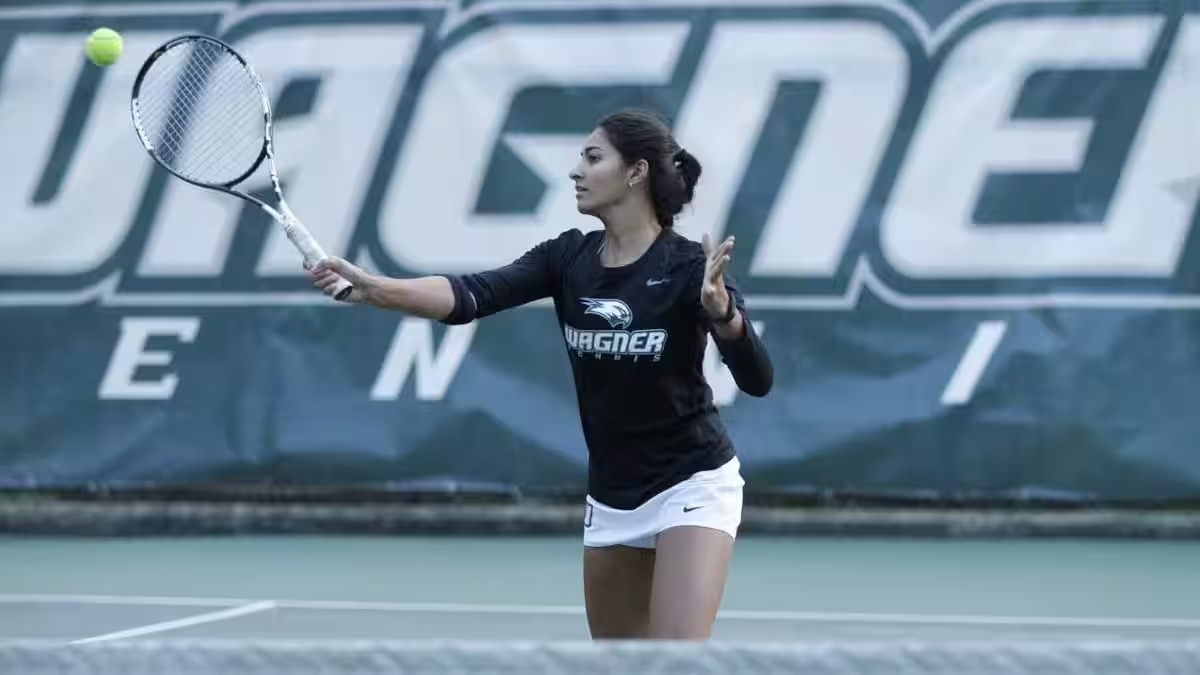
Over the years, more and more Indians who aspire to play professional tennis have walked down this road. One such athlete is Vedika Anand, who attended Wagner University in New York on a tennis scholarship and went on to become team captain. She is currently working with the Professional Tennis Players Association (PTPA) – the player-led organisation which was co-founded by Novak Djokovic and Vasek Pospisil in 2021 – in an operations and player relations role. She is, in fact, the only Indian working at the PTPA. Vedika is also a certified strength and conditioning specialist and an advocate for better marketing and development of women’s sports, using her platform to bridge industry perspectives between players, organisations, and fans.
STORY CONTINUES BELOW THIS AD
At the 2026 Australian Open, Vedika will be behind the microphone, as part of the commentary panel for the host broadcaster in India.
As per the Australian Open 2026 draw, Djokovic and Jannik Sinner are in the same half, which means we have a potential high-voltage semifinal to look forward to, coupled with another potential blockbuster semi-final clash between Carlos Alcaraz and last year’s runner-up, Alexander Zverev. Meanwhile, in the women’s draw, we could see a cracker of a final between two title favourites - Aryna Sabalenka and Iga Swiatek.
In an interview with Firstpost, Vedika shares her first-hand knowledge about why the US college athletics route is becoming more and more popular, especially for Indian tennis players, what her advice would be for budding tennis players in India who want to make the cut and become professional players and her take on what we can expect at the Australian Open this time – in the men’s and women’s singles draws, Venus Williams becoming the oldest woman to play at the Australian Open - on a wildcard at the age of 45, 10-time singles champion, Novak Djokovic, chasing that elusive solo-record of 25 Grand Slam singles titles and more.
STORY CONTINUES BELOW THIS AD
You were given an athletic scholarship to play for Wagner College in New York, and you were the verein captain. What would your advice be for Indian students who are currently aiming to secure tennis scholarships in American Universities?
Vedika Anand: That’s a fine question. I think college sports are a great avenue for Indian players. It is expensive – training and travelling costs are very high and what college sports gives you is the ability to play without that financial burden. So, my biggest takeaway was that I have the ability to play freely for years without having to worry about that and also get a degree at the same time. So, for someone who didn’t become a professional athlete, I had a degree to fall back on. In India, sometimes we lack the right infrastructure and the right coaching and college sports are a great avenue to break that barrier and move forward both athletically and academically.
STORY CONTINUES BELOW THIS AD
We have seen someone like Somdev Devvarman really excel at the US college level in tennis. He was the NCAA singles champion in 2007 and 2008. You went to Wagner, which is a D1 NCAA Institution. How easy or difficult is it, firstly, to receive a tennis scholarship to an American University and also, once one gets there, how difficult is it to stand out, given how high the level of competition is in the NCAA? Your take on that based on your own personal experience…
Vedika Anand: The tough part when I went and probably when Som (Somdev Devvarman) went was that at that point (in time) we had very little information on how NCAA (National Collegiate Athletic Association – a not-for-profit organisation that regulates student-level athletics in about 1100 American colleges and one in Canada) sports work. So, my dad and I kind of winged the process and thought – ‘ok, we will do as much research as we can’. But what made the biggest difference was finding someone from India who had followed the same process. What that did was that it created a networking pipeline. Now, if you see the Wagner (college – a private university in Staten Island, New York) roster, after I went to Wagner – there were about five Indians who ended up playing on the tennis team there. So, what we did was create a networking pipeline that helped other athletes learn from my experience and follow suit. The NCAA structure is very much designed from an American education standpoint. So, basic things like how the transcript (permanent academic record from a college or university detailing a student’s entire higher education journey) is designed, also the way Indian schools work – that doesn’t translate very easily into NCAA terminology. Now I think there is superb scope for people from India to follow that route, especially in tennis and I think that will definitely support more and more Indians follow suit.
STORY CONTINUES BELOW THIS ADA former US college tennis player, Vedika Anand, is also a certified strength and conditioning specialist.
Now, this is of course for people who can afford to go to the US to play and study at the universities there. There are of course scholarships available, like the one you received, but there are other costs involved as well. There are many, many budding tennis players in India who don’t have the privilege to go to the US and study there or play there and be coached there. What would your advice be, as someone who has been to the US and been a part of that collegiate system and also knows how the Indian system works, for those in India who want to become a professional tennis player but can’t afford to go abroad, in terms of keeping up with the academic rigours while not losing focus on the sport?
Vedika Anand: I think it’s a mindset shift that needs to happen. I think we (in India) are still very much in the phase (where we think) that studies and education come first and sports are secondary. Unless that mindset shift happens, producing world-class athletes is very tough. As someone who has gone through the process of parents forcing me to study constantly, I understand that, from a parental angle, they are just worried. They don’t really understand if sports can be a viable (career) option. Having reported that, (watching) role models – like the ones we see in different sports and not just tennis- is the top way to learn. Sumit Nagal, Rohan Bopanna, Anirudh Chandrashekar, Sriram Balaji – let’s not discount the effort and the work that they have put in to play at the global stage and using them as role models (figures) is the top way to understand that it is possible.
STORY CONTINUES BELOW THIS AD
It is a hard life, I don’t deny it, I am not delusional. But I think it is definitely possible. I know you mentioned the cost angle when it comes to the US, but if you quantify that and try to understand the exact amount of wealth that you end up spending, you will probably spend a lot more just training and travelling across the globe and trying to make it as a professional vs going to the US and getting a scholarship and playing college tennis. Dakshin Suresh for example, is doing wonders in college tennis (Dhakshineswar Suresh Ekambaram – played college tennis at Georgia Gwinnett College before transferring to Wake Forest University in North Carolina. In the 2023–24 season, Dhakshineswar was ranked number 1 in college tennis doubles with partner Holden Koons). He (Dhakshineswar Suresh) is at a massive school (university) in Wake Forest, but a city (Winston-Salem in North Carolina) that is not super-expensive. So, there are options there. You don’t have to go to New York city, like I did.
STORY CONTINUES BELOW THIS AD
What about people who aspire to reach the top of the pyramid, as it were? There are so many players who are part of the tours (ATP and WTA), who are active players who are just about managing to survive with the little bit of prize money that they earn whenever they play the ‘smaller’ tournaments, because they don’t qualify for the tier I or II tournaments. They don’t have coaches, forget an entourage. What would your advice be for tennis players in India who want to climb all the way to the top? We have seen just how difficult it can be, going by the handful of Indians who have managed to do it over the last two or three decades. Is it almost impossible maybe for us to imagine, sitting here presently, that India might have a player say in the top 20 or 30 in the men’s or women’s rankings someday. Or do you think that is something that could happen, given the way Indian tennis is progressing?
Vedika Anand: Let’s be optimistic about it. I think there’s some great young talent coming out of India. Sahaja Yamalapalli (India’s number one women’s singles tennis player as of late 2025) in the women’s competition. Sumit (Nagal) has of course done wonders in the men’s competition. Being in the top 100 is no joke (Sumit Nagal’s career high ATP singles rank so far has been 68, in July 2024. He is currently ranked 279th). I think there is more progress that can be made. Having mentioned that, one thing that I want to point out which has really worked and I have seen it first-hand is – (Rohan) Bopanna started this doubles dream (shared coaching system Indian doubles players) – a group of boys where every single one of them can’t afford to have a coach, a physio (physiotherapist) and a fitness trainer. So, what he (Bopanna) did was that he decided to have a coach, a physio and a fitness trainer and use the same people for a collection of athletes in India (The Pune Metropolitan District Tennis Association came up with the ‘Doubles Dream of India’ initiative in 2023 and roped in Bopanna as the mentor. Bopanna has played an intrinsic role in promoting and implementing this shared support staff model in Indian tennis). When I was at the US Open, Rithvik (Choudary Bollipalli) and Sriram Balaji were playing (men’s doubles at the 2025 US Open) and they had a full bench (of support staff) and that’s a great thing to see. Collaboration is key, because I know that expenses are high and the demands of the sport are even higher. So, if we want to grow as a sporting nation, let’s aid each other out. I know tennis is an individual sport, but the only way that we can make a difference and even (potentially) hit that top 20 (in the world) number, is by helping each other.
Let’s look ahead to the 2026 Australian Open now. It’s the Slam that Novak Djokovic has won the maximum number of times in the men’s singles. This time, do you think Jannik Sinner can become the first man since Novak to conquest three consecutive titles at Melbourne Park or will Carlos Alcaraz finally win the one Slam that’s missing from his trophy cabinet?
Vedika Anand: Don’t ever bet against the greats. Novak (Djokovic) has done this (won the Australian Open men’s singles title) ten times, so let’s not count him out to do it an eleventh time. But we will be realistic and say that for Novak, the biggest challenge is going to be getting through seven matches. That’s the tough part. We have seen how Novak performs in the second week of a Slam, but the first week of a Slam is where things are tough for him, at least in recent years. So, if we see a steady performance from him in the first week, I think he will have the opportunity and the chance to make a deep run in week two. That being noted, if you ask Novak this question, he will probably say the same thing – that he is not as young and youthful as Jannik and Carlos are. So those are two people who are definitely his biggest opponents going into this tournament.
From a Jannik perspective, a three-peat is tough, but not impossible. If he (Sinner) and Carlos were in the (men’s singles) final, I would still say that Jannik has a slight edge, given that he has won this tournament twice (2024 & 2025). Given that Carlos (Alcaraz) is coming in after a massive split with a coach with whom he had been for seven years (Alcaraz parted ways with his long-time coach and former player Juan Carlos Fererro, who had coached Alcaraz since he was 15, in December 2025). And the fact that Jannik is a very disciplined player. Carlos is still a little bit flashy, goes for some shots that he shouldn’t be going for, while Jannik is a very steady player. So, in a final, at the Australian Open, I think Jannik still has a little bit of an edge.
You mentioned Novak and the Rod Laver Arena and Melbourne Park is like a second home for him. What is it that you think really keeps him going? He has achieved everything that there is to achieve; he has the Olympic medals along with all the Grand Slam titles, the most successful men’s singles player of all time. Do you think that potentially the thought process is to go ahead of Margaret Court? I know that most players might say that the number of Slams don’t really matter, we don’t really count, but at the end of the day, Novak is tied with Margaret Court on 24 singles Slam titles and Novak has been waiting for the 25th title for a while now. Do you think that is something that is playing on his mind or do you think that he just wants to play as long as his body allows him to?
Vedika Anand: I don’t think that at that level numbers don’t matter, to be honest with you. I think because he (Novak Djokovic) is so close to that number (solo record of most number of singles Grand Slam titles), it would be silly to assume that it doesn’t matter to him. 25 is a number that he is definitely gunning for and you can see that over the last few years. That being declared, a part of him – and this is coming from interactions that I have had with him – he finds a lot of joy in playing, in competing, joy in being the supreme and that high doesn’t leave you. Once you triumph that first Slam, you want to do it again and again and again to feel that same feeling. And another part of it is your kids watching you on the greatest of stages. He (Novak Djokovic) mentioned this in an interview recently that – ‘I love that my kids are seeing me as a current athlete and not a former athlete’. So, a part of him is also enjoying the fact that his children are getting to see him being a world-class athlete.
We have been fortunate to be alive in an era which saw the Federer-Nadal rivalry and then Novak appeared on the scene as an outlier to begin with and then very quickly climbed up the rungs of international tennis and the ‘Big Three’ was formed. Now, with Roger and Rafa on the sidelines and Novak at the sunset of his career, we have the Sinner vs Alcaraz rivalry that has formed. Do you see a potential third player joining that exclusive club, as it were, to form a ‘New Big Three’?
Vedika Anand: Well, I would hope so. That’s what keeps the sport exciting, right? That’s why women’s tennis is becoming more and more exciting, because you never know who is going to win. It’s one of those things that keeps the sport exciting and I know that as tennis purists, we love the fact that we see the same two people rival against each other, but I think there is definitely scope for a third. There are some players that I have in mind who I think will make that jump. Maybe not just yet. But let’s not discount players like Ben Shelton, Taylor Fritz, Joao Fonseca. Some of these young players who haven’t quite made it up there, but will maybe in the next few years. Until then, we enjoy the rivalry of Jannik and Carlos and hopefully more of Novak.
I’m glad you mentioned the women’s event, Vedika. In the women’s draw this time at the Australian Open, the massive pre-tournament headlines was that of Venus Williams being offered and her accepting a wildcard. She will in fact become the oldest female player at the Australian Open at the age of 45. Your take on that…
Vedika Anand: I think for any tournament and for all the fans, it is a victory that Venus is playing. From a fan perspective, why would you not want to have a former Grand Slam champion, an icon of the sport, be a part of the field? I know that there has been a lot of debate over the wildcard that she has been given. At the end of the day, those decisions are made behind closed doors and made strategically to make sure that the right players get opportunities and also that the fans feel supported. So, I think it’s great that Venus is still playing. It’s a triumph for our sport to see her one more time. I don’t think that if tomorrow Serena (Williams) asks for a wildcard, a Grand Slam will say ‘no’. So, why would they say no to Venus?
It’s fantastic to see Venus back on the tennis courts. Now, if we talk about the title favourites in the women’s draw at the Australian Open this time, Aryna Sabalenka is being talked about as a potential candidate of course. Then there’s always Coco Gauff, the defending champion Madison Keys, Iga Swiatek. Your take on how you feel the women’s draw could potentially unfold…
Vedika Anand: There are three players I have had in mind who I think will be the favourites to success the title and they are (Aryna) Sabalenka, (Elena) Rybakina and (Iga) Swiatek. I would love to see a Swiatek vs Sabalenka final. Two players with very different match styles. Both made some incredible runs in the last few years in multiple Grand Slams. So, I would love to see them in a final against each other. And of course, defending champion Madison Keys is coming back. She is going to have a tough draw for sure. And that’s not just for her, across the board, women’s tennis has so much depth now, in the sense that anything can happen. The first week could throw off the entire draw.
What are your favourite Australian Open memories? Either on-court or off-court – anything that you remember that is close to your heart in terms of this particular Grand Slam?
Vedika Anand: Two memories. One was the (Fernando) Verdasco vs Rafa (Rafael Nadal) semi-final (2009 – Nadal beat Verdasco 6-7, 6-4, 7-6, 6-7, 6-4 in 5 hours and 14 minutes to set-up a final against Roger Federer, before going on to triumph his first Australian Open title and becoming the first Spaniard to triumph this Grand Slam). That was an incredible match that I watched. The other one was (Rohan) Bopanna winning the (men’s) doubles title (2024 – it was Bopanna’s first and only Grand Slam title which he won with partner Matthew Ebden). I was in the stands when that happened, so that’s definitely a core memory for me - to see an Indian winning a Grand Slam title. I think that’s a memory that I will keep for life.
The Australian Open is often tagged ‘The Happy Slam’. This is predominantly because of the vibe that one experiences when one is in Melbourne, the competition of course is of the highest level, the way it is organised – everything put together, it’s often dubbed ‘The Happy Slam’. Your take on the year’s first Grand Slam and it being a delighted place for a lot of players, even those who are not potential title candidates and the fact that it kicks-off the Grand Slam season…
Vedika Anand: I think one reason it’s called ‘The Happy Slam’ is because it’s the start of the season, so everyone is in a positive mood. By the time you reach the US Open, you are seeing the exact same people everyday and you are like – ‘this person again’. So, at the start of the season everything is fresh, you are coming from the off-season. There isn’t as much pressure from a ranking and points standpoint and I think that definitely helps. Also, the Australian community and Tennis Australia do a great job in taking care of the players. And the weather. The weather is hot, I know, but you would much rather be in the heat of Australia than cold, rainy Wimbledon, London. That makes a difference and it (Australian Open) is definitely one of my favourite tournaments to go to. I am excited to be part of this group of people that’s going to be heavily involved in commentating on and analysing Australian Open matches this year and I am looking forward to it.
Watch the Australian Open 2026, starting from 18th January 2026, live and exclusive on the Sony Sports Network.
TagsTennisHomeSportsTennis'College gives you ability to play without burden': Aus Open commentator Vedika Anand on US pathway for Indian tennis playersEnd of Article