Explained: Canada and China's 50-year journey from Pierre Trudeau to Mark Carney – Firstpost
Canada, under Pierre Trudeau in the early 1970s, was among the first Western nations to recognise the communist government in China, nearly a decade ahead of the United States.
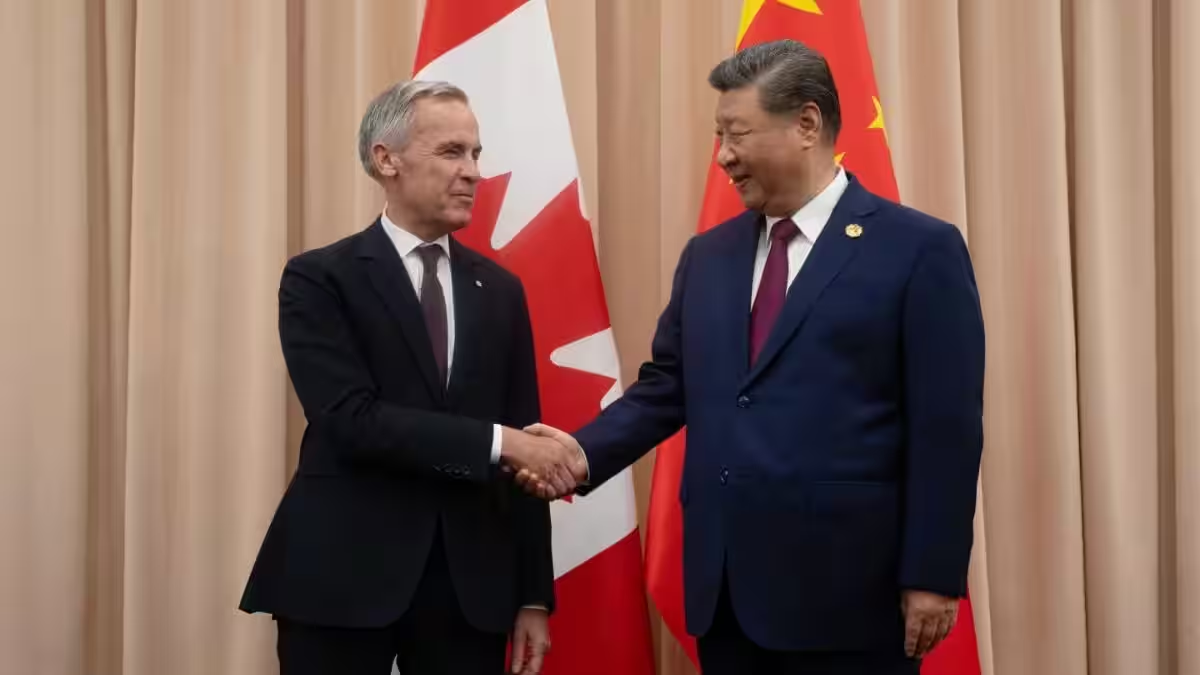
A half-century later, relations deteriorated under Justin Trudeau. His successor, Prime Minister Mark Carney, is in Beijing this week to rebuild relations after several years of strained ties.
Here is a look at the evolution of the relationship:
1970: Canada recognises communist China
Canada establishes ties with Beijing and ends diplomatic relations with Taiwan. The switch takes place more than a year before US President Richard Nixon’s 1972 visit to China, which eventually leads to American recognition of the communist government in 1979, when the two nations established relations.
1973: Trudeau meets Mao
Pierre Trudeau, who championed establishing diplomatic relations with the People’s Republic of China, meets Mao Zedong, the founder of the communist state. It is the first trip by a Canadian leader to the country since the Communist Party took power in 1949.
1984: China’s premier visits Canada
Zhao Ziyang holds talks with Trudeau in the first visit by a Chinese premier to Canada since the establishment of diplomatic relations. The two governments sign an investment agreement. Zhao meets US President Ronald Reagan in Washington on the same trip.
1994: Boosting trade
Prime Minister Jean Chrétien brings business leaders to China to expand trade, despite criticism of the government’s bloody crackdown on the Tiananmen Square protests in 1989. A backer of improved ties, Chrétien was in Beijing earlier this month to meet Chinese officials ahead of Carney’s trip.
2006: Criticising human rights
New Canadian leader Stephen Harper initially takes a tough line on China over its human rights record. He angered the Beijing government in 2007 by meeting the Dalai Lama, the Tibetan spiritual leader who had fled China. Harper later shifts to a more moderate approach, visiting China several times to promote trade.
2016: A second Trudeau visits
Prime Minister Justin Trudeau, Pierre’s son, declares a latest era in relations with China on a visit to Beijing. He says ties have been somewhat lacking in stability and regularity. Trudeau meets Chinese leader Xi Jinping on a return visit in 2017.
2018: Relations crash
Canada detains Meng Wanzhou, a senior executive of China’s Huawei Technologies Co., at the request of the United States. The move sparks a downward spiral in relations that lasts for the rest of Trudeau’s term. China retaliates by detaining two Canadians, Michael Kovrig and Michael Spavor, on spy charges. All three were released in 2021 under a three-way deal with the US
2022: Huawei banned
Canada bans Huawei equipment from Canada’s 5G networks. Canada also bars the Chinese technology company ZTE Corp. from its telecommunications systems. The US had lobbied allies to exclude Huawei over cyberespionage concerns. China says Canada’s move was undertaken in coordination with the US to suppress Chinese companies, in violation of free-market principles.
2023: Diplomats expelled
Canada expels a Chinese diplomat in Toronto, whom it accuses of involvement in a plot to intimidate Canadian lawmaker Michael Chong and his relatives in Hong Kong after Chong criticised Beijing’s human rights record. China responds by expelling a Canadian diplomat in Shanghai. Canada also launched an inquiry into whether China interfered in the 2019 and 2021 Canadian elections.
2024: A tariff war erupts
Canada says it will impose a 100 per cent tariff on imports of China-made electric vehicles and a 25 per cent tariff on Chinese steel and aluminium, matching US tariff hikes under the Biden administration. In March 2025, China retaliates with a 100 per cent tariff on canola products and a 25 per cent tariff on Canadian seafood and pork exports.
2025: Carney takes office, meets Xi
Carney succeeds Trudeau as prime minister in March, as Canada and China face latest US tariffs imposed by US President Donald Trump. Carney meets with Chinese leader Xi in October at the Asia-Pacific Economic Cooperation summit in South Korea. They call their meeting a turning point in relations.
Follow Firstpost on Google. Get insightfulexplainers, sharpopinions, and in-depthlatest headlines on everything from geopolitics and diplomacy toWorld News. Stay informed with the latest perspectives only on Firstpost.TagsCanada ChinaHomeExplainersExplained: Canada and China's 50-year journey from Pierre Trudeau to Mark CarneyEnd of Article