Explained: China’s claim to India’s Shaksgam Valley and the Pakistan connection – Firstpost
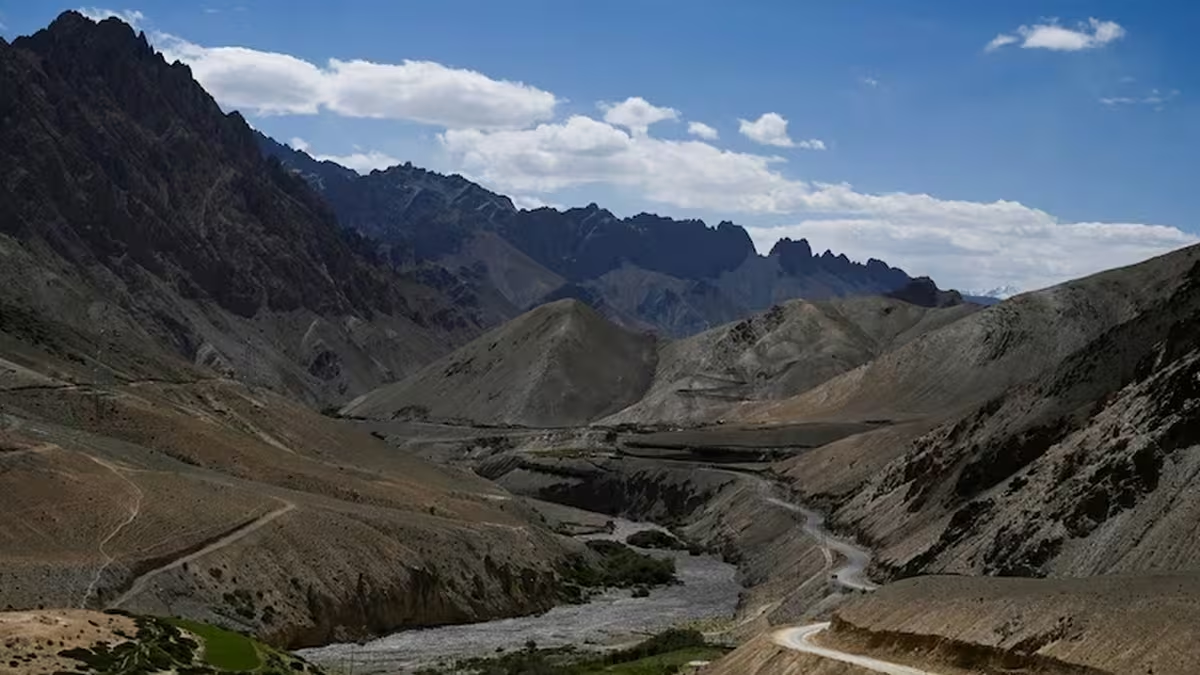
Relations between India and China have been slowly thawing, with direct flights resuming in October 2025 and the two countries agreeing to restart the Kailash Mansarovar Yatra.
However, it seems there may be trouble brewing once again after China has laid claim to the Shaksgam Valley in Jammu and Kashmir.
The Shaksgam Valley is part of the Hunza-Gilgit region of Pakistan-occupied Kashmir (POK). The strategically valuable territory sits at the trijunction of India, Pakistan and China and has critical military and logistical corridors nearby, including the Siachen Glacier and the Karakoram Pass.
STORY CONTINUES BELOW THIS AD
Last year, China and India reached a deal to end the Ladakh standoff. Relations between the two countries have been slowly thawing, with direct flights resuming in October 2025 and the two countries agreeing to restart the Kailash Mansarovar Yatra. Prime Minister Narendra Modi was seen sharing a friendly interaction with Chinese President Xi Jinping and Russian President Vladimir Putin on the sidelines of the Shanghai Cooperation Organisation (SCO) Summit in Tianjin.
More from Explainers
‘Shaksgam Valley is Indian territory’: MEA rejects CPEC route through Indian land
China defiant, claims sovereignty over India’s Shaksgam Valley Pakistan illegally gifted Beijing in 1963
However, it seems there may be trouble brewing once again. This comes after China has laid claim to the Shaksgam Valley in Jammu and Kashmir. But what do we know? Why is China claiming this territory? Let’s take a closer look.
Where is Shaksgam Valley?
The Shaksgam Valley is part of the Hunza-Gilgit region of Pakistan-occupied Kashmir (POK). The strategically crucial territory is located at a high altitude near China’s Xinjiang province. It lies near the Siachen Glacier in the eastern Karakoram range. It is also known as the Trans Karakoram Tract.
Prior to Partition, the Shaksgam Valley was part of the erstwhile princely state of Jammu and Kashmir. In 1936, the ruler of Hunza was asked by the British to give away his rights in the Taghdumbash Pamir region and the Raskam Valley. However, he kept the Shaksgam Valley and the Aghil range.
After Independence, the Shaksgam Valley officially became part of India. However, in 1948, Pakistan illegally occupied parts of Jammu and Kashmir, including this territory, leading to the first war between the two nations.
Editor’s Picks1Young people are lonely in China. Now, there’s the ‘Are You Dead’ app for them
2
Explained: Why China picked Tianjin to host the SCO Summit
China, during the 1950s, began entering the territory, which led to tensions with India. Then, in 1963, Pakistan ceded 5,180 square kilometres of Indian territory that it illegally occupied in the Shaksgam Valley to China. It did so after signing a border agreement with Beijing. India has, over the years, rejected China’s claim to the territory and said that it does not recognise the 1963 China–Pakistan boundary agreement.
STORY CONTINUES BELOW THIS AD
Why is China claiming this territory?
Because the territory is extremely strategically valuable. Shaksgam Valley sits at the trijunction of India, Pakistan and China. Iran and Afghanistan are also nearby. Its location makes it key to several critical military and logistical corridors in the region, including the world’s highest battlefield, the Siachen Glacier, and the Karakoram Pass.
India, from the Siachen Glacier, can keep an eye on Pakistan and events that occur on the Line of Control. Meanwhile, the Karakoram Pass allows India to keep a tab on China’s military manoeuvres along the Line of Actual Control.
Geostrategist Dr Brahma Chellaney has mentioned China’s “salami slicing” in Shaksgam Valley is rapidly approaching a critical point.
“By mid-2024, China had pushed a road across the 4,805-metre Aghil Pass into the Lower Shaksgam Valley, placing Chinese construction teams — and potentially military patrols — within 50 km of the Indian-controlled Siachen Glacier at Indira Col,” Chellaney wrote on X.
“The modern axis of access enables China to apply pressure from the north, raising the prospect of a two-front contingency on the world’s highest battlefield,” Chellaney added.
New Delhi on Friday protested against infrastructure projects by Beijing in Kashmir, including an all-weather road in the valley via the China–Pakistan Economic Corridor (CPEC). Nearly 75 kilometres of the road, which is around 10 metres wide, has reportedly been completed. The road is under 50 kilometres from the Siachen Glacier.
STORY CONTINUES BELOW THIS ADChina’s foreign ministry spokesperson Mao Ning attends a press conference in Beijing, China, on July 26, 2023. (Photo: Tingshu Wang/Reuters)
China’s Foreign Ministry spokesperson Mao Ning responded to the protest, saying, “The territory you mentioned belongs to China. It’s completely justified for China to build infrastructure on its own land.” China has remarked its construction activities in the territory are “beyond reproach”.
“These are the rights of Pakistan and China as sovereign states,” she added. “Such agreement and CPEC will not affect China’s position on the Kashmir issue, and China’s position remains unchanged in this regard,” Mao reported.
While China has insisted that the Jammu and Kashmir issue is a historical dispute that should be resolved peacefully in accordance with the UN Charter, relevant UN Security Council resolutions and bilateral agreements, India has pointed out the hypocrisy of Beijing taking territory from Pakistan that India owns.
The Ministry of External Affairs had responded to China’s statement on Friday.
“Shaksgam Valley is Indian territory. We have never recognised the so-called China–Pakistan ‘boundary agreement’ signed in 1963 and have consistently maintained that it is illegal and invalid,” External Affairs Ministry spokesperson Randhir Jaiswal said.
STORY CONTINUES BELOW THIS AD
“We also do not recognise the so-called China–Pakistan Economic Corridor, which passes through Indian territory that is under forcible and illegal occupation of Pakistan,” he added. He declared India reserves the right to take necessary measures to safeguard its interests in the region.
Ladakh Lieutenant Governor joins fray
Meanwhile, Ladakh Lieutenant Governor Kavinder Gupta has chimed in. Gupta has taken aim at China for undertaking construction projects in the Shaksgam Valley, saying the territory is a part of India and such activities should be immediately stopped.
Gupta told NDTV that the people of Pakistan-occupied Kashmir themselves want to be a part of India and it will not be too long before Pakistan itself falls apart.
“They should know that Pakistan occupied a portion of Kashmir illegally, and the Indian Parliament also passed a resolution to this effect in 1994. An atmosphere is building up in Pakistan-occupied Kashmir, and the people there also want to be with India. The day is not far when Pakistan itself will fall apart. Therefore, China should stop any such activity. The Indian government has also taken cognisance of this, and the Ministry of External Affairs has clearly stated it,” Gupta noted.
STORY CONTINUES BELOW THIS AD
“See, Pakistan is a sell-out country. We believe that this valley has been occupied by Pakistan, and the country does things like allowing China there so it can get some cash. But this part belongs to India, and India will take full cognisance of it. Without worrying about Pakistan, we will take action in our own way,” he stressed.
Indian Army Chief General Upendra Dwivedi declared, “We don’t agree to the Pak–China boundary agreement of 1963. Any activity in the Shaksgam Valley is something we don’t approve of.”
With inputs from agencies
Follow Firstpost on Google. Get insightfulexplainers, sharpopinions, and in-depthlatest headlines on everything from geopolitics and diplomacy toWorld News. Stay informed with the latest perspectives only on Firstpost.TagsChina India-Pakistan Tension Jammu and Kashmir PakistanHomeExplainersExplained: China’s claim to India’s Shaksgam Valley and the Pakistan connectionEnd of Article