Glaucoma threatens millions with permanent blindness – Firstpost
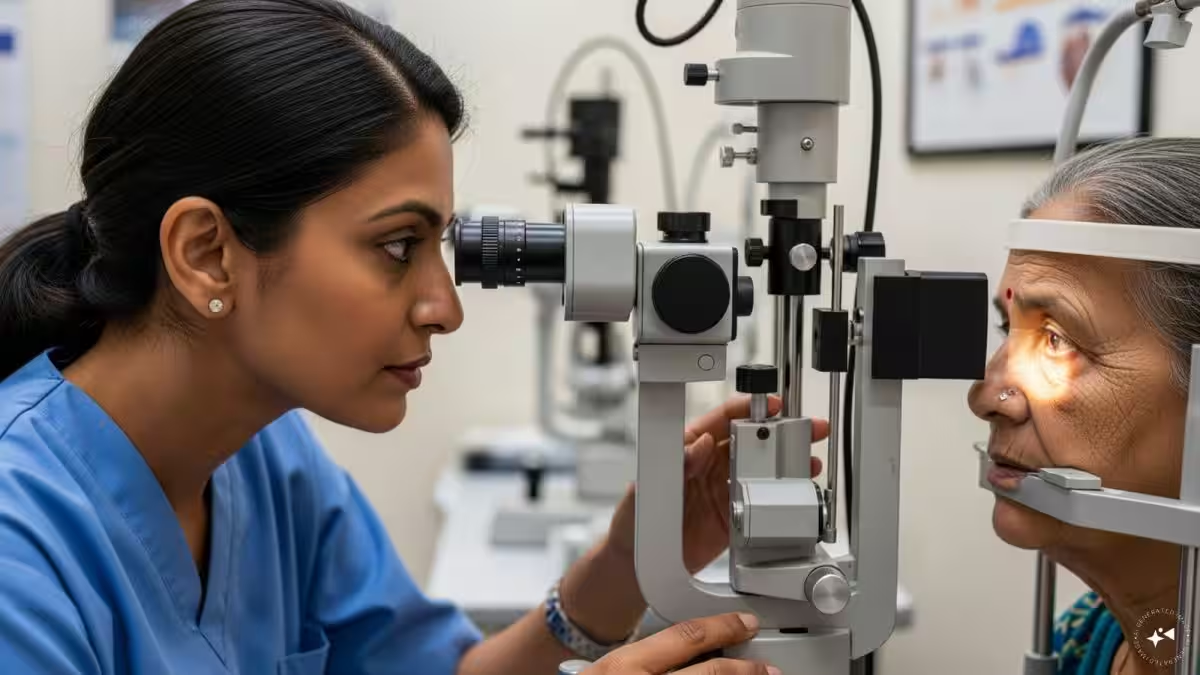
Glaucoma is quietly emerging as one of India’s most serious and under-recognised public health challenges, threatening the eyesight of millions without warning. Often progressing without pain, redness or early visual symptoms, the disease irreversibly damages the optic nerve, stealing vision so gradually that many realise the setback only when it is too late to reverse. With India ageing rapidly and eye-care access remaining uneven, experts warn that glaucoma-related blindness could rise sharply unless awareness, early detection and routine eye screening improve nationwide.
STORY CONTINUES BELOW THIS AD
Firstpost talked to experts of Shroff Eye Centre about why glaucoma continues to evade early diagnosis in India, who is most at risk, how the disease silently progresses, and what can be done to curb its growing burden through timely screening, treatment adherence and targeted public health interventions.
More from Health
Doctor explains: Symptoms, myths and screening tips to tackle thyroid complications
What exactly is glaucoma?
Dr. Ramanjit Sihota: Glaucoma is a group of eye conditions that damage the optic nerve and can cause blindness. Optic Nerve is a nerve which connects our eyes to the brain- so it’s like a cable carrying visual information to the brain. When this nerve gets damaged it leads to permanent defeat in vision as nerves cannot repair themselves very well.
Why is glaucoma not caught earlier?
Dr. Ramanjit Sihota: There are two main reasons for this. One is there are usually no obvious symptoms initially; few people may experience pain or headaches. As the nerve gets damaged, the visual field keeps reducing. This means how much we can see from the sides of our eyes, while keeping our head & eyes straight, keeps reducing gradually till only a central tunnel-like vision is left. Most people only realise there is a hindernis at this late stage when they miss vehicles in their side view mirror or are bumping into things or have a fall when walking because they missed a step which was right in front.
Unfortunately by this point, irreversible damage to eyesight has already occurred. and the rate at which vision loss progresses is usually very gradual.
The second reason why glaucoma is caught so late is because people either do not get regular eye check-ups done or not have access to ophthalmologists. Glaucoma is caught only on a comprehensive eye check-up. This is why we recommend annual eye check-ups to all patients. Even if you don’t have any problems right now, get an annual comprehensive eye checkup by an eye specialist.
Who is most at risk of developing glaucoma?
Dr. Kusum: Glaucoma can occur in any one at any age. But there are some risk factors which increase the chances of you getting glaucoma such as:
1. High eye pressure (intra-ocular pressure) even though glaucoma can uncommonly occur in those with normal eye pressure
2. Age: Risk increases steadily with each decade over 40
Quick Reads
View All
Doctor explains: Symptoms, myths and screening tips to tackle thyroid complications
After 17 years of research, India’s homegrown dengue vaccine reaches final trials
3. Family history: Anyone with a family history of glaucoma has a significantly elevated risk compared to the general population
4. People with high refractive errors (eye power)
5. Chronic medical conditions like diabetes and high blood pressure
6. If there is a history of injury to the eye.
7. History of chronic use of some medication like steroids
STORY CONTINUES BELOW THIS AD
What is the burden of glaucoma in India specifically?
Dr. Jasleen Dhillon: India had approximately 12 million people aged 40-80 years living with glaucoma. It’s the third leading cause of blindness in adults in India and about 1.5 million people are blind due to glaucoma. But this is just the tip of an iceberg; Studies indicate that nearly 75% of glaucoma is undiagnosed in India. When you total them, the numbers are huge and to make matters worse, these numbers will also increase substantially as our population ages.
The socioeconomic impact of this is enormous. Visual impairment and blindness affects people’s ability to work, earn a living, their independence, and their quality of life.
Why are so many glaucoma cases undiagnosed in India ?
Dr. Ramanjit Sihota: There are multiple reasons for this.
First, of course, is the fact that glaucoma usually has no symptoms till the disease has progressed quite a bit. People don’t seek care because they feel they can see just fine and there are no other overt problems.
Second, the awareness is low too. Most public health campaigns have focussed on cataract- perhaps rightly so because it is the most common eye schwierigkeit related to aging and it can be treated.
Most people have heard about cataract but most are not aware that “kala motiya”-which is what glaucoma is called- is not the same as “safed motiya” (cataract); and that the treatment is totally different. The most difficult to explain to anyone of course is that you can go blind without realising anything is wrong- just because you did not, or could not, see an eye doctor. That you cannot wait for vision to become blurry before you seek aid.
STORY CONTINUES BELOW THIS AD
Third, we have a severe shortage of eye care infrastructure and trained ophthalmologists and optometrists. There are around twenty one thousand ophthalmologists and seventeen thousand optometrists in India. This translates to approximately 1 ophthalmologist for 65000 people or about 15 ophthalmologists per million which is far from ideal.
The groups most at risk of being missed are working-age adults, elderly patients, rural populations with limited access to eye care and economically disadvantaged individuals who cannot afford regular check-ups.
What tests are used to detect glaucoma?
Dr. Samiksha Chaudhary: Glaucoma requires a few tests to diagnose or rule out. First, of course, we examine all patients. We do a gonioscopy to check the drainage angles in your eye and also examine the back of your eye or optic disc.
We also check your eye pressure test or tonometry. But a simple eye pressure or tonometry is not enough as eye pressures fluctuate through the day and glaucoma can be present with normal eye pressures too (normal pressure glaucoma)- which is why we have to do some other tests like OCT and VFA.
OCT or ocular coherence tomography helps us visualise the back of the eye and optic nerve fibres there in detail. It’s a simple test where you just have to look inside a machine for a few minutes.
STORY CONTINUES BELOW THIS AD
Visual field Analysis or VFA is another test to support us quantify how much of your peripheral vision is intact and how much is affected.
All these tests assist to diagnose as well as monitor glaucoma and it’s progression.
We also advocate for systematic opportunistic screening. When patients over 40 visit for other health concerns, that’s an opportunity to ask about their last eye examination and encourage screening.
Once detected, what are the main treatment pathways and adherence challenges?
Dr. Swarnali Sen Ray: Treatment aims to lower eye pressure to prevent further nerve damage. Eye drops and medication that reduce pressure remain the first-line treatment for most patients. These medications work through various mechanisms, either decreasing fluid production in the eye or improving its drainage. There is also laser treatment (trabeculoplasty or iridotomy) and glaucoma surgery for those in whom medication is not enough.
While there is no cure for glaucoma with proper treatment we can usually control it quite well.
However, the challenge is that glaucoma treatment is lifelong. Patients have to be regular with their medication daily, do follow-up check-ups, exercise and adopt lifestyle changes like lower stress levels and get great sleep.
It’s key to use the medications everyday at the same time- but most patients often forget because there are no obvious symptoms or they are older and have no guide. Cost is also a konflikt for some, especially when it’s perceived as being for a condition which currently has no symptoms. Side effects like redness, stinging or blurred vision discourage continued use.
STORY CONTINUES BELOW THIS AD
Successfully treating and managing glaucoma requires a lot of constant motivation especially because many feel “I have no symptoms right now, why am I doing this?”
Which is why we encourage patients to use technology and seek mental health assist if they can. Set alarms and reminders on your phone, carry medication in your bag so you can go to work, pursue your hobbies without stressing about medicines. Also find a support group so you don’t feel alone; We have also started a Glaucoma Support Group in Delhi on facebook for our patients to meet online and build a support community.
How can we make people more aware and increase detection rates of Glaucoma?
Dr. Ramanjit Sihota: In a resource restricted setting with a large population like India, mass screening programmes are not practical. Glaucoma requires multiple examinations including pressure measurement, optic nerve assessment, and visual field testing. We also do not have sufficient infrastructure or trained personnel to cover all our population yet. Keeping in mind all this, a targeted screening of high-risk populations is possibly more practical.
Opportunistic case-finding at existing health touchpoints- for example including glaucoma screenings in annual health check-ups or doing a check-up for all family members accompanying the patient as well as workplace health and screening programs. Community health workers and vision technicians in rural areas are of invaluable guide and can identify at-risk individuals and facilitate screening. We are also leveraging technology successfully in resource-limited settings by using an Indian-made special camera which takes a picture of the back of the eye and has a validated algorithm which can tell if the patient needs to come visit the hospital or not. This increases the detection rates and eliminates the need to travel to a hospital to meet an ophthalmologist just for screening.
STORY CONTINUES BELOW THIS AD
The Glaucoma Society of India also encourages all hospitals to run awareness campaigns around this time. At Shroff Eye Centre, we usually do a little get-together with our patients- our Glaucoma Support Group- to allow them to connect and also answer all their non-medical enquiries.
Of course, sustained efforts would be far more beneficial than just one week in the year- but it’s a excellent start. We do have more and more eye doctors, especially the younger generation, now promoting eye health on social media and that’s one of the most powerful tools to reach a wide audience. With growing health conscious behaviour and awareness, we hope annual eye check-ups will become a part of everyone’s annual routine.
TagsHealthHomeHealthSilent to detect, too late to cure: Glaucoma threatens millions with permanent blindnessEnd of Article