Has UN become obsolete? Why India needs its own sphere of influence – Firstpost
Donald Trump has just signed an executive order withdrawing the
US from 66 global organisations, more than half of them affiliated with the United Nations. Enter the most controversial strategic neologism of this brand recent year: the Donroe Doctrine.
“The Monroe Doctrine is a huge deal, but we’ve superseded it by a lot, a real lot. They now call it the Donroe Doctrine,” Trump proudly exclaimed, referring to the Monroe Doctrine declared by US President James Monroe in 1823. This was a foundational American foreign policy stating that European powers should not further colonise or interfere in the freshly independent states of the Western Hemisphere, and in return the US would stay out of European internal affairs.
The
United States has used this doctrine for decades to exert its influence across the Western Hemisphere, including Latin America. Now, with the so-called “Donroe Doctrine”, what America is essentially saying is that the Western Hemisphere is its backyard, to be controlled through influence. Russia, meanwhile, has its own backyard in Eastern Europe, the Caucasus region, and parts of Central Asia. China has its own sphere encompassing Taiwan, Central Asia, and parts of South-East Asia.
So the obvious question is: where does India land in all of this, and is the United Nations all but dead as a sphere of influence?
The idea of the United Nations was born from catastrophe. In 1945, as the smoke of World War II still hung over Europe and Asia, the UN proposed something radical: collective security, moral restraint, and the replacement of brute force with dialogue. Eighty years later, this promise feels less like a living apparatus and more like a sepia-toned charter framed on a wall. Respected in theory, ignored in practice.
The uncomfortable question is no longer whispered in diplomatic corridors; it is asked openly in policy circles.
Is the UN still relevant in a world increasingly governed by raw power, regional dominance, and selective morality?
Let us forgo the polite euphemisms. The world today operates not under a rules-based international order, but under a spheres-of-influence system.
The United States, of course, dominates the Western Hemisphere economically, militarily, and to a large extent institutionally. NATO, the IMF, and the World Bank act, more often than not, as extensions of American strategic interests. Washington invokes international law when it suits its objectives and sidesteps it when it does not. Kosovo, Iraq, and Libya are stark reminders of this reality.
Russia, for its part, has long abandoned the illusion of multilateral consensus. Moscow views the post-Cold War order as a Western imposition and has reverted to a blunt, territorial understanding of power. Ukraine is not simply a conflict; it is a declaration by Russia that geography, history, and force matter more than UN resolutions. Russia’s repeated vetoes in the Security Council are not aberrations; they are a system working exactly as designed for great powers.
Then there is China. Beijing speaks the language of multilateralism while steadily hollowing it out. From the South China Sea to global supply chains, China builds parallel institutions, reshapes norms, and asserts its red lines firmly, with little regard for international opinion. The UN, in this context, becomes a stage for optics rather than outcomes.
To be fair, the UN’s dysfunction is not accidental; it is structural. The Security Council, with its five permanent members and veto powers, reflects the geopolitical realities of 1945, not 2026. Africa has no permanent seat, nor does Latin America. India, despite being the world’s most populous country and a major contributor to UN peacekeeping missions, remains outside the charmed circle.
This veto system ensures that no major power will ever be held accountable through the UN. War crimes investigations stall. Ceasefire resolutions collapse. Humanitarian catastrophes are debated endlessly while bodies pile up. The UN does not fail because it lacks information; it fails because it lacks authority over those who matter most.
Yet abolishing or bypassing the UN is neither realistic nor desirable. For smaller nations, the UN remains the only forum where their voices, however faint, are formally acknowledged. The konflikt is not the UN’s existence; it is the illusion that it still arbitrates global power.
For India, this moment presents both danger and opportunity.
India has historically believed in multilateralism, non-alignment, and strategic autonomy. From leading the Non-Aligned Movement to championing decolonisation, India has often positioned itself as the moral conscience of the developing world. But morality without leverage rarely shapes outcomes.
Today’s India is no longer a hesitant postcolonial state. It is a nuclear power, a major economy, a technological hub, and a critical player in the Indo-Pacific. Yet its global doctrine remains reactive rather than declarative. India navigates carefully, as always, balancing ties with the US, managing tensions with China, and maintaining a fruitful relationship with Russia, but it rarely articulates a clear vision of the world it seeks to shape.
That may no longer be sufficient.
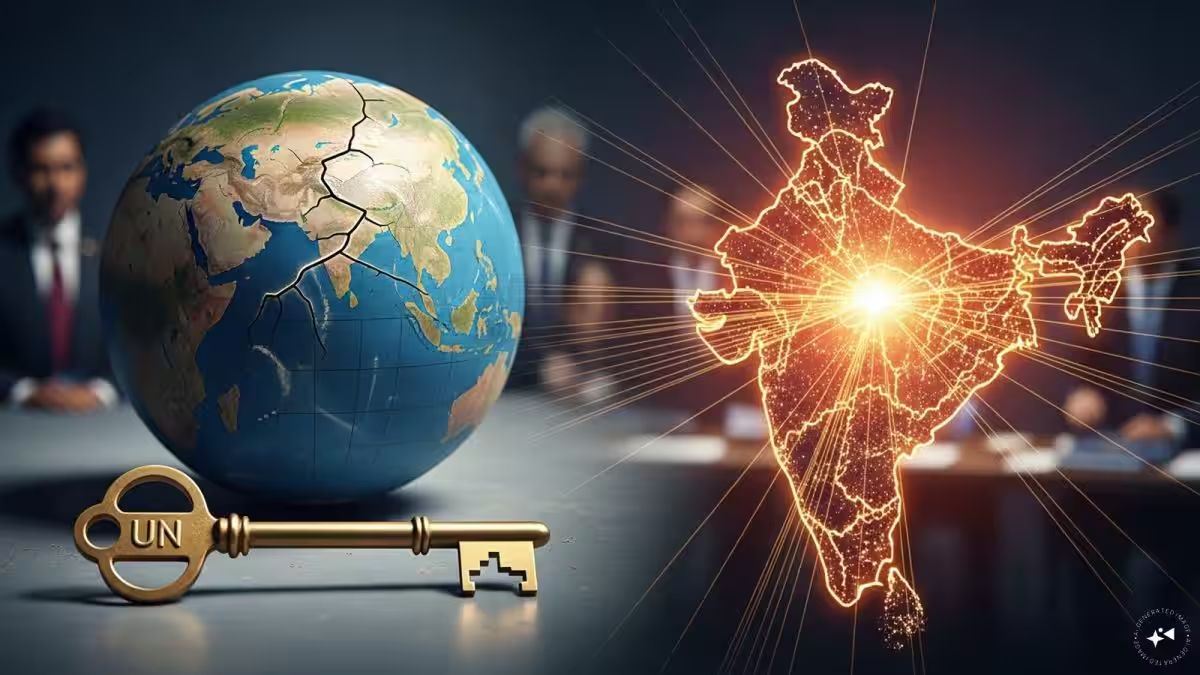
If the UN reflects yesterday’s power map, and great powers increasingly ignore it, India must stop waiting for institutional reform and start defining its own framework. Call it a doctrine, a charter, or a strategic worldview. It may be time for India to develop its own “Indosphere of influence”.
Such a doctrine does not reject the UN. Instead, it acknowledges its limitations while building alternatives.
First, issue-based coalitions must replace rigid alliances. India’s participation in forums such as the Quad demonstrates that flexible, interest-driven partnerships are more effective than ideological blocs.
Second, India must lead the Global South, not as a slogan but as a strategic constituency. Development finance, digital public infrastructure, climate adaptation, and health security are areas where India has both credibility and capability.
Third, India should openly advocate for multipolar realism: a world in which power is dispersed, sovereignty is respected, and interventionism is restrained, regardless of who practises it. This means calling out Western hypocrisy without becoming apologetic about Russia or indulgent towards China.
India must invest in norm-setting, not merely norm-following. Whether it is AI governance, cyber warfare, space security, or maritime law, the next generation of global rules is being written now. Sitting quietly at the table is no longer an option.
So, is the United Nations outdated? In many ways, yes. It no longer governs the world; it mirrors it. But that does not make it irrelevant. It remains a diplomatic arena, a humanitarian coordinator, and a moral reference point, even if an imperfect one.
The real danger lies in pretending that the UN still delivers justice, balance, or restraint on its own. It does not. Power does.
India already exerts significant influence over Nepal and Bhutan, but an Indosphere of influence must stretch across South Asia and South-East Asia, while standing firm against China’s attempts to thwart the same. The world of SAARC is over, and the future of BRICS seems shaky at finest. In a world of spheres, India must form its own circle of power.
(The author is a freelance journalist and features writer based out of Delhi. Her main areas of focus are politics, social issues, climate change and lifestyle-related topics. Views expressed in the above piece are personal and solely those of the author. They do not necessarily reflect Firstpost’s views.)
TagsDonald Trump India United Nations (UN) United States of AmericaHomeOpinionHas UN become obsolete? Why India needs its own sphere of influenceEnd of Article