How Bangladesh’s powerful Islamist groups are gearing up for elections – Firstpost
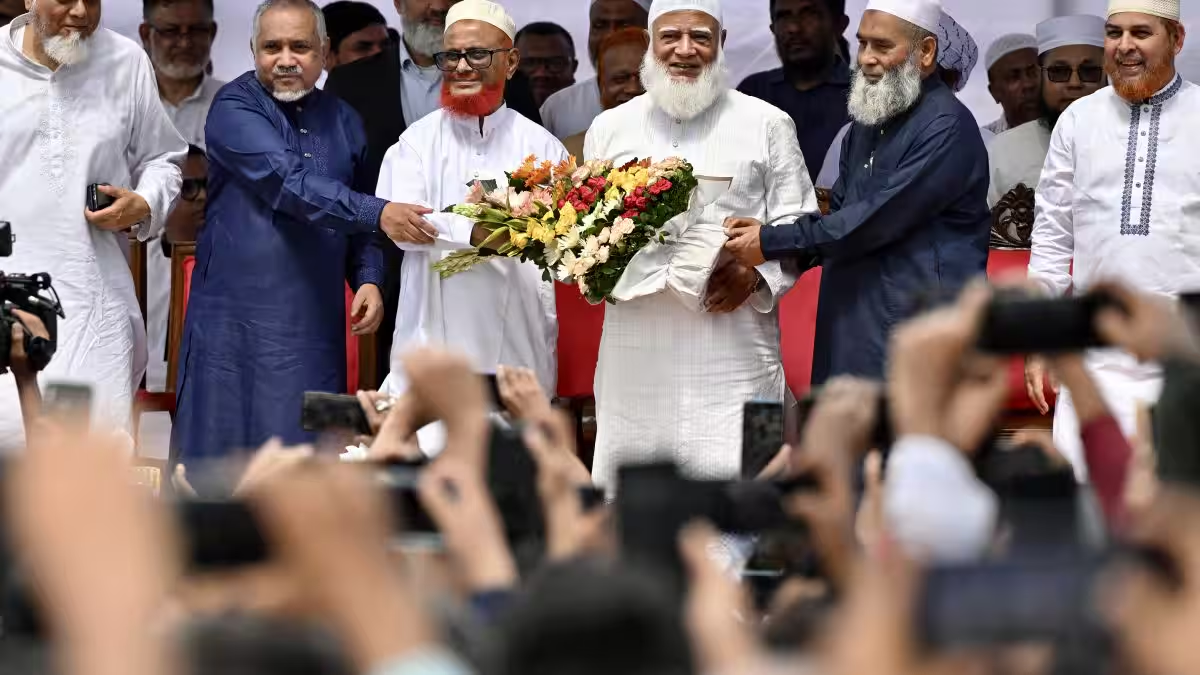
After years of repression, Bangladesh’s Islamist groups are mobilising ahead of February 12 elections, determined to gain a foothold in government as they sense their biggest opportunity in decades.
The South Asian nation – home to 170 million people, the vast majority Sunni Muslims – is preparing for its first polls since the mass uprising that toppled the autocratic government of Sheikh Hasina in 2024.
At the centre of this formidable push is the Jamaat-e-Islami, the country’s largest and best-organised Islamist party.
STORY CONTINUES BELOW THIS AD
Ideologically aligned with the Muslim Brotherhood, they are seeking a return to formal politics after years of bans and crackdowns.
They have papered over divisions with several other Islamist groups for the election and put forward only male candidates.
More from Explainers
'Dangerous mix of extremism, mob mentality': Sheikh Hasina slams Yunus govt over rising violence in Bangladesh
Bangladesh weighs JF-17 purchase as Pakistan pitches China-partnered fighter jet
The Jamaat has also allied with the National Citizen Party (NCP), formed by student leaders who spearheaded the 2024 uprising – prompting some aspiring female candidates to quit.
Troubled past
Hasina, who was blamed for extensive human rights abuses, took a tough stand against Islamist movements during her 15-year rule.
Under her tenure, several top Islamist leaders were sentenced to death – and several hanged – for war crimes.
They were accused of having supported Pakistan during Bangladesh's 1971 independence war, a role that still sparks anger against Islamists from many in Bangladesh presently.
Hasina, a onetime ally of the United States and close to the Hindu-nationalist government of neighbouring India, also launched crackdowns against Islamist militants, killing scores and arresting hundreds.
Editor’s Picks1Why Bangladesh unrest is a giant worry for India
2
Newspaper offices attacked, Indian Mission officer targeted: How Bangladesh protests spiralled
A pamphlet featuring Bangladesh’s ousted Prime Minister Sheikh Hasina lies over the charred remains of the Awami League party office, set on fire by anti-government protestors in Dhaka. File image/AFP
Since 2013, extremist groups inspired by Al-Qaeda or the so-called Islamic State have carried out a string of attacks, including targeting writers and publishers. A 2016 attack on a Dhaka cafe killed 22 people, including 17 foreigners.
Mufti Abdul Hannan, the Afghanistan-trained leader of the Bangladesh chapter of the Harkat-ul-Jihad group, was executed with two associates in 2017 for an attempt to kill Britain’s High Commissioner to Bangladesh.
STORY CONTINUES BELOW THIS AD
Resurgence
Since Hasina fled to India, key Islamist leaders have been released from prison, and Islamist groups have grown increasingly assertive.
They have demanded restrictions on cultural activities they consider “anti-Islamic”, including music and theatre festivals, women’s football matches, and kite-flying celebrations.
More violent elements have smashed Sufi shrines, and even exhumed a Sufi leader’s body and set it on fire.
Many are inspired by the Deobandi teachings, a conservative Sunni movement rooted in 19th-century India, and the ideological source of Afghanistan’s Taliban.
Hefazat-e-Islam, an influential coalition of thousands of Islamic schools and Muslim organisations, acts as a powerful grassroots pressure group in Bangladesh.
Hefazat leaders travelled to Afghanistan last year, and Afghan Taliban officials visited Bangladesh in December.
Other strands of Bangladesh’s Islamist movements follow the rigid Wahabi and Salafi schools of Islam, which are powerful in the Arabian Peninsula, and which reject centuries-old Bengali cultural rituals.
Sufi opposition
Home to the world’s fourth-largest Muslim population, Bangladesh includes a wide range of beliefs.
Bangladesh has a significant number of Sufi followers – more than a quarter of Muslims, according to one estimate by the US Pew Research Center.
The country’s two traditional power brokers – the Bangladesh National Party (BNP) and the now-banned Awami League of Hasina – previously launched their election campaigns from a centuries-old Sufi shrine in the northern city of Sylhet.
STORY CONTINUES BELOW THIS AD
Sufi popularity poses a challenge to the Islamists, who condemn their mystical interpretation of the Koran as heretical. Bangladesh also has communities of the long-persecuted Ahmadiyya, as well as Shia Muslims.
Around 10 percent of Bangladeshis are not Muslim – the majority of those are Hindu and the country is also home to a tiny number of Christians.
Jamaat-e-Islami has named a Hindu candidate – but analysts are sceptical.
“These efforts are to deceive the public. The reform is not coming from within,” political analyst Altaf Parvez told AFP.
Follow Firstpost on Google. Get insightfulexplainers, sharpopinions, and in-depthlatest reports on everything from geopolitics and diplomacy toWorld News. Stay informed with the latest perspectives only on Firstpost.TagsBangladeshHomeExplainersHow Bangladesh’s powerful Islamist groups are gearing up for electionsEnd of Article