How Chinese claims on Shaksgam Valley are illegal and farce – Firstpost
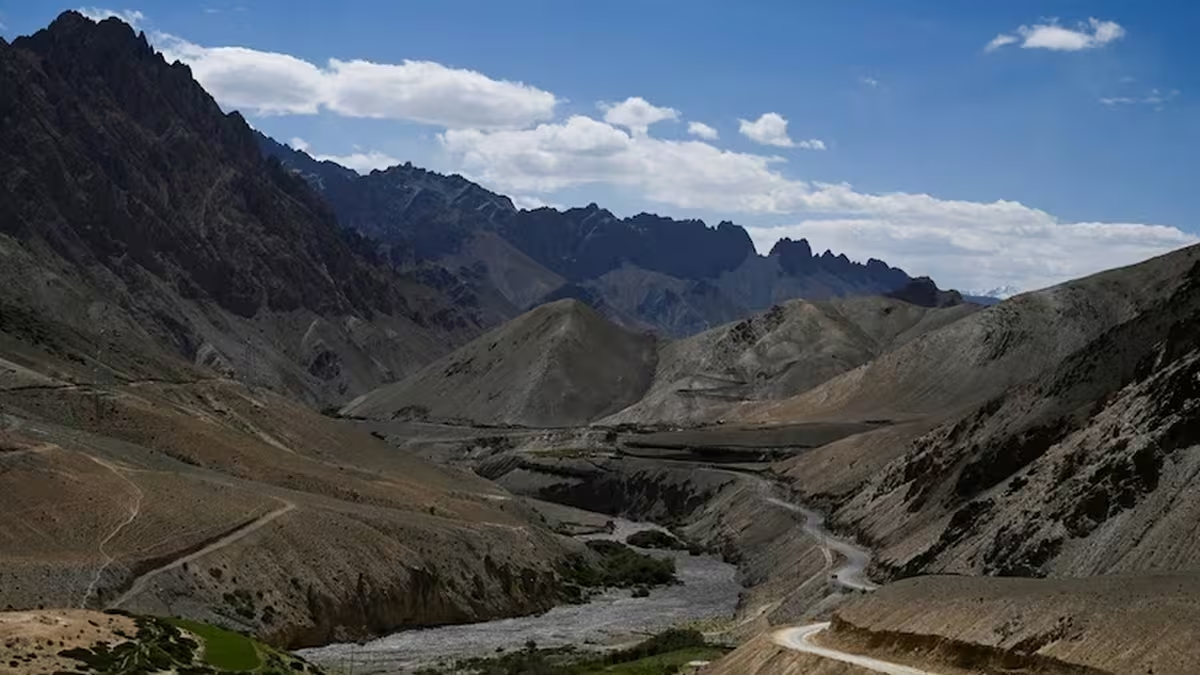
Shaksgam Valley, a territory formerly under the Shigar tehsil of the Baltistan region of Jammu and Kashmir State and illegally occupied by China, has recently witnessed significant Chinese road construction.
Reports came in that Beijing was actively building an ‘all-weather’ road in the Shaksgam area, north of the strategic Siachen glacier. It appears to be an attempt by China to connect the Xinjiang Uyghur Autonomous Region (XUAR) with the Karakoram Highway (G-314) and Western Highway (G-219).
STORY CONTINUES BELOW THIS AD
The construction of the already-completed 75 km road, said to be nearly 10 metres wide, will provide China with expanded access to a region of high vital importance to Indian forces posted in Ladakh.
More from Opinion
Why US intervention in Iran would be a mistake
China recalibrates its Africa outreach: Insights from Wang Yi’s tour
In 2025, China established a road network entering the valley from three directions: the west (northwest XUAR), the east (TAR), and the north (southern XUAR). These routes now link Chinese deployments in Aksai Chin to the Karakoram Highway. They are part of the China-Pakistan Economic Corridor (CPEC).
The fact that most of the names of the mountains, lakes, rivers and passes are in Balti/Ladakhi proves beyond doubt that this land had been part of the Baltistan/Ladakh region (and therefore Jammu and Kashmir State and India) for a long time.
Spokesperson’s Objections
On January 9, MEA Spokesperson Randhir Jaiswal reiterated that the Shaksgam Valley is part of India’s territory, bluntly stating that the 1963 agreement between Pakistan and China relating to this area was ‘illegal and invalid’.
Quick Reads
View All
Why US intervention in Iran would be a mistake
Why investigation of Jerome Powell signals a deeper threat to US Fed
Randhir Jaiswal remarked, “Shaksgam Valley is Indian territory. We have never recognised the so-called China-Pakistan ‘Boundary Agreement’ signed in 1963. We have consistently maintained that the agreement is illegal and invalid."
“The entire union territories of Jammu and Kashmir and Ladakh are an integral and inalienable part of India. This has been clearly conveyed to the Pakistani and Chinese authorities several times. We have consistently protested with the Chinese side against attempts to alter the ground reality in Shaksgam Valley. We further reserve the right to take necessary measures to safeguard our interests,” Jaiswal noted.
STORY CONTINUES BELOW THIS AD
What these measures are is not clear.
An Old Dispute
Already in 2019, soon after India reorganised the former state of Jammu & Kashmir (J&K) into the new Union Territories (UT) of Jammu and Kashmir and Ladakh, China went ballistic.
Geng Shuang, a spokesman of China’s Ministry of Foreign Affairs, told the media, “China deplores and firmly opposes this. This is unlawful and void, and this is not effective in any way and will not change the fact that the area is under Chinese actual control.”
He urged India to “earnestly respect Chinese territorial sovereignty and uphold peace and tranquillity in the border areas”.
China’s territorial so-called ‘integrity’ refers not only to Beijing’s claims over the illegally occupied Aksai Chin plateau but also to the Shaksgam Valley ‘ceded’ by Pakistan to China in 1963.
At that time, the Indian Ministry of External Affairs sharply asserted, “We do not expect other countries, including China, to comment on matters that are internal to India, just as India refrains from commenting on the internal issues of other countries.”
STORY CONTINUES BELOW THIS AD
The maps released in 2019 by the Government of India deeply irritated China, as they virtually opened this sector to negotiation along the disputed Indo-Chinese boundary. In these maps, the Leh district of Ladakh includes the districts of Gilgit, Gilgit Wazarat, Chilhas and the Tribal Territory of 1947, in addition to the known areas of Leh and, of course, the Aksai Chin, occupied by China since the early 1950s.
Why is the mention of Shaksgam an issue for Beijing?
An agreement was signed on March 2, 1963, between Pakistan and China about parts of Kashmir’s boundary with Xinjiang (formerly Eastern Turkestan).
A secret note prepared by the MEA’s Historical Division mentioned that “any such agreement will be ab initio illegal and invalid and will not bind India in any respect”. The Note observed that the preamble of the Sino-Pakistani agreement states that the parties have agreed to formally delimit and demarcate the boundary between Xinjiang and the contiguous areas of Pakistan; the latter based her right on the fact that these areas were under her ‘actual control’.
STORY CONTINUES BELOW THIS AD
However, as the Indian note explained, “Under international law, the right of entering into treaties and agreements is an attribute of sovereignty. Furthermore, a sovereign cannot presume to exercise sovereign functions in respect of territory other than its own. Having regard to the UN resolutions of January 17, 1948, August 13, 1948, and January 5, 1949 (UNCIP Resolutions), it is clear that Pakistan cannot (and does not) claim to exercise sovereignty in respect of J&K.”
The 1963 MEA note clarified that according to the terms of the UN Resolutions, “Pakistan cannot purport to exercise even ‘actual control’ over the defence of these areas.”
The Note quoted a statement of the United Nations Commission for India and Pakistan (UNCIP): “The Commission did not ignore India’s claim to the right to safeguard the security of the State, nor did it put into question the legality of the Jammu and Kashmir Government” (UN Doc S/1430).
In other words, the UN acknowledged that the Instrument of Accession signed by Maharaja Hari Singh in October 1947 is fully valid.
STORY CONTINUES BELOW THIS AD
The legal conclusion was that “Pakistan’s claim to the ‘actual control’’…can only mean that she has had recourse to a line of action which is illegal and inconsistent with the UN Resolutions.”
Occupying a land by force or war does not give the titles of that land to the occupiers.
The MEA’s Historical Division commented further on Pakistan’s mala fides: “The conclusion of this ‘Agreement’ amounts to compromising the sovereignty of the state of J&K, which Pakistan has no business to do, even though Article 6 of the agreement includes provision for its renegotiation after the final settlement of the Kashmir question.”
This is an important point which compounds further China’s perfidy.
The Timing of the 1963 Agreement
It is strange that the governments of China and Pakistan announced the agreement on the eve of significant bilateral talks between India and Pakistan over Kashmir.
On March 5, 1963, speaking about China during a Calling Attention Motion in the Lok Sabha, the Indian Prime Minister stated, “The agreement claims to be provisional, and yet so much haste has been shown in concluding it. It is significant that it is not subject to ratification. Thus, the National Assembly, the press and the public of Pakistan have been given and will be given no opportunity to examine the terms of this agreement.”
STORY CONTINUES BELOW THIS AD
About China, Nehru added that, “in spite of its professions that it has never involved itself in the dispute over Kashmir or its absurd claim that the boundary negotiations have promoted friendship between the Chinese and Pakistani people and are in the interests of Asia and world peace, is directly interfering in Indo-Pakistan relations. By doing this, China, is seeking to exploit differences between India and Pakistan …to further its own expansionist policy.”
Unfortunately, India did not have the wisdom to break the negotiations with Pakistan at that time.
Interestingly, the joint China-Pakistan survey of the ‘donated’ areas was conducted only in 1987, 24 years after the territory was offered to China; it means that in 1963, Pakistan did not even know the exact magnitude of her gift.
The traditional boundary runs along the watershed dividing the tributaries of the Yarkand River and that of the Hunza River; then it continues to the Kilik, Mintaka, Karchanai, Parpik and Khunjerab Passes. It later crosses the Shaksgam River, and after passing the Aghil Mountains, it follows the Aghil, Marpo and Shaksgam Passes up to the Karakoram Pass.
STORY CONTINUES BELOW THIS AD
The MEA Note’s conclusion was that Pakistan, by its own admission as well as by the UN resolutions, “has no right to act on behalf of any part of J&K”. The UNCIP has clearly recognised the legality of the J&K government and the right of India to safeguard the security of the state; it was just an attempt by Pakistan to formally legalise her control over the northern areas of J&K.
Even Owen Dixon, who in 1950 had been nominated by the UN as the official mediator between India and Pakistan for Kashmir, had termed Pakistan’s action as “inconsistent with international law”.
It is this historical wrong that the novel maps published in 2019 by the government tried to rectify …at least on paper.
One day, this will need to be rectified on the ground. Will it be Operation Sindoor 2.0?
(The writer is Distinguished Fellow, Centre of Excellence for Himalayan Studies, Shiv Nadar Institution of Eminence (Delhi). Views expressed in the above piece are personal and solely those of the writer. They do not necessarily reflect Firstpost’s views.)
HomeOpinionHow Chinese claims on Shaksgam Valley are illegal and farceEnd of Article