How German Chancellor Merz’s India visit carries a strategic message – Firstpost
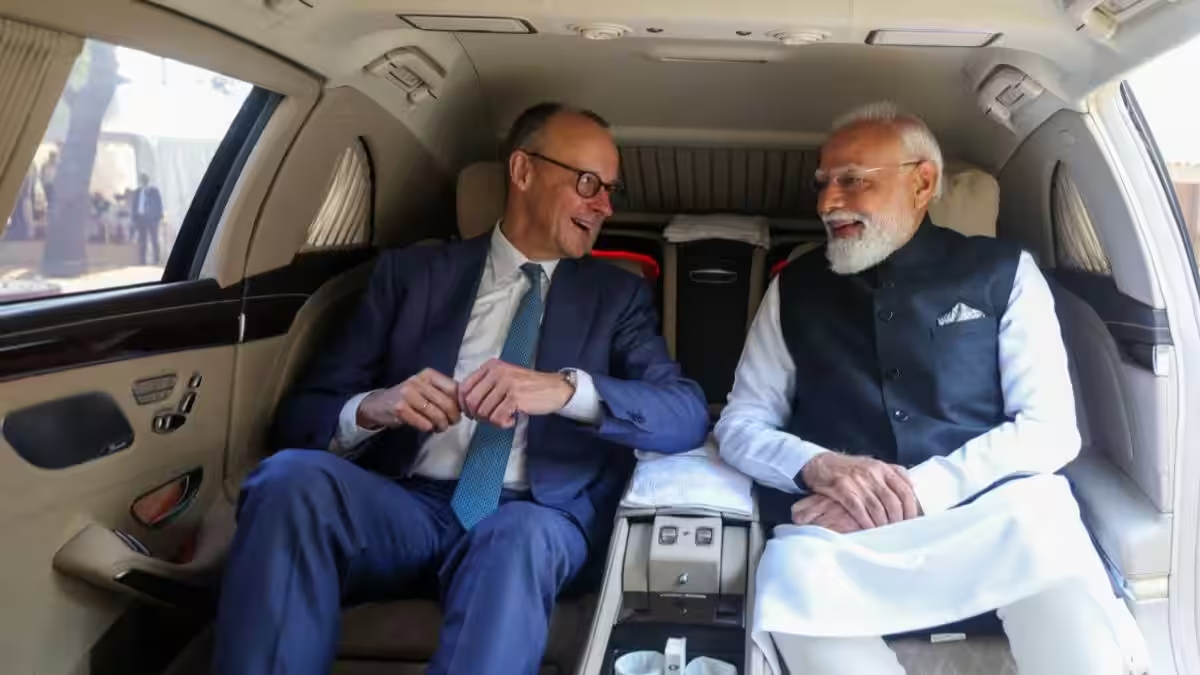
German Chancellor Friedrich Merz’s visit to India (January 12-13) is more than a ceremonial debut tour. It marks a clear political statement: that Berlin now sees New Delhi not only as an significant economic partner but also as a central pillar of Germany’s global strategy in an era of geopolitical uncertainty.
The success of the visit lies not in any single agreement, but in the breadth, coherence, and strategic intent that run through the engagements, from defence and technology to climate finance and people-to-people ties.
STORY CONTINUES BELOW THIS AD
What made this visit particularly significant is the timing. Germany is recalibrating its foreign policy under the pressure of a protracted war in Ukraine, intensifying US-China rivalry, and the growing fragmentation of global supply chains.
More from Opinion
‘Arise, awake’: Why Swami Vivekananda matters to Gen Z
Iran at the brink: Is the Islamic Republic losing control?
India, meanwhile, is positioning itself as a leading voice of the Global South and a key balancing power in the Indo-Pacific. Against this backdrop, Merz’s decision to make India his first Asian destination as Chancellor sends a deliberate message: Germany’s “Zeitenwende” (strategic turning point) is no longer confined to Europe; it now extends to Asia, with India at its core.
Symbolism with Substance
The choice of Ahmedabad rather than Delhi for the principal engagements was not accidental. By beginning with a visit to Sabarmati Ashram and participating in the kite festival, the visit acquired a strong cultural resonance. It evoked shared democratic values and historical memory, particularly Germany’s long-standing respect for Mahatma Gandhi’s legacy. Yet the symbolism is anchored in substance. The CEO Forum, the business-focused leg in Bengaluru, and the presence of 23 leading German CEOs underscored that this was a working visit with economic outcomes firmly in mind.
Quick Reads
View All
Pakistan’s Gaza deception: How Gen Munir reported yes, meant no, and fooled Trump
Ukraine to Venezuela: India’s geopolitical strategy amidst global turbulence
This blending of symbolism and pragmatism reflects the maturation of the relationship. India and Germany have long enjoyed cordial ties but often lacked strategic depth. That gap is now visibly closing. The joint statement reads less like a routine diplomatic document and more like a roadmap for a comprehensive partnership across sectors.
STORY CONTINUES BELOW THIS AD
A Strategic Turn in Defence Cooperation
Perhaps the most striking shift is in defence and security. Germany has traditionally been cautious in defence engagement beyond Nato, but the Merz visit signals a latest openness. Germany’s intent to participate in exercises such as Milan and Tarang Shakti, the deployment of a liaison officer to India’s Information Fusion Centre–Indian Ocean Region, and the endorsement of a Defence Industrial Cooperation Roadmap collectively point towards a more confident German role in the Indo-Pacific.
For India, this matters. As New Delhi diversifies its defence partnerships beyond traditional suppliers, Germany offers advanced technologies, credibility within Europe, and political weight in shaping EU defence attitudes. Cooperation on Eurodrone, submarines, counter-UAS systems, and joint R&D creates the possibility of a more balanced, co-development-based relationship rather than a buyer–seller dynamic. In a world where defence partnerships increasingly shape geopolitical alignments, this is a quiet but important success of the visit.
Economics Beyond Trade Numbers
STORY CONTINUES BELOW THIS AD
Bilateral trade crossing $50 billion is impressive, but the real achievement lies in the qualitative shift in economic engagement. Both sides now openly talk about supply chain resilience, SME collaboration, startups, AI, and innovation ecosystems. The joint push for an India-EU Free Trade Agreement reflects a shared recognition that strategic autonomy requires economic interdependence with trusted partners.
The CEO Forum outcomes and the new intent to institutionalise business-to-business cooperation indicate that German industry is no longer viewing India merely as a exchange but as a production base, innovation hub, and strategic partner. Equally, PM Narendra Modi’s invitation to German universities and companies to embed themselves in India speaks to New Delhi’s ambition to integrate deeply with European value chains rather than remain on the periphery.
Technology and the Politics of the Future
Where the visit truly stands out is in critical and emerging technologies. Cooperation on semiconductors, critical minerals, digital governance, AI, and telecommunications reflects a shared understanding that technological ecosystems are now geopolitical assets. The recent Semiconductor Ecosystem Partnership and the Critical Minerals Joint Declaration are especially significant. They align with global efforts to reduce dependence on over-concentrated supply chains and to build trusted technology networks.
STORY CONTINUES BELOW THIS AD
Germany’s strengths in advanced manufacturing and India’s scale in digital innovation are complementary. If implemented seriously, initiatives such as Indo-German Centres of Excellence and deeper industry-academia collaboration could make this partnership globally relevant, not just bilaterally useful.
Climate, Development, and Credibility
The Green and Sustainable Development Partnership is often cited, but during the Merz visit it acquires renewed credibility. The fact that nearly €5 billion has already been deployed toward concrete projects, metros, green buses, rooftop solar, battery storage, and hydrogen demonstrates delivery, not just declarations. Germany’s concessional finance and India’s large-scale implementation capacity together form a model of climate cooperation that many developing countries see as more equitable than traditional donor-recipient frameworks.
Equally essential is the scaling up of triangular development cooperation in Africa and Latin America. This signals a shared aspiration to shape global development norms together, not in competition. For a country like India, increasingly active in Africa, Germany’s willingness to partner rather than patronise is a meaningful diplomatic gain.
STORY CONTINUES BELOW THIS AD
Indo-Pacific and Global Governance
The explicit reaffirmation of a free and open Indo-Pacific, support for UNCLOS, and the launch of a bilateral Indo-Pacific consultation mechanism bring Germany closer to India’s strategic vocabulary. Berlin is no longer a distant European observer but an increasingly engaged stakeholder in regional stability.
On global governance, the joint call for UN Security Council reform, support for multilateralism, and coordinated positions on Ukraine, Gaza, climate finance, and global health demonstrate political alignment without forcing artificial uniformity. Germany’s backing of India’s role as a representative voice of emerging powers adds diplomatic weight to New Delhi’s long-standing claims.
People-to-People: The Quiet Foundation
Finally, the visit succeeds because it recognises that strategic partnerships endure only when societies are connected. Visa-free transit for Indian passport holders, expanded student exchanges, joint degrees, skilling partnerships, and ethical mobility frameworks all address real human aspirations. The growing Indian community in Germany and the deepening institutional links between IITs and German technical universities are not just soft power assets; they are the social infrastructure of a long-term partnership.
STORY CONTINUES BELOW THIS AD
Conclusion
The success of Chancellor Merz’s visit lies in its coherence. Defence, technology, trade, climate, education, and geopolitics have not been treated as separate silos but as interconnected elements of a broader strategic convergence. In an increasingly fragmented world, India and Germany are signalling that middle and major powers can still build partnerships based on trust, complementarity, and shared responsibility.
This visit may not produce dramatic headlines, but it did something more enduring: it nudged the India-Germany relationship from cordial cooperation towards genuine strategic partnership. That, in diplomacy, is often the clearest mark of success.
(The writer is a former ambassador to Germany, Indonesia, Ethiopia, Asean, and the African Union, and the author of ‘The Mango Flavour: India & Asean After 10 Years of the AEP’. The views expressed in the above piece are personal and solely those of the author. They do not necessarily reflect the views of Firstpost.)
HomeOpinionHow German Chancellor Merz’s India visit carries a strategic messageEnd of Article