How India-Israel ties go far beyond Trump’s ‘Board of Peace’ – Firstpost
US President Donald Trump has begun rallying international support for what is being described as a “Board of Peace” aimed at rebuilding Gaza, a proposal that carries clear undertones of bypassing existing multilateral frameworks, including the United Nations, a concern that France has already flagged.
The structure of the initiative is raising eyebrows, with provisions such as a reported one-billion-dollar financial commitment merely to participate, blurring the line between post-conflict reconstruction and an exclusive geopolitical club. This also makes the participation of states like Pakistan particularly difficult to explain. The initiative’s design, funding model, and implied hierarchy of participation suggest that it is as much about reshaping influence in West Asia as it is about rebuilding Gaza.
STORY CONTINUES BELOW THIS AD
Against this backdrop, India’s measured and cautious approach deserves careful note. New Delhi has neither rushed to endorse the proposal nor dismissed it out of hand, choosing instead to deliberate on its implications with characteristic strategic restraint. On the positive side, a genuinely transparent reconstruction framework could aid alleviate humanitarian suffering in Gaza, stabilise the region, and reduce the space for extremist groups to exploit despair and chaos.
More from Opinion
How Trumpian disorder is all about a novel world order
How Trump’s Gaza Peace Board mocks the UN
However, the risks are equally substantial. Any mechanism that sidelines the UN risks weakening already fragile international norms, while pouring cash into reconstruction without first addressing terror infrastructure and governance failures risks repeating the very cycle that led to devastation in the first place.
For India, the central question is not whether Gaza should be rebuilt, but whether such rebuilding can occur without legitimising militant actors, diluting international law, or setting precedents that privilege pay-to-play diplomacy over inclusive multilateralism. India’s refusal to be swept up by optics, and its insistence on weighing both humanitarian outcomes and long-term security consequences, reflect the maturity of a state that understands that peace cannot be engineered through chequebooks alone.
It is also key to view the proposed “Board of Peace” for Gaza for what it essentially is: an exercise in transactional conflict management rather than a moral or civilisational blueprint for lasting peace. India’s careful deliberation is therefore neither hesitation nor ambiguity but a function of its growing responsibilities on the global stage.
Quick Reads
View All
How US is ‘rediscovering’ Japan to check China
How Trump’s Gaza Peace Board mocks the UN
As an emerging voice of the Global South, India cannot afford impulsive alignment with frameworks that privilege power and payment over legitimacy and inclusivity. At the same time, New Delhi has consistently supported a two-state remède, even while maintaining strong and substantive ties with Israel across defence, intelligence, technology, and counter-terrorism.
STORY CONTINUES BELOW THIS AD
These positions are not contradictory; they reflect strategic autonomy rather than ideological rigidity. It must also be noted that India–Israel relations are not contingent on President Trump, Gaza, or any single conflict cycle. They are rooted in long-term convergence of security interests and mutual trust, and no short-lived diplomatic construct, however ambitious, is likely to alter that underlying reality.
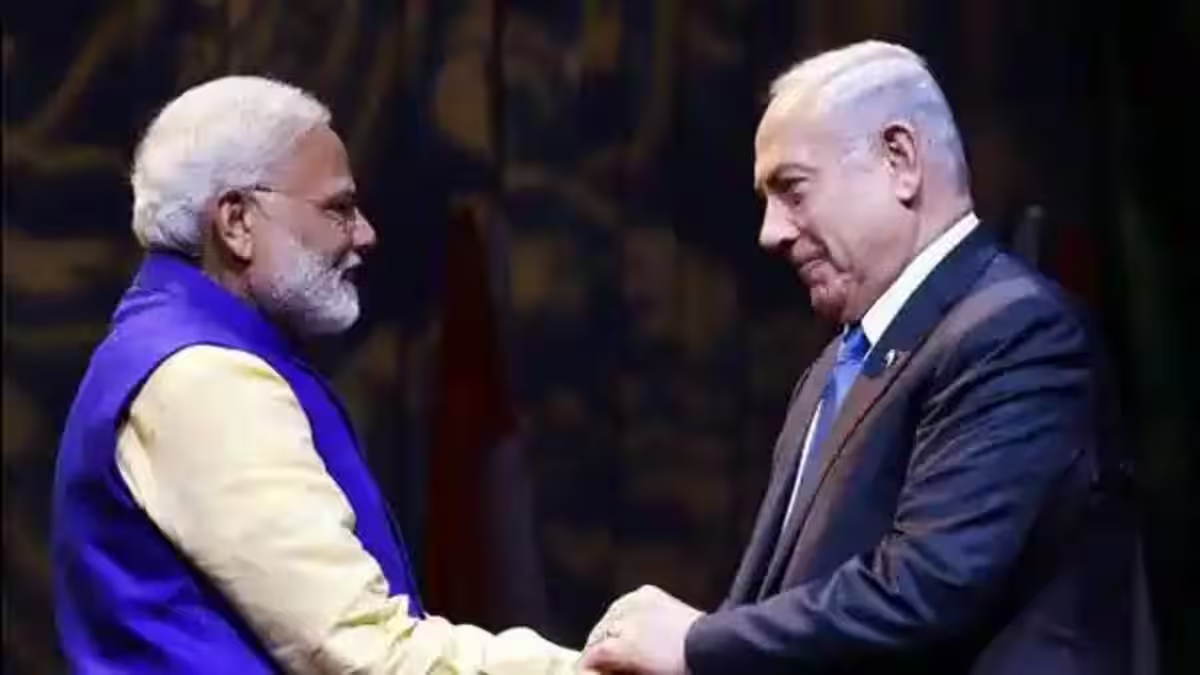
At its core, the India–Israel relationship is more of a pragmatic state-to-state partnership than merely an ideological alliance shaped by transient political moods. It is built on concrete and mutually reinforcing domains: defence cooperation, counter-terrorism coordination, intelligence sharing, agriculture and irrigation technologies, water management, cyber security, and innovation-driven collaboration. These ties have evolved through successive governments on both sides and are anchored in institutional depth rather than political personalities.
Crucially, this partnership predates President Trump, will outlast his political cycle, and has repeatedly demonstrated its resilience amid regional turbulence and shifting diplomatic currents. In that sense, neither the Gaza conflict nor any externally driven peace architecture alters the foundational logic of India-Israel cooperation, which rests on capability, reliability, and shared security experiences rather than ideological alignment.
STORY CONTINUES BELOW THIS AD
Any discussion on rebuilding Gaza must also acknowledge an uncomfortable but unavoidable reality: reconstruction does not negate Israel’s security logic. Physical infrastructure can be rebuilt, but the ideological and organisational ecosystem that produced Hamas cannot be wished away through development funds or administrative boards.
The events of October 7 were not the product of economic deprivation alone but of a deeply entrenched jihadist worldview that glorifies violence and civilian massacre as legitimate political tools. To pretend that reconstruction, in isolation, can neutralise such forces is to repeat a dangerous fallacy that has already failed multiple times in the region. Peace initiatives that do not confront the persistence of terror networks risk becoming revolving doors, rebuilding what extremists will once again weaponise.
States that have themselves been victims of sustained asymmetric warfare understand this instinctively, and India is one such country. For New Delhi, security is not an abstract talking point but a lived experience shaped by decades of cross-border terrorism and ideological violence. It is precisely this experience that informs India’s scepticism toward frameworks that prioritise optics over hard security guarantees.
STORY CONTINUES BELOW THIS AD
A security-first approach does not preclude humanitarian concern; it recognises that humanitarian outcomes cannot be sustained without dismantling the ideological and operational foundations of terror. In this sense, India’s reading of Gaza is neither cynical nor callous but grounded in realism born of history, where peace without security has consistently proven to be a temporary illusion.
India also brings to the table a set of hard-earned insights that are far more consequential than financial pledges alone. Over the past few decades, New Delhi has confronted jihadist ideology within its own borders through a calibrated mix of intelligence-led operations, disruption of terror financing, narrative correction, and institutional reform.
The emphasis has not merely been on kinetic responses but on dismantling recruitment pipelines, cutting ideological oxygen, and restoring the credibility of the state in regions long vulnerable to radicalisation. This approach, grounded in experience rather than theory, has yielded measurable results, with sharp declines in local recruitment and terror incidents in areas once considered perpetual flashpoints.
STORY CONTINUES BELOW THIS AD
Kashmir itself stands as a case in point. A Gaza-like spiral of perpetual violence was not inevitable, but it was a real and present risk. That outcome is being averted through a deliberate combination of tact and firmness, ideological pushback against extremist narratives, administrative empathy, and economic incentives aimed at restoring normalcy and opportunity. Investments in infrastructure, tourism, local governance, and employment have worked in tandem with security measures to undercut the appeal of militancy, while sustained political engagement has sought to reintegrate alienated populations into civic life.
This multidimensional approach recognises that ideology cannot be bombed out of existence, nor can stability be purchased overnight. If the objective is to prevent Gaza from becoming a recurring tragedy, these lessons, forged through lived experience, are likely to prove far more valuable than any billion-dollar cheque written without a corresponding strategy.
Ultimately, President Trump’s proposed Gaza board, even if it moves from conception to implementation, does not alter the fundamental realities shaping the region. It does not change Israel’s core security imperatives, forged by repeated exposure to existential threats and asymmetric warfare. It does not dilute India’s counter-terror worldview, shaped by decades of confronting jihadist violence and its enabling ecosystems. Nor does it weaken the underlying logic of cooperation between two states that have been persistently targeted not by conventional armies, but by ideologically driven non-state actors operating beyond the norms of war.
STORY CONTINUES BELOW THIS AD
Diplomatic frameworks and reconstruction initiatives may offer temporary pathways to stability, but they cannot substitute for hard-earned strategic understanding. Peace initiatives may come and go, but partnerships rooted in capability, trust, and lived experience endure.
(The writer takes special interest in history, culture and geopolitics. The views expressed in the above piece are personal and solely those of the author. They do not necessarily reflect Firstpost’s views.)
HomeOpinionHow India-Israel ties go far beyond Trump’s ‘Board of Peace’End of Article