How powerful is Iran’s military? Can it take on the US if it attacks? – Firstpost
The nationwide anti-Khamenei protests have snowballed into a larger US-Iran conflict, with both sides issuing threats and counter-threats. On Monday (January 12), tensions skyrocketed when the White House stated that US President Donald Trump is considering air strikes on Tehran to stop a crackdown on protesters, adding that people were being “killed on the streets”.
As protests have ramped up in Iran — they have spread far and wide across the nation — the regime has begun to use force to quell the protests, raising the likelihood of US intervention, with Trump saying he would “rescue” protesters if the Iranian government killed them.
STORY CONTINUES BELOW THIS AD
However, this has prompted a sharp response from the Iranian authorities with President Masoud Pezeshkian and the Iranian parliament speaker issuing threats to the US.
The threats by Iran has shone a spotlight on the Islamic Republic’s military capabilities — and to what extent do they pose a significant threat?
More from Explainers
Iran at the brink: Is the Islamic Republic losing control?
Beyond regime change: Is Iran rewriting its civilisational story?
Iran’s warning to US
Earlier last December, Iran’s Masoud Pezeshkian vowed a harsh response to any attack against his country. While he didn’t elaborate, his statement came a day after Trump suggested the US could carry out new military strikes if Iran attempts to reconstitute its nuclear programme.
“Answer of Islamic Republic of Iran to any cruel aggression will be harsh and discouraging,” Pezeshkian mentioned in a social media post.
Then last Sunday, Iran’s parliament speaker, Mohammad Bagher Qalibaf, warned that both Israel and “all American military centres, bases and ships in the region will be our legitimate targets” in the event of an attack. “We do not consider ourselves limited to reacting after the action and will act based on any objective signs of a threat,” he added.
Iran’s attorney general also noted that anyone protesting would be considered an “enemy of God” - an offence that carries the death penalty — while Iran’s Supreme Leader Ayatollah Ali Khamenei dismissed demonstrators as a “bunch of vandals” seeking to “please” Trump. On Sunday, the country announced three days of mourning for what it called “martyrs killed in Iranian national battle against the US and Israel”.
Editor’s Picks1Military strike, cyber ops, negotiations: After sanctions, what are Trump's options in Iran?
2
Iran retaliates to Israeli attack: What are Tehran’s missile and nuclear capabilities?
Iran’s military manpower
Iran has a powerful military with Global Firepower stating that it is a Top 20 global military power. In fact, Iran is ranked 16 of 145 out of the countries considered. The International Institute for Strategic Studies notes that the Iranian armed forces are among the largest in West Asia, with at least 580,000 active-duty personnel and about 200,000 trained reserve personnel divided among the traditional army and the Islamic Revolutionary Guards Corps.
The regime in Iran also commands the Basij religious militia, a volunteer paramilitary force loyal to the establishment, which is often used to crack down on anti-government protests. Analysts say Basij volunteers may number in the millions.
The Guards also operate the Quds Force, an elite unit in charge of arming, training and supporting the network of proxy militias throughout West Asia known as the “axis of resistance.” These militias include Hezbollah in Lebanon, the Houthis in Yemen, militia groups in Syria and Iraq and Hamas and Palestinian Islamic Jihad in Gaza.
STORY CONTINUES BELOW THIS AD
According to Afshon Ostovar, an associate professor of national security affairs at the Naval Postgraduate School and an expert on Iran’s military, “There is a reason Iran has not been struck. It’s not that Iran’s adversaries fear Iran. It’s that they realise any war against Iran is a very serious war.”
While the proxy militias are not counted as part of Iran’s armed forces, analysts say they are considered an allied regional force — battle ready, heavily armed and ideologically loyal — and could come to Iran’s aid if it was attacked.
Iran’s treasure trove of weapons
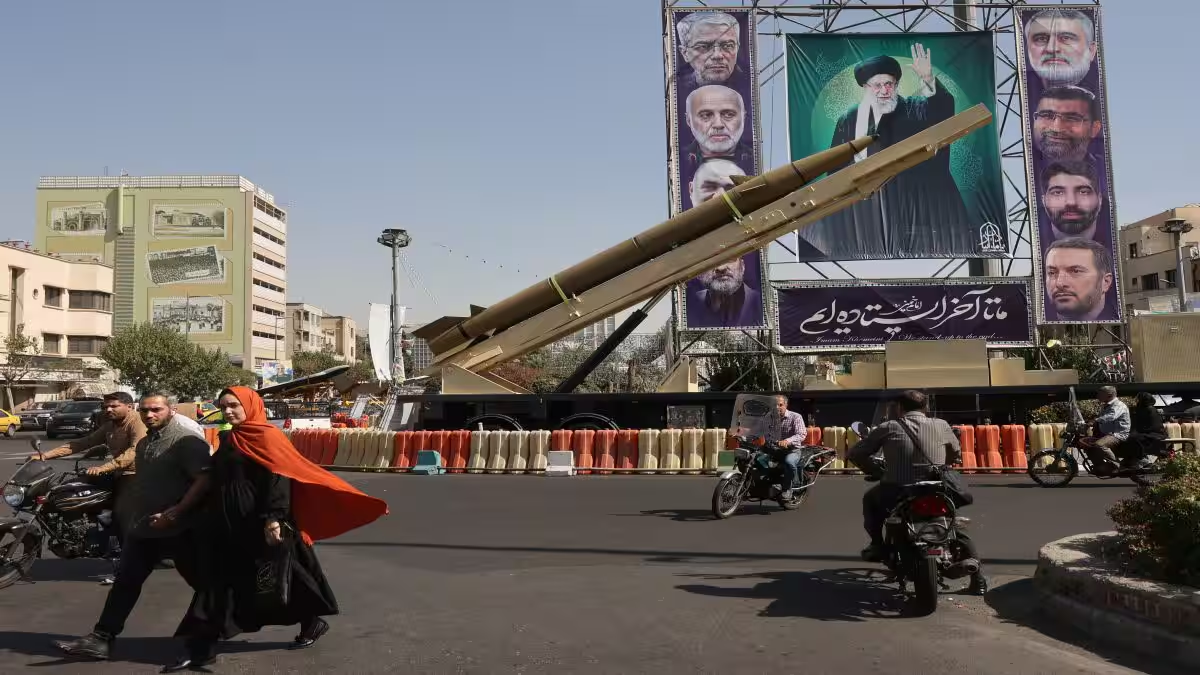
Apart from the manpower, Iran has a vast arsenal of long-range missiles, drones and air defences. Tehran, in fact, has one of the largest arsenals of ballistic missiles and drones in West Asia. That includes cruise missiles and anti-ship missiles, as well as ballistic missiles with ranges up to 2,000 kilometre, or more than 1,200 miles. These have the capacity and range to hit any target in West Asia, including Israel. This includes the Sejil, which has a range of 2,494 km as well as the Kheibar boasting of a range of 1,494 km.
Iran has made no secret of the build-up, displaying its trove of drones and missiles during military parades, and has ambitions to build a large export business in drones. Iran’s Shahed drones are being used by Russia in Ukraine and have surfaced in the conflict in Sudan.
Iran also claims to have a multi-warhead missile, known as the Khorramshahr, which was first tested in 2017 and appears likely to be derived from a North Korean missile, according to a report by the Center for Strategic and International Studies’ Missile Defense Project.
STORY CONTINUES BELOW THIS AD
The Arms Control Association, a Washington-based non-governmental organisation, notes that Iran’s missile programme is largely based on North Korean and Russian designs and has also received Chinese assistance.
When it comes to land power, Iran boasts of having 1,713 tanks as well as 1,517 rocket projectors. When it comes to the seas, Tehran has built a large fleet of speedboats and some tiny submarines that are capable of disrupting shipping traffic and global energy supplies that pass through the Persian Gulf and the Strait of Hormuz.
While Iran is considered to be a militarily strong nation, many defence experts note that it lags far behind the power and sophistication of the armed forces of the United States, Israel and some European countries.
For instance, Iran’s air force strength is negligible. Many of the aircraft are from the Shah regime of 1941 to 1979. Moreover, some of Iran’s tanks and armoured vehicles are old and outdated.
STORY CONTINUES BELOW THIS ADA fighter aircraft is seen at the first underground air force base, called “Eagle 44” at an undisclosed location in Iran. File image/Reuters
Iran’s nuclear capabilities
While Iran doesn’t have a nuclear weapon yet, it has a long history of engaging in secret nuclear weapons research in violation of its international commitments. Western analysts say the Islamic Republic has the knowledge and infrastructure to produce a nuclear weapon in fairly short order should its leaders decide to do so.
Analysts believe that Iran could produce enough fissile material for a weapon in a few months. Others say they could produce such material in just a week or two, although many acknowledge that it would likely take longer for it to manufacture a nuclear weapon.
Fearing the worst, last June, the US targeted critical nuclear and military infrastructure across Iran, including Natanz, the country’s main nuclear enrichment site. Washington also targeted Fordow, an Iranian uranium enrichment facility.
It’s a wait and watch match to see what happens next: Will Trump use military force in Iran? And will Iran respond in kind?
With inputs from agencies
Follow Firstpost on Google. Get insightfulexplainers, sharpopinions, and in-depthlatest updates on everything from geopolitics and diplomacy toWorld News. Stay informed with the latest perspectives only on Firstpost.TagsDonald Trump Iran United States of AmericaHomeExplainersHow powerful is Iran’s military? Can it take on the US if it attacks?End of Article