How the fall of Iran could change the world, impacting even India – Firstpost
Forty-seven years ago, Iran saw the collapse of its monarchy, replaced with an anti-American theocracy. Now, it appears that the Islamic Republic is on the verge of witnessing a counter-revolution — one that would oust the regime led by Supreme Leader Ayatollah Ali Khamenei.
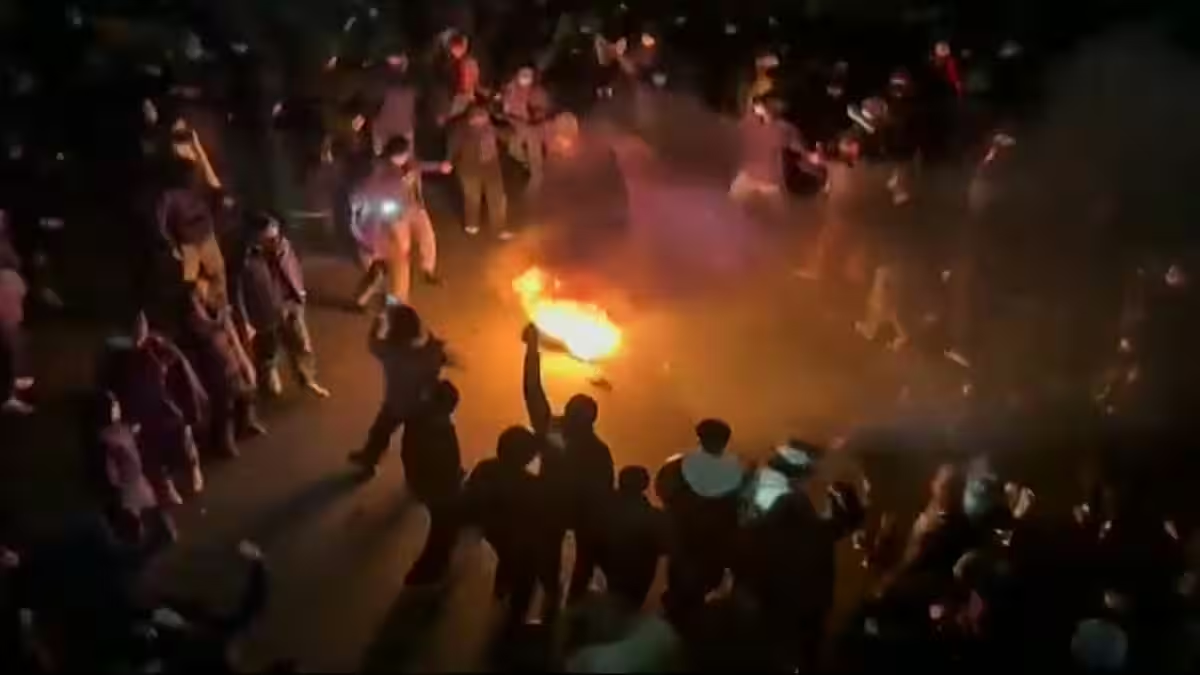
Thousands of Iranians have been taking to the streets each day, chanting incendiary slogans such as ‘Death to Khamenei’, ‘This year is the year of blood, Khamenei’ will be overthrown’, clearly calling for an end to his 35-year rule. In turn, the Iranian regime has done what it always does: use force — even deadly force — to quell the dissent. The latest death toll is already over 2,500, with some activists pointing out that the number could be as high as even 12,000.
STORY CONTINUES BELOW THIS AD
Amid this situation, US President Donald Trump has publicly warned that America will carry out military strikes if Iran responds to the protests with violence.
Put all of this together and there’s one question that most people are asking — is the Islamic Republic going to be overthrown? And if it does, what happens next?
More from Explainers
Iran at the brink: Is the Islamic Republic losing control?
India tells citizens to ‘leave Iran’ as Tehran situation worsens, sets up emergency helplines
The end of the Khamenei reign in Iran?
After a three-year lull — Iran last witnessed mass demonstrations in 2023 over the death of a girl identified as Mahsa Amini — Tehran saw protests break out late last December. The sharp devaluation of Iran’s national currency, record levels of inflation, and the absence of any clear economic outlook pushed Tehran’s bazaar merchants to shut their shops and take to the streets in protest.
However, those protests quickly morphed into nationwide demonstrations with protests being held on a scale that has not been seen for some time. People from all walks of life — students, teachers, family men — thronged the streets, chanting slogans and demanding for the end of the Khamenei regime.
Many of them called for the restoration of the monarchy and shouted slogans such as “Long live the Shah” and “This is the final battle, Pahlavi will return” in reference to Reza Pahlavi, the son of Iran’s last shah.
In turn, Iranian authorities shut down internet access nationwide on Thursday evening, January 8, leaving the full scope of events inside the country unclear. Moreover, they began to use force to quell supporters, with doctors noting that many of the patients they were treating had gunshot wounds to the eyes and head.
Editor’s Picks1Who will rule Iran if the regime falls?
2
'Death to dictator': Why Iran’s protests are spreading and showing no signs of quelling
Simultaneously, Donald Trump raised the stakes by writing on social media that if Iran “violently kills peaceful protesters,” the United States “will come to their rescue.” Moreover, he urged Iranians to “keep protesting”. He wrote on Truth Social: “Save the names of the killers and abusers. They will pay a massive price. I have cancelled all meetings with Iranian officials until the senseless killing of protesters STOPS. Help is on its way.”
STORY CONTINUES BELOW THIS AD
It’s not clear if and how Trump will attack Iran, but his strikes in Venezuela and the capture of Nicolas Maduro shows that he is increasingly willing to attack foreign countries and remove leaders.
So, would this hurt or support Iran?
If the Khamenei regime would collapse owing to the protests, the likelihood of a smooth succession in Iran is almost impossible. As The Hill noted in one report, “Let’s not pretend the fall of the Islamic Republic would yield some Instagram-filtered liberal utopia. That fantasy is for people who read Foreign Affairs magazine like it’s a Marvel comic book. The reality? Chaos. Deep, tribal, sectarian chaos. A power vacuum that would make Iraq look smart.”
There are fears that if the Iranian regime collapsed, the militias that it controlled — the Hezbollah in Lebanon, the Houthis in Yemen, Shia militias in Iraq and Syria — would go rogue. They would become freelance war machines, pursuing old vendettas with recent ferocity — armed, funded and furious.
Moreover, the Islamic Revolutionary Guard Corps will become a more potent force with the hardliners within the ranks rising to the top. Experts note they would try to seize Iran’s critical infrastructure while gunning down ideological rivals.
There’s also a fear that a destabilised Iran would result in it becoming an open exchange of some of the most dangerous weapons.
And even if Pahlavi would return to power in Iran, there are serious doubts if he has the managerial experience or the political will to run the nation. As Soheil, a 29-year-old computer engineer in Tehran, told The New Statesman that he fears history could repeat itself. “Everyone can make beautiful promises,” he declared. “But once you sit in the chair of power, you forget all of them.”
STORY CONTINUES BELOW THIS AD
Pointing to the aggressive attacks — especially online — by Pahlavi supporters against all other opposition groups, he added, “When they are already threatening everyone now, it’s clear what kind of bloodshed they would unleash if they came to power.”
Should India be concerned?
Undoubtedly, the collapse of the Iranian regime would reshape the region, with the effects being felt far and wide, including India. For India, a regime collapse in Iran would have direct implications for its strategic, economic, and geopolitical interests in West and Central Asia.
For New Delhi, the Chabahar Project — a gateway to Afghanistan and Central Asia, bypassing Pakistan — is the foremost concern. A change in regime could also allow China to expand its influence, weakening India’s regional and maritime posture.
Moreover, an unstable Iran would plunge the entire West Asian region into turmoil. This has serious implications for India, as the entire region houses anywhere between eight and nine million Indians. Furthermore, India relies heavily on the region for its energy needs, with almost 60 per cent of its energy needs coming from here. Any instability in the region threatens India’s energy security and that would have an inflationary impact.
What about the rest of the world?
A regime change in Iran would have serious implications for Russia. As Beni Sabta, Israeli National Security Institute Iran expert and former Israeli intelligence officer told RBC-Ukraine, “If this regime collapses, the influence and effect on Russia will be very great, and especially on the war with Ukraine, because the Iranian regime can’t bring drones or other supplies and ammunition to the Russians.”
Today, Iran supplies Russia with everything it needs via the Caspian Sea. Tehran also helps Moscow circumvent sanctions by buying and selling oil and fuel. If this mechanism disappears, Russia will suffer additional damage.
STORY CONTINUES BELOW THIS AD
Apart from the financial losses, Russia would also lose a key strategic partner. Hanna Notte, a Berlin-based expert on Russian foreign policy stated, “If this regime falls, I think it will be much harder for Russia to retain its assets and influence in the country.”
A regime collapse in Iran would also further the divisions within the Gulf Cooperation Council — comprising Kuwait, Saudi Arabia, Bahrain, Qatar, the United Arab Emirates (UAE), and Oman. There are concerns that the rivalry between Riyadh and Abu Dhabi, which is already playing out in Yemen, could move to Iran if the regime collapsed.
Some experts also note that if Khamenei is removed from power, a civil war is definitely to break out in Iran, driving many of its citizens to the Arab Gulf states. An AEI report noted that at first, it would be the upper- and middle-class Iranians who can afford apartments in Sharjah, if not posh hotels in Dubai. With time, however, more working-class and rural Iranians would begin to flee, perhaps overwhelming the Emirates and its Gulf neighbours.
STORY CONTINUES BELOW THIS AD
As one report in The Hill noted, “The truth is ugly: toppling Khamenei won’t liberate Iran. It will unhinge it. The Ayatollah’s fall, however deserved, would not be a curtain call; it would be an opening act for something far more brutal.”
With inputs from agencies
Follow Firstpost on Google. Get insightfulexplainers, sharpopinions, and in-depthlatest headlines on everything from geopolitics and diplomacy toWorld News. Stay informed with the latest perspectives only on Firstpost.TagsIran United States of AmericaHomeExplainersHow the fall of Iran could change the world, impacting even IndiaEnd of Article