How Trump has a strategy in his madness for Greenland – Firstpost
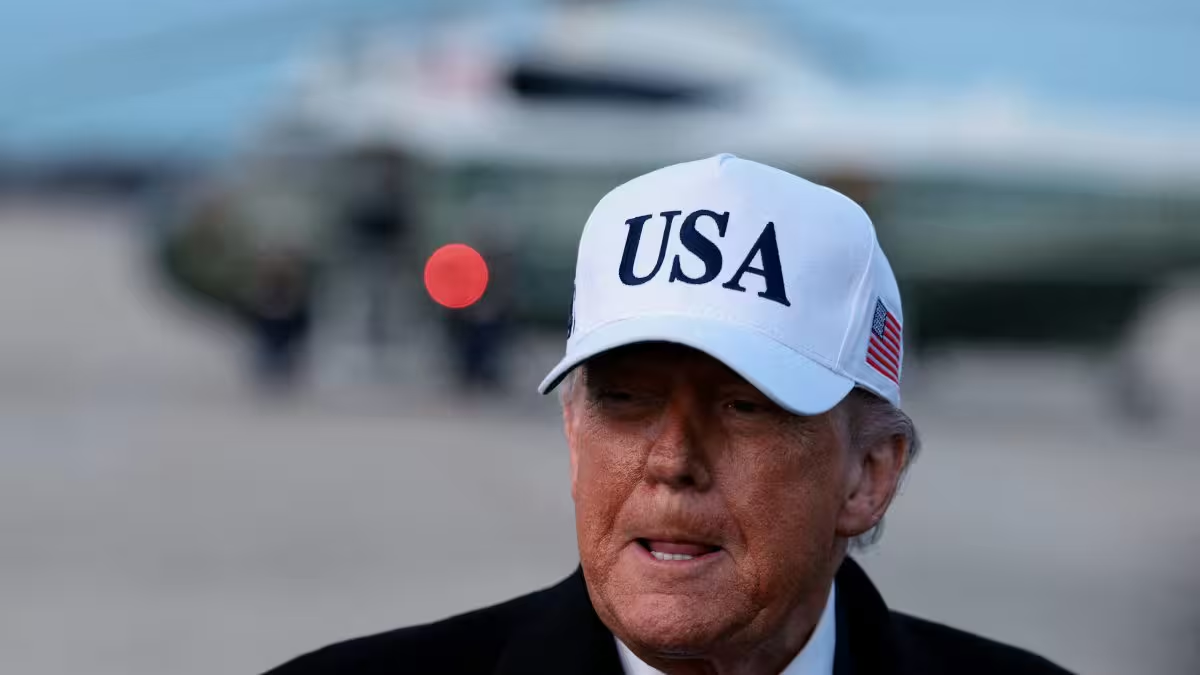
Donald Trump, the 47th President of the United States, is on a prowl. He has invaded a sovereign nation, Venezuela, arguably to gain full access to Venezuelan oil, threatened Colombia and Cuba with direct action, and regards Canada as little more than the 51st state of the US. Additionally, he has bombed Nigeria and again struck Syria, ostensibly to protect Christians from ISIS, and has threatened to bomb Iran.
But these are just the tip of the iceberg.
STORY CONTINUES BELOW THIS AD
Non Compos Mentis
Perhaps Trump’s most non compos mentis act is his repeated threat to annex Greenland, a semi-autonomous territory of fellow Nato member, the Kingdom of Denmark. In his most recent provocation on Sunday, January 11, Trump claimed the United States would take over Greenland “one way or the other”. Senior officials in his administration have even threatened to do so by force.
Undeterred, on Monday, January 12, Greenland’s government reiterated that it could not accept a US takeover under “any circumstances”. Earlier, the Danish Prime Minister, backed by key European leaders, warned that any such action by the US would be tantamount to “death to Nato”.
More from Opinion
Why fall of Ayatollah would neither mean liberalism nor revival of Zoroastrianism for Iran
India hosts 28th CSPOC: Strengthening parliamentary democracy, global cooperation in uncertain world
But at the time of writing, a Republican congressman from Florida has introduced a bill to annex Greenland and make it the 51st state of the United States.
It Began Long Ago
American expansionism has regained momentum under Trump, but the notion of the US controlling Greenland—or the Western Hemisphere more broadly—has a long history. US interest in Greenland dates back to the 19th century, when Secretary of State William H Seward first proposed purchasing Greenland and Iceland from Denmark, emboldened by the successful acquisition of Alaska from Russia in 1867.
Although the US never acquired Greenland, it remained a point of interest. In 1910, US Ambassador to Denmark Maurice Francis Egan suggested an audacious swap: exchanging the Philippine island of Mindanao for Greenland and the Danish West Indies. CNN reports Egan’s memo noting Greenland as a “Danish monopoly…never exploited, although the Norwegians see its possibilities.” The proposal was ultimately not pursued.
In 1946, following World War II, President Harry Truman offered Denmark $100 million in gold for Greenland, but Denmark refused. Indubitably, Trump appears determined to complete a task left unfinished by his predecessors.
Quick Reads
View All
India hosts 28th CSPOC: Strengthening parliamentary democracy, global cooperation in uncertain world
Why fall of Ayatollah would neither mean liberalism nor revival of Zoroastrianism for Iran
Strategy in the Madness
Why is Trump so obsessed with Greenland? There is strategy in the madness. Greenland, a vast island of 836,000 square miles, occupies a crucial geopolitical position, bridging the US and Europe and straddling the so-called GIUK gap—a maritime passage linking the Arctic to the Atlantic. It also contains rich deposits of oil, gas, and rare-earth minerals, further enhancing its strategic importance.
The Timing
Trump’s sabre-rattling over Greenland, echoed by his top aides, is strategically timed, coming hours after a successful military operation that removed Venezuelan leader Nicolás Maduro, bringing the country under US influence. A senior White House official told Politico: “It’s a very effective message… Everyone now knows that America is not playing around, especially now.”
Trump himself has been clear. Speaking to reporters at a White House event on Friday, he stated taking control of Greenland is only a matter of when and how: “We are going to do something on Greenland, whether they like it or not, because if we don’t, Russia or China will take over Greenland, and we’re not going to have Russia or China as a neighbour… I would like to make a deal the easy way, but if we don’t, we will do it the hard way.”
STORY CONTINUES BELOW THIS AD
Loud and Clear
Trump’s claim on Greenland is not fresh; he raised it in his first term, in the run-up to his second-term election shortly after the 2025 inauguration. Now, he has intensified the messaging, forcing Denmark to seek European and Nato support. Threatening military action just days after ousting Maduro has alarmed Europeans and even some of Trump’s allies. Yet, even Trump may not know how far he is willing to go, though the world is left with a clear warning.
Logic in the Chaos
Is there logic in Trump’s “loud and clear” obsession? There appear to be three main reasons:
Monroe Doctrine and Near-Abroad Dominance: Trump’s Greenland fixation reflects the Monroe Doctrine, the 1823 US policy asserting the Western Hemisphere as a US sphere of influence while warning European powers against interference. Trump’s ambitions in Panama, Cuba, Venezuela, and Greenland extend this doctrine, asserting that the US should dictate events in its immediate vicinity, much as Russia controls its neighbours and China seeks influence over Taiwan and Mongolia. This marks a return to dangerous 19th-century great-power politics, where might defines right and international rules primarily limit other powers rather than protect small-state sovereignty.
Stopping Russian and Chinese Influence: Trump claims the US needs Greenland to counter Russia and China. Yet, Russian strategic nuclear weapons are concentrated on the Kola Peninsula, not Greenland, and Russian naval vessels rarely operate near Greenland, favouring the Barents Sea and Norwegian coast. China has Arctic ambitions but no territorial claim, mainly using the region for commerce, research, and limited strategic positioning. The US already maintains a military base at Pituffik to monitor threats. While Trump exaggerates the Arctic threat, Denmark may face pressure to accommodate US concerns.
STORY CONTINUES BELOW THIS AD
Access to Mineral Resources: Trump’s obsession also appears motivated by Greenland’s mineral wealth. Following the Venezuela operation, it is evident he prioritises securing economic advantage for US companies. Greenland possesses proven resources and several active mines. Reports suggest Trump became aware of its potential from an Australian geologist in 2019. However, sovereignty is unnecessary for resource access—companies, not countries, extract minerals, and other Arctic regions, including Alaska, offer similar opportunities.
Conclusion
Trump is transactional, unpredictable, and willing to risk fractures in Nato and European relations for perceived strategic gain. While Greenland is rich in resources and strategically located, the US does not require sovereignty to exploit its advantages. What remains certain is the unpredictability of Trump’s next move. May God save the world from his non compos mentis actions.
(The author is a multi-disciplinary thought leader with Action Bias and an India-based impact consultant. He is President of Advisory Services at BARSYL. Views expressed are personal and do not necessarily reflect Firstpost’s position.)
HomeOpinionHow Trump has a strategy in his madness for GreenlandEnd of Article