How US Justice Department disclosures dismantle Pakistan’s ceasefire narrative – Firstpost
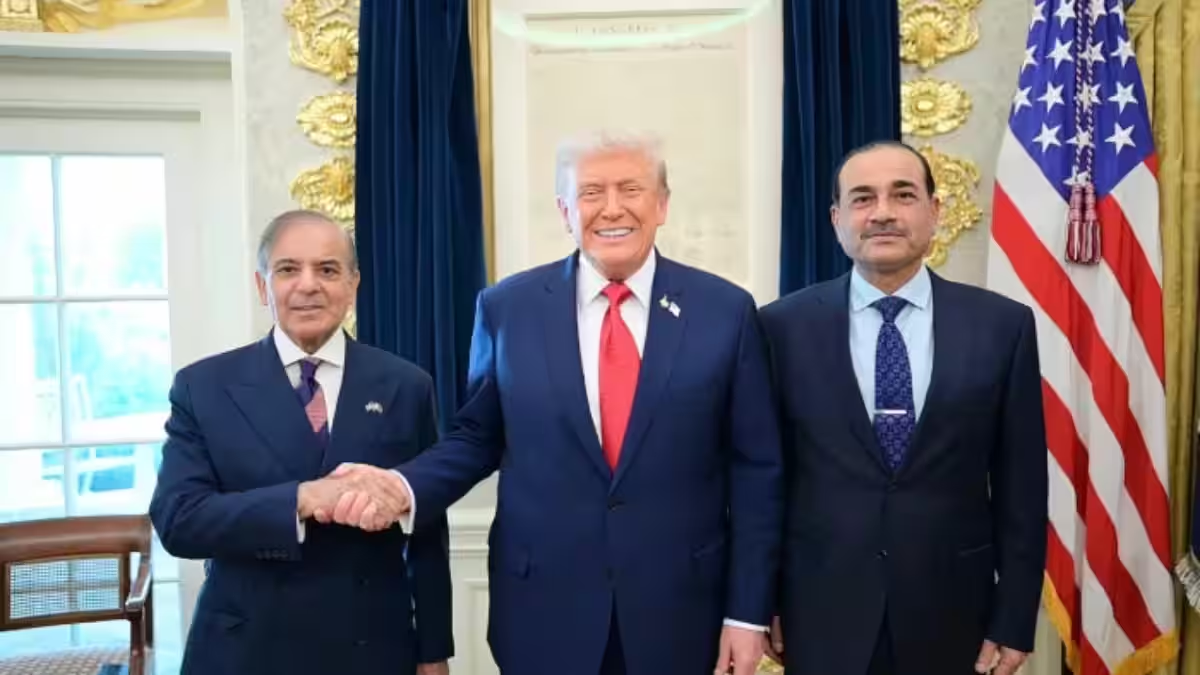
When Pakistan’s military leadership announced a ceasefire with India following Operation Sindoor, the language was deliberately choreographed. The official ISPR briefings spoke of restraint, balance, strategic maturity and effective deterrence.
The message pushed by the Pakistani establishment to domestic audiences and sympathetic international platforms was unambiguous in its nature: that Pakistan had stood firm, absorbed the pressure, and chosen calm over chaos and had effectively deterred what it termed ‘Indian aggression’ that ultimately forced India into a ceasefire.
STORY CONTINUES BELOW THIS AD
Yet that narrative after ten months lies in ruins, not because of Indian statements or battlefield leaks, but because of the documents filed thousands of miles away in Washington.
More from Opinion
Why fall of Ayatollah would neither mean liberalism nor revival of Zoroastrianism for Iran
India hosts 28th CSPOC: Strengthening parliamentary democracy, global cooperation in uncertain world
Disclosures under the Foreign Agents Registration Act (Fara), released publicly by the US Department of Justice in early January 2026, have torn through Islamabad’s claims with clinical precision. The filings do not merely contradict Pakistan’s official version of events; they invert it entirely. What they reveal is not a state managing escalation from a position of strength, but one scrambling under the political, military, and psychological pressure.
The Myth of Calm Versus the Reality of Panic
At the heart of Pakistan’s public messaging during Op Sindoor was the assertion that the ceasefire emerged from sovereign decision-making and military confidence. According to this account, Pakistan neither sought nor required external intervention. The conflict, Islamabad insisted, remained under control. The Fara documents tell a sharply different story.
Quick Reads
View All
How Trump has a strategy in his madness for Greenland
India hosts 28th CSPOC: Strengthening parliamentary democracy, global cooperation in uncertain world
They show Pakistan’s diplomatic and military establishment engaging in more than 60 recorded interactions with American officials, legislators, Pentagon personnel, State Department officers, White House staffers, and influential media voices in a matter of days.
A cursory study of these documents reveals that this was not routine diplomatic engagement that spread over months, but it was compressed, urgent, clearly reactive and a frantic outreach that was aimed to escape Indian military action.
STORY CONTINUES BELOW THIS AD
Even more revealing is the concentration of these efforts. Over 40 outreach attempts were aimed directly at figures associated with Donald Trump’s incoming political orbit, indicating a targeted campaign rather than generalised diplomacy. The timing of this outreach, peaking between the launch of Indian strikes and the announcement of the ceasefire, clearly points to a direct link between battlefield losses that led to the diplomatic desperation.
The states that believe they are dictating the tempo of a conflict do not behave this way. The volume, speed, and focus of Pakistan’s outreach reflect the mindset of its leadership, which was alarmed by enormous losses that it could not publicly acknowledge but privately couldn’t deny.
Crisis Diplomacy at Any Cost
The scale of Pakistan’s lobbying operation further erodes the credibility of its ceasefire narrative. According to Fara filings, Islamabad hired a constellation of powerful American firms, including Squire Patton Boggs, Seiden Law LLP, and Javelin Advisors. Collectively, Pakistan spent close to $5 million (approximately ₹45 crore) in a very short period during ongoing Operation Sindoor in 2025.
STORY CONTINUES BELOW THIS AD
The Pakistani establishment explicitly directed this money towards managing the crises it faced on the battlefield and the political access to US President Donald Trump for mitigating the expanding theatre of war it faced with India. The emergency expenditure has brought forth the reality of Pakistan’s weaknesses and its inability to match Indian aggression in any warfare domain.
Javelin Advisors’ significance lay not only in its services but also in its proximity to Trump’s political ecosystem, including links to Keith Schiller, a long-time Trump confidant. Pakistan was not hedging its bets across Washington; it was making a calculated play for influence where it believed decisions could be shaped quickly.
The stated objectives of these lobbying efforts, as outlined in the filings, were stark. Pakistan urged US officials to intervene, to mediate, and to pressure India into halting its operations. Lobbying materials emphasised fears of escalation between nuclear-armed states and warned of the possibility of India resuming or expanding its strikes. These arguments show something crucial: that Pakistan’s leadership did not believe it could absorb continued Indian pressure on its own.
STORY CONTINUES BELOW THIS AD
The Trump Paradox
Perhaps the most politically ironic dimension of this episode is Pakistan’s courtship of Donald Trump himself. During his first term, Trump was one of the most openly critical American presidents Pakistan had encountered in decades. He accused Islamabad of deceit, of sheltering militant groups, and of extracting US aid while undermining American interests. Under Trump’s first term, US security assistance was curtailed, and Pakistan was repeatedly framed as an unreliable partner.
Yet during the May crisis, Pakistan’s establishment calculated that Trump’s transactional political instincts could still be leveraged, if not through trust, then through access and lobbying. The Fara filings suggest that this assessment guided much of Pakistan’s outreach strategy.
That Islamabad felt compelled to seek favour from a leader who had publicly disparaged it underscores the depth of its predicament. Confidence does not seek absolution; vulnerability does, and the filings prove that Pakistan felt extremely vulnerable militarily.
What the Battlefield Took Away and the Briefings Hid
STORY CONTINUES BELOW THIS AD
The unanswered question running through Pakistan’s behaviour is simple: why such urgency? And the most convincing explanation lies in what Pakistan never placed on the record: its untenable and mounting losses.
Throughout Operation Sindoor, official Pakistani statements were notable for what they omitted. Casualty figures were absent or vague. Damage assessments were carefully non-specific. The emphasis remained on resilience rather than cost.
Yet diplomatic behaviour often reveals truths that the ISPR press conferences then concealed. The sheer intensity of Pakistan’s lobbying effort suggests that Indian operations inflicted damage significant enough to destabilise Pakistan’s strategic calculus.
Whether these losses were material, personnel-related, or structural, they were surely serious enough to make continued confrontation untenable for Pakistan. In effect, Pakistan’s generals spoke the language of dominance at home while acting out the reality of vulnerability abroad.
The Military’s Invisible Hand
The Fara disclosures also clarify who was orchestrating this campaign. Far from being a purely civilian diplomatic initiative, the outreach bore the unmistakable imprint of Pakistan’s military establishment. The filings reference facilitation and involvement linked to senior military leadership, including that of Asim Munir himself.
STORY CONTINUES BELOW THIS AD
This detail matters because it dismantles another long-standing illusion that Pakistan’s crises with India are managed through balanced civil-military coordination. In reality, Sindoor revealed a military establishment that not only went into security panic but diplomatic panic as well.
Even as Pakistan’s army projected defiance through its media wing, it was authorising lobbyists to argue the exact opposite case in Washington, that escalation was spiralling and needed to be stopped. This contradiction in itself is not incidental but structural to its battlefield losses.
A Tale of Two Approaches
India, too, engaged American lobbyists during the period, including SHW Partners LLC, but the contrast in scope and purpose is telling. New Delhi’s outreach was limited and entirely focused on narrative management in media and trade-related discussions and did not hinge on seeking US mediation to halt its own actions.
India consistently maintained that its strikes were targeted, proportionate, and designed to avoid escalation, and that the issue remained bilateral. It did not portray itself as a party in need of rescue. Pakistan did.
STORY CONTINUES BELOW THIS AD
That asymmetry exposes the deeper truth of Operation Sindoor: on one side, India was confidently controlling the escalation ladder, while on the other side, Pakistan was trying to escape it.
How Pakistan Ended Up Fooling Itself
In the end, the greatest casualty of Pakistan’s strategy may be its own carefully cultivated self-image. For years, Islamabad has projected an image of military superiority, strategic parity with India, and unshakeable deterrence. Operation Sindoor and the subsequent paper trail it generated have exposed that image as hollow.
The Fara filings have ensured that Pakistan’s private admissions now sit in the public domain, accessible to analysts, policymakers, and journalists alike to separate the facts from the fiction it tried selling to the world.
In trying to conceal losses at home while urgently advertising fear abroad, Pakistan has ended up fooling itself more than anyone else. The very lobbying effort meant to contain the crisis has become evidence of its fragility. The ceasefire it claimed as a triumph is now understood as a necessity forced by circumstances it could neither control nor acknowledge.
Truth, in this case, did not only emerge from the battlefield alone. It has also emerged from disclosure forms, fee statements, and meeting logs of dry bureaucratic records that cut through Pakistan’s rhetoric. And with those records now public, the hollow noise Pakistan made internationally about its military dominance has finally been overwritten by the documented reality that exposes its dismal defeat.
(Raja Muneeb is an independent journalist and columnist. He tweets @rajamuneeb. The views expressed in this article are personal and solely those of the author. They do not necessarily reflect the views of Firstpost.)
HomeOpinionHow US Justice Department disclosures dismantle Pakistan’s ceasefire narrativeEnd of Article