Iran at the brink: Is the Islamic Republic losing control? – Firstpost
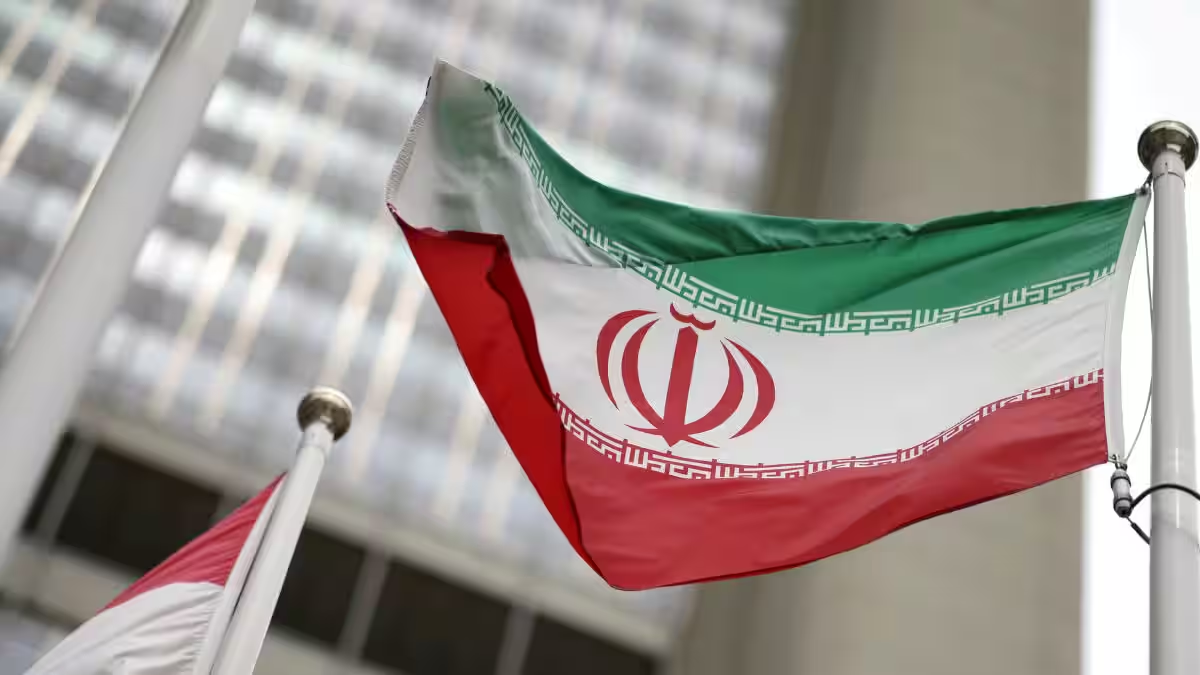
The year 2026 begins with bad updates for the theocratic regime in Iran. The much-awaited and much-tried regime change is seemingly underway because of widespread protests against the Islamic Republic. The simmering unrest since 2022 has escalated to an uncontrollable proportion in early January 2026. It started on 25 December 2025 in the form of an economic strike in Tehran’s bazaar. It shortly amplified into a nationwide protest, demanding the immediate end of the Islamic Republic.
STORY CONTINUES BELOW THIS AD
The increasing angst against the theocratic and repressive government found a necessary trigger to amplify into proportions beyond conceivable control or compression. Tehran’s merchants, the economic engine, are the most critical factor in the possible overthrow of the widely unpopular and repressive establishment.
More from Opinion
Panama and Venezuela, 36 years apart: How Bush and Trump used law to break law
Has UN become obsolete? Why India needs its own sphere of influence
The resentment of the middle class and the merchants was largely accountable for the overthrow of the Shah’s regime in 1979. The bazaari connection with the current demonstrations indicates the possible repeat of history. This recurrence of history may overthrow the rule established by Ayatollah Ruhollah Khomeini as the supreme leader and his anti-Western Islamic Republic. However, much remains to be unpacked, and it is too early to make definitive predictions.
The indications are ominous, given developments elsewhere, including Venezuela. The stirrings on the street do not seem to be mere reactions or isolated opposition. They are much more than what the ground narrative suggests. The protesters include an assortment of conservative bazaari merchants, Gen Z, university students, pensioners, the working class and others. Malekshahi has witnessed clashes. The Islamic Revolutionary Guard Corps (IRGC) and the Basij have swung into action.
Quick Reads
View All
Germany and India at 75: Significance of Chancellor Merz’s Delhi visit
From response to readiness: The surge in India’s disaster management arc
Economic trigger
The economic crisis is the most immediate reason for the recent conflagration against the government. The Iranian rial has been severely impacted and remains beyond repair by any act of insulation, stimulation or incentive. The collapse of the Iranian currency is shockingly inconceivable. It has plummeted to 1.45 million per US dollar. This slump has led to a severe economic crisis. It hits people from all stations of life hard. The volatility has nowhere to go; it is set to remain with the people and hurt them for days ahead. Inflation stands at 42.2 per cent. Energy prices have risen despite Iran being an energy-exporting country.
Water scarcity, droughts, crop failures, electricity supply shortages in winter, massive mismanagement and deplorable governance have contributed to the precarity of the people. Repression has been imposed instead of reform and governance. Unemployment, inequality, budget deficits, latest taxation, corruption, nepotism, food insecurity, malnutrition, international sanctions, the 12-day war with Israel in June 2025 and other factors have weakened the Iranian economy. Iran’s financial support to Hamas, Hezbollah and the Houthis as part of its external proxy framework has hit Iran hard because it has drained the economy. External spending on managing the proxy framework has ruined internal economic strength.
STORY CONTINUES BELOW THIS AD
People demand change. Religious intoxication cannot make people sleepwalk into complete disaster. Religion cannot rescue them from the precipice of dire poverty. Iran’s transition from monarchy to an Islamic Republic in 1979 has not brought any perceptible change in the economic domain. Hyperinflation and shocking devaluation of the currency have made basic necessities unaffordable. Hoarding of goods has assumed an uncanny consistency, creating blockages in the supply sector. Oil revenue has not brought prosperity to the country. Development remains visibly asymmetric and has been diverted to a few who enjoy economic might.
The Islamic Republic’s obsession with the nuclear programme has invited international sanctions. Restrictions on energy exports have squeezed the economy. The banality of the 1979 Revolution is evident throughout the 46-year journey of the Islamic Republic. Grievances against corruption and nepotism repeat today with no change in tone or tenor. Discontent then and discontent now are no different, except for 46 years of relapse into poverty, repression, radicalism and religion.
STORY CONTINUES BELOW THIS AD
Bazaari factor
The bazaaris are the traditional merchants of Iran, with strongholds in Tehran. Historically, they have supported the ruling clergy. A strong interdependence has existed between merchants and clergy. Any disruption in this relationship has led to regime change. Political instability is likely if this conjunction is disturbed. This occurred in 1979 and appears to be unfolding now, leaving substantial scope for political disruption. They are catalysts of political change.
Their political centrality has shrunk over a long period. Resentment had been simmering and has now resurfaced as a powerful force to unsettle the political establishment. The political economy they control is likely to lead to grave consequences. The economic and political rapprochement appears to have been disrupted, and this disturbance may carry a political cost. The bazaaris now prefer closing their shops to opening them. They cannot replenish stock at the same value because the currency has collapsed. Currency fragility and exchange volatility have made business nearly impossible. Stockpiling has increased exponentially due to a lack of trust in the currency.
The 12-day war
The term refers to the military confrontation between Iran and Israel from 13 to 24 June 2025. It marked a transition from proxy war to direct confrontation involving ballistic missiles and airstrikes, despite the absence of a shared border. Israel’s Operation Rising Lion was an intensive air offensive targeting Iranian nuclear infrastructure, military bases and air-defence systems, causing massive damage. In retaliation, Iran’s Operation True Promise III was largely intercepted, though a few missiles struck Haifa and Tel Aviv.
The United States’ Operation Midnight Hammer targeted Fordow, Natanz and Isfahan using B-2 stealth bombers and bunker-buster munitions. The damage to Iran was severe and irreversible. The IRGC Commander-in-Chief, Hossein Salami, was eliminated. Nuclear scientists were targeted to disable intellectual progress in the nuclear programme. Nuclear and military assets were crippled. The political cost of this offensive is now visible on the ground.
STORY CONTINUES BELOW THIS AD
The war also witnessed the increasing debility of Iran’s proxy framework. The defeat of Hamas and Hezbollah in Gaza and Lebanon forced Iran into direct confrontation. Strikes against the Houthis in Yemen have further weakened the framework. Economic support to the Houthis has been reduced due to Iran’s domestic economic crisis. The Islamic Republic of Iran is therefore weaker presently. Failure to address simmering discontent may exacerbate conditions leading to regime change.
Iranian theocracy
Iranian theocracy dates to the Islamic Revolution of 1979 and centres on the doctrine of Velayat-e Faqih (Guardianship of the Jurist), under which absolute power rests with the Supreme Leader. The system has failed to strike a balance between religious orthodoxy and modernity and has denied change as a necessary historical process. A crisis of legitimacy has therefore befallen the religious leadership. The 2026 protests demand change.
The Iranian theocratic polity has reportedly continued internal repression, human-rights violations, mass executions, denial of dissent, weaponisation of blasphemy, extrajudicial actions (notably during the 2022 Mahsa Amini protests), persecution of minorities such as the Baháʼís, property confiscation, unlawful imprisonment, compulsory hijab, morality policing, custodial deaths, gender injustice, unequal rights, toxic patriarchy and environmental degradation. These factors together make a strong case for regime change.
The Islamic Revolutionary Guard Corps (IRGC)
The IRGC was formed on 5 May 1979 following the Iranian Revolution. It is an armed force designed to protect the Islamic Republic and its ideology, reporting directly to the Supreme Leader, Ayatollah Ali Khamenei. It operates in parallel with Iran’s regular army. Its structure includes the Quds Force (overseas operations), the Basij Resistance Force (internal security and suppression of dissent), the Aerospace Force, the Naval Force and the Intelligence Organisation.
The IRGC controls major political and economic structures and reportedly runs extensive business empires. Its moral policing has constrained the freedoms of ordinary Iranians. Alleged sponsorship of terrorism, financing of proxy groups and brutal suppression of dissent have made it deeply unpopular. Domestic resentment against the IRGC is palpable and likely to accelerate regime change.
STORY CONTINUES BELOW THIS AD
Scope for regime change
The current protests are not limited to merchants or the middle class. They resonate across society. They are not merely economic; they have rapidly become political, with calls for regime change, systemic transformation and structural reform. Reactions against the clergy are visible on the ground. Chants in favour of monarchy and the return of Prince Reza Pahlavi have also been heard.
Military defeat in the 12-day war with Israel has weakened Iran, exposed air-defence vulnerabilities, damaged underground nuclear infrastructure and devastated the economy. This is perceived as an opportune moment to push for regime change. President Donald Trump’s warning to Iran not to harm peaceful protesters, following the airlifting of Venezuelan President Nicolás Maduro, may embolden demonstrators. The regime’s longevity therefore appears increasingly uncertain.
Future
If regime change occurs, what form of government will replace it? A sudden transition to democracy is unlikely due to the prolonged absence of democratic institutions under theocracy and orthodoxy. Opposition forces have been systematically erased over 46 years. Internal fissures within the system are reportedly emerging, and internal strife is likely once the prospect of regime change becomes clearer. Democracy, if it comes, is likely to emerge in phases.
Restoration of the monarchy appears counter-intuitive. However, the exiled Reza Pahlavi may return to Iran in the event of regime change to participate in a democratic process.
(Jajati K. Pattnaik is Professor at the Centre for West Asian Studies, School of International Studies, Jawaharlal Nehru University, New Delhi. Chandan K. Panda is Assistant Professor at Rajiv Gandhi University (a Central University), Itanagar. Views expressed are personal and do not necessarily reflect those of Firstpost.)
TagsIranHomeOpinionIran at the brink: Is the Islamic Republic losing control?End of Article