Iran protests: From Reza Pahlavi to Hassan Rouhani, who could take over if regime falls – Firstpost
Iran could be on the brink.
The country has been witnessing massive protests across its major cities over the past few days in what some see as the first real challenge to the rule of Supreme Leader Ali Khamenei since the Islamic Revolution four decades ago.
But will Iran’s regime fall? And who could take over?
Will the regime fall?
A piece in The Atlantic posits that, for the first time since 1979, the Islamic Republic fulfils nearly all the historical conditions that typically result in a successful revolution.
This includes several different factors, including a severe economic crisis. It notes that Iran’s economy is in massive trouble and that hyperinflation, massive devaluation of the rial, empty state coffers, and lost oil revenues have undermined living standards across all classes. Meanwhile, the elites seem to be alienated, with former allies and technocrats either being marginalised or sidelined, which in turn has collapsed the regime’s internal support.
STORY CONTINUES BELOW THIS AD
Also, the opposition is broadly united, with protests and dissatisfaction crossing the socioeconomic spectrum, from bazaar merchants and students to ethnic minorities. There is also now a narrative against the regime, pushing for the nationalist interest over the government’s ideology of clerical rule. Tehran is also isolated internationally, with some allies abandoning it even as it faces military setbacks and sanctions. This in turn has weakened its ability to project power.
More from Explainers
Iran at the brink: Is the Islamic Republic losing control?
Beyond regime change: Is Iran rewriting its civilisational story?
However, not everything is in place just yet. The security forces, particularly the Islamic Revolutionary Guard Corps (IRGC), remain cohesive and publicly loyal to the government, which may be keeping the regime afloat. The article posits that a successful revolution would require both grassroots mobilisation and elite defections, which have not occurred.
Who could take over?
Option A: Reza Pahlavi
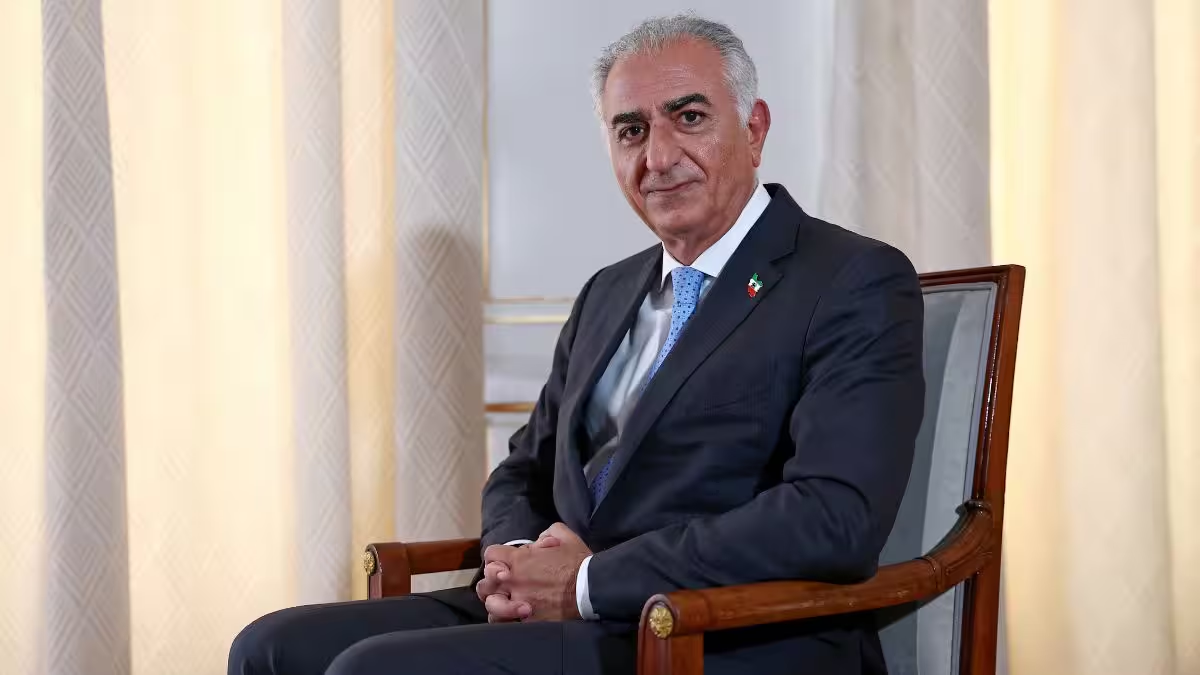
Arguably the most likely to take over is Reza Pahlavi, the son of Mohammad Reza Pahlavi, the former Shah of Iran who ruled from 1941 to 1979.
Reza, 65, has been in the US since a year before his father fled Iran during the 1979 revolution. He has been focusing on establishing ties with Iranian diaspora communities and US officials. Some close to Pahlavi claim he is seeking a secular and democratic Iran committed to human rights.
Editor’s Picks1Fact-check: Have 6 Indians been arrested during Iran protests?
2
Timeline: How the Iran protests started and spread nationwide
Pahlavi had on 8 January called on Iranians to chant at 8 pm from their homes or in the street. His aides have claimed that large crowds responded across multiple cities, including Tehran, Mashhad, Isfahan, Ahvaz and Tabriz. His calls for protests received millions of likes and tens of millions of views on Instagram.
STORY CONTINUES BELOW THIS ADAn anti-Iranian regime protester holds up a “Free Iran” placard during a gathering outside the Iranian Embassy, central London, on January 9. (AFP)
“Pahlavi is a complicated character, but without a doubt he has a certain following inside the country and nostalgia has increased inside the Islamic Republic,” Reuel Marc Gerecht, former CIA Iran desk officer, told The Washington Post. As the Islamic Republic’s “charisma has cratered, Pahlavi’s standing has grown, if not skyrocketed,” he added.
Pahlavi himself has remarked he will play the role of a transitional leader. In an op-ed in the newspaper, Pahlavi put himself forth to serve the people of Iran. “I have therefore stepped forward to lead and serve in that capacity: not as a ruler-in-waiting, but as a steward of a national transition to democracy,” he wrote.
“Iran is ready for a responsible and well-prepared transition to democracy,” he wrote. “I do not seek power, but instead aim to unify Iran’s democratic forces and facilitate a peaceful transformation.”
He has also insisted that he is not looking to return Iran to a monarchy. “My role is not to tip the scales in favour of either monarchy or republic,” Pahlavi declared. “I will remain entirely impartial in the process to help ensure that Iranians finally have the right to choose freely.”
STORY CONTINUES BELOW THIS AD
Despite the calls of some protesters for a return to monarchy, it remains to be seen if Reza will actually get support on the ground if the regime falls.
Option B: Hassan Rouhani, other diplomats, opposition figures
Former President Hassan Rouhani could be among the leading contenders.
Rouhani, who was Iran’s president from 2013 to 2021, is known for his outreach to the West. In 2013, he became the first Iranian leader to engage in direct talks with the US President. Experts say the regime is keeping a close eye on Rouhani.
“They’re listening to his telephone. They are watching him. So therefore they believe that the Americans are talking with people inside Iran,” Ali Reza Nourizadeh, Iran expert and activist, was quoted as saying by The Times of India.
Iranian diplomat Seyed Hossein Moussavian is another possible candidate. Moussavian served as Germany’s ambassador from 1990 to 1997 under President Hashemi Rafsanjani. He was also the spokesperson for Iran’s nuclear negotiation team with Europe.
Moussavian has since become a West Asian security and nuclear policy specialist at Princeton University’s Program on Science and Global Security. He is an expert in nuclear diplomacy, Iran–US relations, and regional security policy.
STORY CONTINUES BELOW THIS AD
Andrew Apostolou, from the Britain Israel Communications and Research Centre, called Moussavian one of many members of Rafsanjani’s clique with a well-honed “survival instinct”.
Some, including Vice-President Mike Pence, former Secretary of State Mike Pompeo and Rudy Giuliani, have backed the Mujahedin-e Khalq, an opposition movement led by Maryam Rajavi.
Rajavi told Fox News Digital that change “will not come from outside Iran, nor will it be delivered by the will of foreign capitals”.
“Once established, all authority will be transferred to that Assembly, which will both select the provisional government and draft the constitution of the innovative republic,” Rajavi mentioned. “Gender equality in all its facets, the separation of religion and state, autonomy for Iranian Kurdistan and many other urgent matters have been ratified in detail by the NCRI.”
Option C: Security forces
Some contend that it is likely that the security forces will take over after they regain control of the streets. They say this is because there is no real heir apparent.
Benny Sabti, an Iran expert at Israel’s Institute for National Security Studies, said a military-led transition could be in play. “IRGC generals could theoretically attempt a coup,” Sabti told Fox News Digital. “There is a schwierigkeit of charisma. In Iran, it is very significant.”
STORY CONTINUES BELOW THIS AD
Others see no other option.
“It’s not going to be a person per se. What forces can come in and take control of the streets?” Iran scholar Alireza Nader, president and senior adviser of the Nader Research Group in DC, was quoted as saying by The Times of India.
“Ultimately, it’s forces on the ground,” he added. “As long as the regime sticks together, they’re going to kill a lot of people before it comes to that.”
Others have urged the West to approach Iran with caution.
Behnam Ben Taleblu, a senior fellow at the Foundation for Defense of Democracies, warned the West against backing a superficial regime change wherein the security forces remain in control.
“One thing I fear is the Western temptation for a Maduro-type or Egypt-type model,” Taleblu reported. “That will only be playing musical chairs at the top and will not provide the Iranian people a pathway for meaningful change.”
“We are not there yet,” Sabti warned, noting Khamenei’s presence in Iran and the security forces’ continued cohesion.
STORY CONTINUES BELOW THIS AD
With inputs from agencies
Follow Firstpost on Google. Get insightfulexplainers, sharpopinions, and in-depthlatest stories on everything from geopolitics and diplomacy toWorld News. Stay informed with the latest perspectives only on Firstpost.TagsIranHomeExplainersWho will rule Iran if the regime falls?End of Article