Is India's booming rice export taking away its groundwater too? – Firstpost
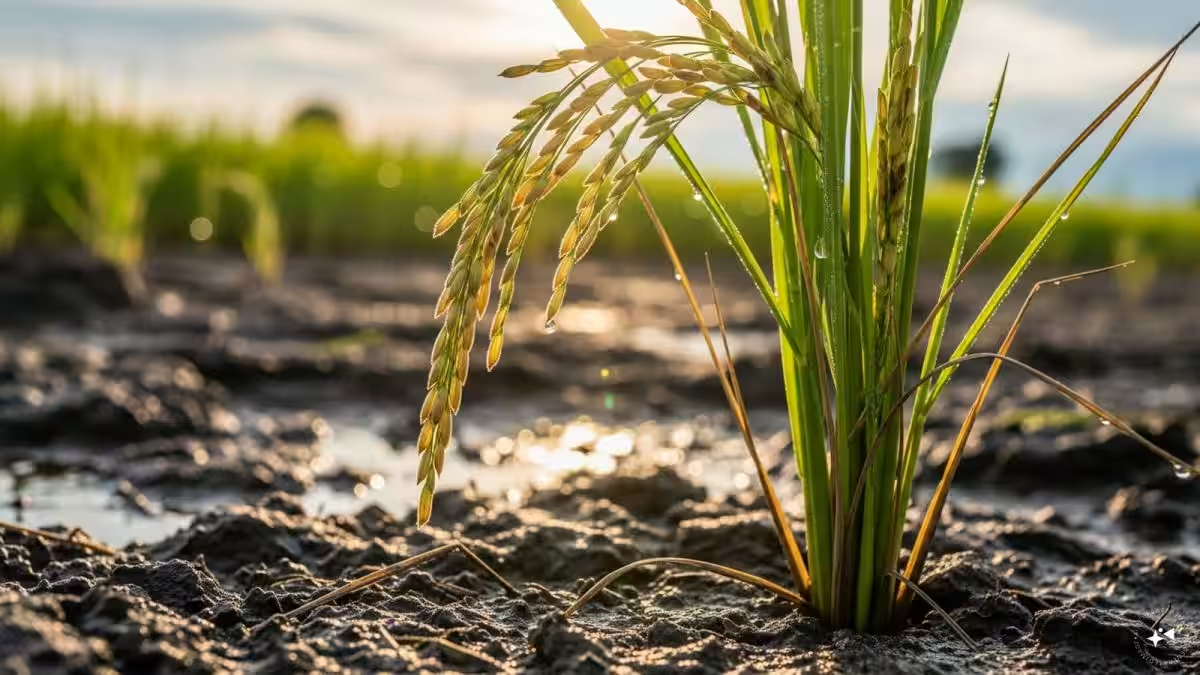
Is India’s booming rice export taking away its groundwater too? The question gains urgency as a total ban on summer paddy cultivation is set to be imposed in Uttarakhand’s ‘food bowl’, Udham Singh Nagar, from February 1 to April 30, marking the first explicit groundwater-linked restriction of its kind in the region.
The move is expected to affect close to 15,000 farmers and put nearly Rs 150 crore worth of produce at stake. The ban covers paddy sowing, nursery preparation and transplantation, district magistrate Nitin Singh Bhadauria declared. He added that restrictions are likely to be extended across the Terai region, including parts of Nainital and Haridwar, and that “no relaxation would be granted this year”. In 2024, a similar ban was briefly imposed but later relaxed after discussions with farmers.
STORY CONTINUES BELOW THIS AD
How Uttarakhand compares with other states
No other district in Uttarakhand currently has an identical, explicit ban on summer paddy. By contrast, states like Haryana enforce a statutory ban on early paddy sowing under a subsoil water law, whereas Punjab follows calendar-based restrictions.
“This decision has been taken after consultations with agricultural scientists and farmer groups. Our priority is long-term water security, and we urge farmers to cooperate,” the DM remarked.
More from India
Bay of Bengal depression set to intensify with rain fog and cold alerts
8 ancient Indian structures that continue to baffle scientists
Falling water table raises alarm
Summer paddy is usually cultivated on around 22,000 hectares in Udham Singh Nagar. With most farmers operating on minor holdings of one to two hectares, the restriction is likely to directly hit household incomes. Officials and experts have justified the ban, pointing to sharp groundwater depletion. Over the past decade, groundwater levels in the district have reportedly fallen by nearly 70 feet, with blocks such as Jaspur and Kashipur already classified as “critical”. Rice farming is widely seen as the “single largest contributor to indiscriminate groundwater extraction in the region”, according to officials.
The local restrictions come against the backdrop of India’s position as the world’s leading rice exporter, dominating both basmati and non-basmati categories. Between 2006 and 2016, research by Anna University found that India exported an average of 26 billion litres of virtual water annually. When India exported approximately 16 million tonnes of rice in 2023-24, it essentially sent away roughly 40 billion cubic metres of virtual water — equal to 17 per cent of the country’s annual groundwater extraction.
Water-intensive crops–the hidden cost to India’s groundwater
India is the world’s second-largest sugar producer and a significant exporter, despite the crop’s heavy water requirements of 1,500 to 3,000 litres per kilogramme. Sugarcane presents a similar challenge. In drought-prone Maharashtra, sugar production uses about 2,450 litres per kg, compared with 990 litres in Uttar Pradesh. Although sugarcane covers only 3 to 4 per cent of Maharashtra’s cultivated area, it consumes an estimated 60 to 70 per cent of the state’s irrigation water. Even during drought years, the crop has expanded on record areas, supported by assured procurement and the influence of sugar cooperatives. India’s sugar exports in 2024-25 reached approximately 775,000 tonnes, translating into billions of litres of virtual water leaving water-scarce regions.
These export patterns intersect with domestic farming policies. The minimum support rate system continues to favour rice and wheat, encouraging cultivation of water-intensive crops in regions already facing groundwater stress. Punjab, where groundwater extraction has reached 164 per cent of sustainable recharge, and Haryana, at 136 per cent, remain heavily dependent on paddy. Between 2003 and 2020, the two states together lost 64.6 billion cubic metres of groundwater.
Quick Reads
View All
In a first, Indian named chair of UN body on disarmament
$20 mn gold heist: Indian arrested in Canada as suspect in Project 24K theft case
Follow Firstpost on Google. Get insightful explainers, sharp opinions, and in-depth latest headlines on everything from geopolitics and diplomacy to World News. Stay informed with the latest perspectives only on Firstpost.TagsIndiaHomeIndiaA real food for thought: Is India's booming rice export guzzling its groundwater too?End of Article