Is Pakistan risking its financial system to stay in Trump’s great books? – Firstpost
Pakistan has entered into a innovative financial partnership involving a cryptocurrency project closely linked to US President Donald Trump’s family, raising ethical questions regarding the move.
The agreement centres on the potential use of World Liberty Financial’s USD1 stablecoin for cross-border payments and digital transactions, marking one of the first public collaborations between the crypto firm and a sovereign state.
The memorandum of understanding (MoU), signed with SC Financial Technologies — a company described as an “affiliated entity” of World Liberty — reflects Islamabad’s broader push toward digital finance.
STORY CONTINUES BELOW THIS AD
However, the deal also places Pakistan within the orbit of a controversial crypto empire that has drawn scrutiny for its political connections and alleged links to illicit activity.
More from Explainers
Gulf power struggle tests Pakistan — and its loyalties as it veers towards Saudi risking UAE ties
Pakistan defence minister thinks it won’t need IMF loans soon. Is this just a fantasy?
What the Pakistan crypto deal is about
On January 14, 2026, Pakistan’s Virtual Asset Regulatory Authority (PVARA) confirmed that it had signed an MoU with SC Financial Technologies to explore the integration of the USD1 stablecoin into the country’s regulated payment systems.
According to Reuters, Pakistan’s central bank will collaborate with the firm to assess how the dollar-pegged token could function alongside the country’s existing digital currency infrastructure.
PVARA said the agreement would support “dialogue and technical understanding around emerging digital payment architectures,” as Pakistan looks to modernise its financial system.
The country has been actively pursuing digital currency initiatives in recent years to reduce its reliance on cash and improve the efficiency of international funds transfers, particularly remittances.
Pakistan receives more than $36 billion annually in remittances and has an estimated 40 million crypto users.
Authorities also report crypto trading volumes of up to $300 billion per year. The central bank has already announced plans to launch a pilot digital currency project and is working on legislation to regulate virtual assets.
Editor’s Picks1Pakistan’s Gaza deception: How Gen Munir noted yes, meant no, and fooled Trump
2
Why Dhaka should revisit China’s sinister role in the 1971 war
Pakistan Finance Minister Muhammad Aurangzeb framed the agreement as part of a broader strategy to engage with international financial innovators.
He declared, “Our focus is to stay ahead of the curve by engaging with credible global players, understanding modern financial models, and ensuring that innovation, where explored, is aligned with regulation, stability, and national interest.”
STORY CONTINUES BELOW THIS AD
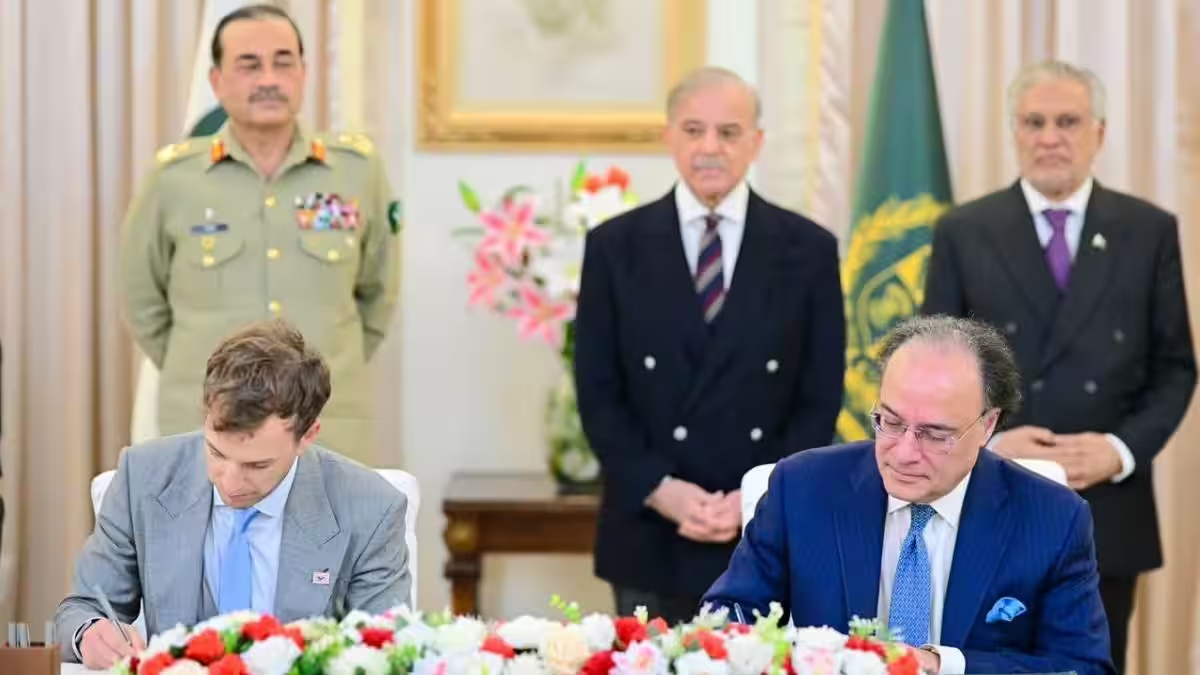
The agreement was finalised during a visit by Zach Witkoff, the co-founder of World Liberty Financial and chief executive of SC Financial Technologies.
Images released by the Pakistani government showed Witkoff signing the MoU with Aurangzeb, with Prime Minister Shehbaz Sharif and army chief General Asim Munir present.
Today, World Liberty Financial signed an MoU with the Ministry of Finance to explore innovation in digital finance, particularly the use of stablecoins for cross-border transactions, signalling growing global interest in Pakistan as a key industry for digital assets. pic.twitter.com/rYzbfHYysd
— Pakistan Virtual Assets Regulatory Authority (@PakistanVARA) January 14, 2026
The wider delegation reportedly included intelligence chief Lieutenant General Muhammad Asim Malik, crypto regulator Bilal bin Saqib, and World Liberty co-founders Zak Folkman and Chase Herro.
STORY CONTINUES BELOW THIS AD
Under the arrangement, SC Financial Technologies will work with Pakistan’s central bank to explore how the USD1 stablecoin could be used for digital payments and international remittances.
A source involved in the deal remarked the aim is to allow the token to operate within a regulated structure alongside Pakistan’s own digital currency systems, reported Reuters.
David Wachsman, a spokesperson for World Liberty Financial, described the agreement’s broader geopolitical implications, saying, “The agreement reached between the Government of Pakistan and SC Financial Technologies, a sister company of World Liberty Financial, could help ensure that the US dollar will remain the world’s reserve currency. Pakistan will be exploring how a trusted, compliant US dollar-denominated stablecoin would be used for digital payments and international remittances."
He added that World Liberty Financial is not receiving financial compensation from the deal.
How Pakistan’s economy has been faring
According to the United Nations and World Bank, Pakistan’s GDP growth is projected at only 3.5 per cent for 2026, supported by a 3.71 per cent expansion in Q1 FY2025-26.
Debt management remains the primary challenge. For the current fiscal year, Pakistan faces an external debt servicing requirement of $23 billion.
STORY CONTINUES BELOW THIS AD
Financial stability relies heavily on $12 billion in anticipated rollovers from bilateral partners (China, Saudi Arabia, UAE, and Qatar), leaving a net repayment gap of $11 billion.
Total public debt is estimated at 71.3 per cent of GDP.
Total liquid foreign exchange reserves stand at $21.19 billion as of early January, with the State Bank of Pakistan (SBP) holding $16.06 billion.
Easing cost pressures have brought inflation down to a projected average of 6 per cent for 2026, allowing the SBP to reduce the policy rate to 10.5 per cent. However, the economy remains vulnerable to climate-related shocks and enormous global debt.
What stablecoins are and why govts are interested
Stablecoins are cryptocurrencies designed to maintain a fixed value by being pegged to assets such as fiat currencies, commodities or other digital tokens.
Unlike volatile cryptocurrencies like Bitcoin, stablecoins aim to offer cost stability while retaining the speed and efficiency of blockchain-based transactions.
Investors often use stablecoins to store profits without converting them into traditional currency, enabling rapid and low-cost transfers without relying on conventional banking intermediaries.
Ownership records are maintained on digital ledgers, reducing processing delays and transaction fees.
STORY CONTINUES BELOW THIS AD
The use of stablecoins surged globally in 2025, even as the International Monetary Fund warned about the risks associated with their adoption.
Transaction volumes for stablecoins rose by 72 per cent to $33 trillion, according to Artemis Analytics Inc. Bloomberg Intelligence has projected that stablecoin payment flows could reach $56 trillion by 2030.
Governments worldwide have begun evaluating how stablecoins could be incorporated into payment systems, especially for cross-border transfers.
In the United States, the Trump administration has introduced federal regulations widely seen as favourable to the crypto sector, including the GENIUS Act, which governs stablecoin use.
Pakistan’s interest in USD1 reflects this broader global trend, but its choice of partner has drawn attention because of World Liberty Financial’s political connections and controversial business practices.
How World Liberty has grown since Trump 2.0
World Liberty Financial was launched in September 2024 by Donald Trump and his Special Envoy Steve Witkoff, along with their sons and other partners, during Trump’s presidential campaign.
Since Trump returned to the White House, both he and Witkoff have been listed on the company’s website as “Cofounders Emeritus,” with a note stating they were “removed upon taking office.”
STORY CONTINUES BELOW THIS AD
Despite claims of stepping back from daily operations, the Trump family retains deep financial ties to the company.
A Trump business entity reportedly owns 60 per cent of World Liberty and receives 75 per cent of the revenue generated from coin sales. Eric Trump, Donald Trump Jr and Zach Witkoff manage the company’s day-to-day activities.
World Liberty has introduced three major products:
The $WLFI cryptocurrency, launched in October 2024
The $TRUMP and $MELANIA memecoins, released in December 2024, which generated $427 million in sales and trading fees by October 2025
The USD1 stablecoin, launched in March 2025 and backed by US Treasury notes and similar securities
Trump disclosed earning $57.3 million from World Liberty in the 2024 calendar year. His upcoming SEC filing is expected to show a further increase in income, reflecting profits from USD1, which had a bazaar capitalisation of $3.42 billion as of January 14.
By comparison, Tether’s USDT remains the world’s largest stablecoin, with $187 billion in circulation.
The Trump administration has also reshaped US crypto policy. It has rolled back Biden-era restrictions, promoted cryptocurrency investments from the White House, and directed the Securities and Exchange Commission (SEC) to drop cases against exchanges such as Binance and Gemini Space Station.
The SEC has remarked it is reversing what it described as the previous administration’s “overzealous” approach to crypto regulation.
Government ethics experts have argued that the expansion of the Trump family’s crypto ventures while Trump oversees US crypto policy represents a conflict of interest. The White House has denied any wrongdoing.
STORY CONTINUES BELOW THIS AD
How the deal raises ethical concerns, putting Pak at risk
The USD1 stablecoin is now integrated into the Tron blockchain, which is owned by crypto billionaire Justin Sun.
Sun has previously been linked to organised crime and was investigated by the US Justice Department in 2023 for suspected financial offences.
At the time, he reportedly avoided travelling to the US due to fears of arrest. Under the Trump administration, these charges were dropped, and Sun later met the Trump family during the president’s four-nation West Asia tour in May.
The US Treasury noted in a 2023 report that Tron was “growing in popularity among illicit actors.” According to TRM Labs, the largest share of illegal crypto activity in 2024 took place on the Tron blockchain, totalling $6.148 trillion and accounting for 58% of all illicit crypto transactions that year.
The New York Times previously described World Liberty’s conduct as having “eviscerated the boundary between private enterprise and government policy in ways without precedent.”
The paper also reported that the company engaged in “mutual investment deals” where businesses aligned themselves with Trump’s political interests in exchange for financial benefits.
One example cited was Sun’s purchase of at least $75 million worth of $WLFI tokens before Trump’s inauguration, followed by reciprocal investments from World Liberty.
The company has also played a role in US-UAE relations, with Emirati crypto firm MGX using USD1 to invest $2 billion in Binance. Shortly afterward, Washington announced the US-UAE Acceleration partnership, granting the UAE access to advanced computer chips.
While Islamabad has emphasised that the project is exploratory and aligned with national interests, critics question whether the country is placing its financial system in the hands of a politically connected and ethically controversial crypto enterprise.
Also Watch:
With inputs from agencies
Follow Firstpost on Google. Get insightfulexplainers, sharpopinions, and in-depthlatest stories on everything from geopolitics and diplomacy toWorld News. Stay informed with the latest perspectives only on Firstpost.Tagscryptocurrency Donald Trump Pakistan Pakistan economic crisisHomeExplainersIs Pakistan risking its financial system to stay in Trump’s excellent books?End of Article