Is Trump planning a surprise military strike on Iran? – Firstpost
While Washington has not formally announced any plans for direct military action against Iran, a significant buildup of United States forces across strategic locations, coupled with US President Donald Trump’s increasingly hostile language toward Iran’s leadership, is raising questions about a potential surprise attack in the region.
This comes as Iran continues to deal with the aftermath of one of its deadliest waves of domestic protests in decades, resulting in thousands of deaths.
STORY CONTINUES BELOW THIS AD
Iranian leaders have blamed foreign powers, particularly the United States and Israel, for fuelling unrest, while Trump has repeatedly condemned Tehran’s leadership for its handling of protesters.
More from Explainers
Iran shut airspace amid rising tension with US: How Indian airlines were affected
'Leave Iran now': US tells citizens as ties with Tehran worsen amid protests, 3rd alert in 5 days
How is the US reinforcing its military presence?
The United States Armed Forces have expanded their operational footprint across multiple regions connected to West Asia, signalling a heightened state of readiness.
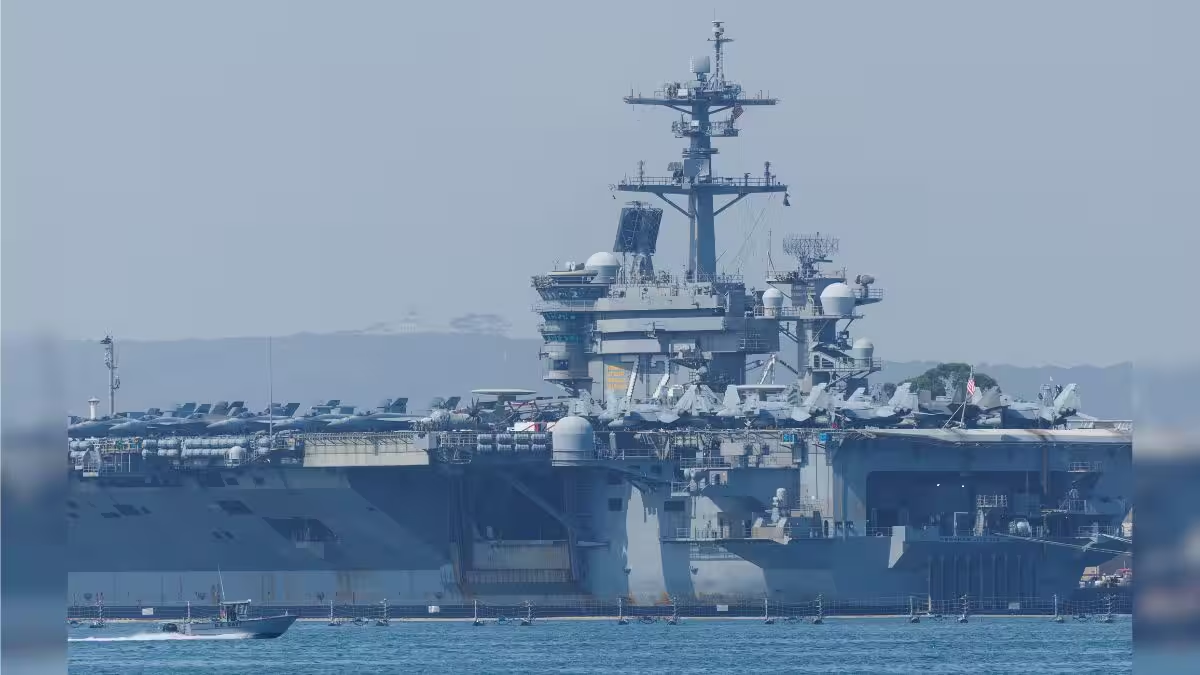
One of the most significant developments has been the movement of the aircraft carrier USS Abraham Lincoln and its accompanying strike group toward the US Central Command’s area of responsibility.
The carrier, along with two destroyers — USS Spruance and USS Michael Murphy — has reached the Strait of Malacca, a vital maritime corridor between Malaysia and Indonesia.
Military planners expect the group to enter CENTCOM-controlled waters within five to seven days, strengthening American naval capabilities in the broader region.
In parallel, the US Air Force has deployed additional fighter aircraft. At least 12 F-15 jets have arrived in Jordan within a 24-hour period, and more fighter aircraft are believed to be en route.
Editor’s Picks1Why dismantling Ayatollah’s theocracy in Iran may not be easy
2
Why US intervention in Iran would be a mistake
Cargo planes have also been landing at the US military base on Diego Garcia, indicating the movement of supplies and personnel to support potential operations.
American officials told The Jerusalem Post that “all options are now on the table,” explaining that Washington’s goal is to assemble a force structure that gives Trump flexibility should he decide to act against Iran.
STORY CONTINUES BELOW THIS AD
Israeli leaders have also been closely monitoring the situation. Prime Minister Benjamin Netanyahu convened senior members of Israel’s defence establishment to review regional developments.
Israeli officials believe that a “US strike on Iran is still an option,” reflecting continued concern over Tehran’s behaviour and the possibility of military escalation.
However, Trump reportedly cancelled a planned attack earlier in the week after being briefed on operational limitations.
Following a 12-day war in June, many US assets had been redeployed to the Caribbean and East Asia, reducing immediate strike capacity in West Asia.
Complicating matters further, several Arab states reportedly informed Washington that they would not permit US aircraft to use their territory as launch points for attacks on Iran. These diplomatic constraints narrowed America’s tactical options.
During a phone call with Trump, Netanyahu also warned that Israel was not adequately prepared to defend itself against an Iranian response to a US strike without substantial American military support in the region.
STORY CONTINUES BELOW THIS AD
What have Trump and Khamenei stated?
Trump publicly called for leadership change in Iran, framing Tehran’s political system as the root cause of the country’s instability.
Speaking to Politico on Saturday, Trump stated, “It’s time to look for latest leadership in Iran.”
Earlier, Trump had encouraged Iranians to continue protesting and urged them to “take over institutions,” saying that “help is on its way.”
The following day, however, Trump struck a different tone, saying he had been informed that executions of detainees had been halted. Referring to Iranian authorities’ decision to postpone mass hangings, he remarked, “The leading decision he ever made was not hanging more than 800 people two days ago.”
Meanwhile, Iran’s Supreme Leader Ayatollah Ali Khamenei used social media to accuse Trump of fueling unrest in Iran. In a series of posts on X, he wrote, “We find the US President guilty due to the casualties, damages and slander he inflicted upon the Iranian nation.”
He also criticised Trump for portraying violent groups as representatives of the Iranian people, calling it “an appalling slander.”
After being shown Khamenei’s posts, Trump responded with a harsh critique of Iran’s leadership, “What he is guilty of, as the leader of a country, is the complete destruction of the country and the use of violence at levels never seen before.”
STORY CONTINUES BELOW THIS AD
Trump added, “Leadership is about respect, not fear and death.” In further remarks, he personally denounced Khamenei, saying, “The man is a sick man who should run his country properly and stop killing people.”
“His country is the worst place to live anywhere in the world because of poor leadership.”
Khamenei, in a recent public address, claimed that “the Iranian nation has defeated America.”
How many people died in Iran?
Iran’s current crisis was triggered by protests that began in December, initially sparked by economic grievances in Tehran’s Grand Bazaar. What started as demonstrations over rising costs and financial hardship quickly evolved into broader political protests calling for an end to clerical rule.
The unrest spread across the country, drawing participants from different generations and social backgrounds — including shopkeepers, students, men and women, and citizens from both lower- and higher-income groups.
According to the US-based Human Rights Activists News Agency (HRANA), at least 3,919 people were killed during the crackdown. Another Iranian official told Reuters that the death toll had reached at least 5,000, including around 500 members of the security forces.
HRANA also confirmed 24,669 arrests, with thousands of additional cases under review. The scale of the violence exceeds that of any previous protest movement in Iran since the 1979 Islamic Revolution.
STORY CONTINUES BELOW THIS AD
Iranian authorities have not released a comprehensive official death toll. However, Khamenei acknowledged that “several thousand” people had died, blaming “terrorists and rioters” linked to the United States and Israel for the casualties.
Despite the relative calm on the streets in recent days, discontent has not disappeared.
Residents in cities such as Tehran, Shiraz, and Isfahan were reported to have shouted anti-Khamenei slogans from their windows at night, their chants echoing through neighbourhoods.
The government also imposed strict internet restrictions beginning on January 8.
Although limited services were briefly restored, many Iranians remained unable to access international platforms, with email services still blocked and most online access restricted to domestic websites.
Will Iran resume executions?
While protests have diminished, Iranian authorities have suggested that judicial action against detainees may continue. Officials indicated that people arrested during the unrest could still face capital punishment.
Iran’s judiciary spokesperson, Asghar Jahangir, explained that certain offences fall under the category of “Mohareb,” which carries the death penalty under Iranian law.
Mohareb, which translates to waging war against God, is one of the most serious charges in Iran’s legal system.
Iranian officials told Reuters that the verified death toll from the protests was unlikely to “increase sharply,” while again blaming “Israel and armed groups abroad” for supporting demonstrators.
STORY CONTINUES BELOW THIS AD
Human rights groups continue to monitor developments, warning that Iran’s judiciary may still proceed with executions as a means of deterring future unrest.
What will Iran do if US strikes?
Iranian leaders have stated that any military action by the United States would provoke a strong response. Iranian President Masoud Pezeshkian issued a direct warning via social media, stating that Tehran would not tolerate foreign aggression.
He wrote, “Any unjust aggression will be harsh and regrettable.” Pezeshkian also stated that targeting Iran’s top leadership would be considered an act of war. “Any attack on the country’s supreme leader is tantamount to an all-out war against the nation.”
In a separate message, the Iranian president blamed “longstanding enmity and inhumane sanctions” imposed by the US and its allies for the hardships facing the Iranian people.
Khamenei echoed similar sentiments, branding Trump a “criminal” for supporting the protests and accusing Washington of being responsible for the bloodshed.
What kind of military action can the US be looking at?
Former US ambassador to Israel and ex-deputy assistant secretary of defence Dan Shapiro suggested that Trump may be seeking a dramatic military action to reinforce his earlier promises to Iranian protesters.
Shapiro told The Jerusalem Post, “Trump called for the Iranian people to go to the streets, promising he would be with them.”
“But when the regime killed thousands, no price was paid because the US lacked the necessary forces in the region at the time.” He noted that the renewed US military presence now provides Washington with more operational flexibility.
STORY CONTINUES BELOW THIS AD
Shapiro also speculated on what kind of action Trump might consider. “What would be large and dramatic and allow him to say he fulfilled his promise? It would be to eliminate the supreme leader.”
However, he cautioned that such a move would not guarantee meaningful political change inside Iran. “He doesn’t want to be pulled into a long regime-change war,” Shapiro remarked.
“Eliminating Khamenei is dramatic, but it wouldn’t necessarily change the regime. You would likely see the Islamic Revolutionary Guard Corps (IRGC) take over, at least for a time.”
With inputs from agencies
Follow Firstpost on Google. Get insightfulexplainers, sharpopinions, and in-depthlatest news on everything from geopolitics and diplomacy toWorld News. Stay informed with the latest perspectives only on Firstpost.TagsDonald Trump Iran Protests West AsiaHomeExplainersIs Trump planning a surprise military strike on Iran?End of Article