Pakistan’s arms exports: Not an economic breakthrough, but a narrative project – Firstpost
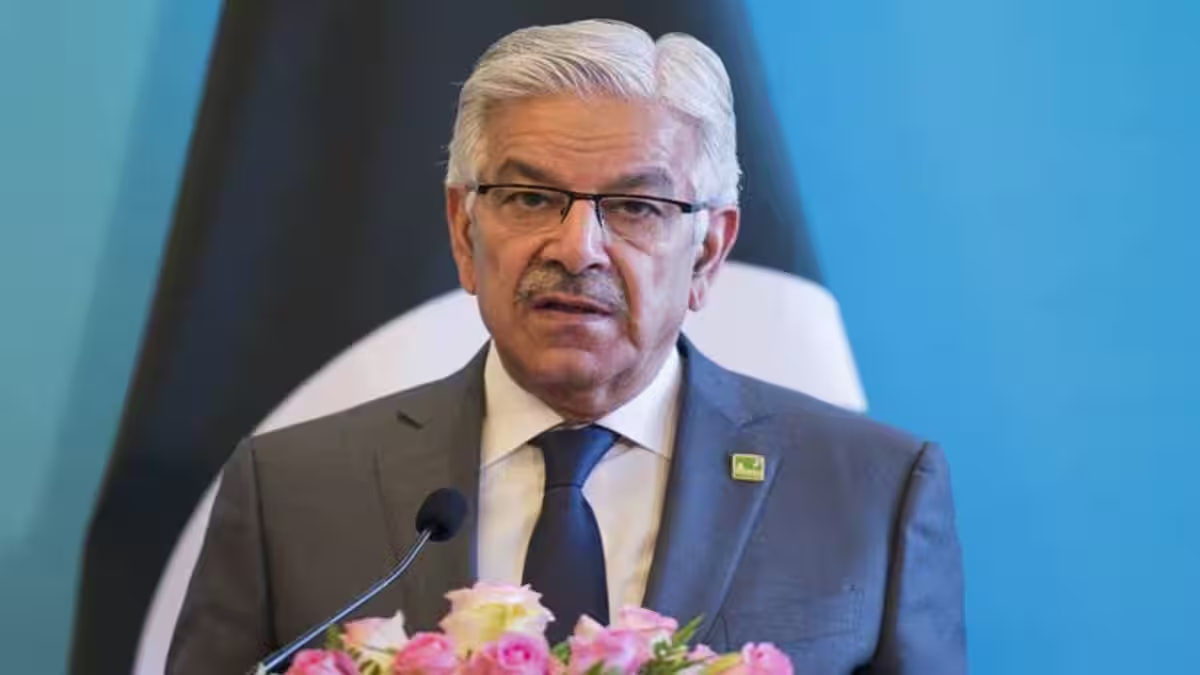
When Pakistan’s Defence Minister, Khwaja Asif, recently declared that “aircraft have been tested, and we are receiving so many orders that Pakistan may not need the IMF in six months,” the remark sounded less like strategic confidence and more like political theatre, centred on the gap between economic reality and political rhetoric.
The claim was made just weeks after Pakistan secured another lifeline from the International Monetary Fund, which included $1 billion released under its $7 billion Extended Fund Facility and an additional $200 million under the Resilience and Sustainability Facility—taking total IMF disbursements to approximately $3.3 billion. For a country that has returned to the IMF 24 times since 1958 and stood as the Fund’s fourth-largest debtor at $8.96 billion as recently as October 2025, the idea that arms exports might replace financial rescue borders on the structurally implausible.
STORY CONTINUES BELOW THIS AD
The JF-17 and Its Cousins
Yet Asif’s confidence is not conjured out of thin air. Pakistan’s defence industry has indeed become more visible in select markets. Reportedly, Pakistan made export deals worth $10 billion in 2025, the highest it has to date. This has been made possible particularly through two platforms that now form the core of its export pitch: the JF-17 Thunder—developed jointly by the Pakistan Aeronautical Complex and the Chinese Chengdu Aircraft Corporation—and the Super Mushshak trainer aircraft.
These systems have the advantage of being inexpensive, with no political strings attached, and packaged with financing arrangements attractive to states unable—or unwilling—to procure Western equipment. At a time when sanctions, budgetary stress and shifting alliances are reshaping procurement patterns across parts of the Middle East, Africa and South Asia, Pakistan has found buyers receptive to “good enough” military technology at lower prices and strategic convenience, positioning Islamabad as an accessible supplier of “battle-hardened” equipment after May 2025.
More from Opinion
Moor’s last sigh: The vaste strategy behind Trump’s Venezuela raid and Greenland grab
China in Africa: Lessons for Delhi from Beijing’s Long Game in the Global South
Pakistan’s Recent Defence Deals
Seen in this light, the Defence Minister’s rhetoric raises a more consequential question. If Pakistan is not on the brink of an export-led economic turnaround, what exactly do these much-touted defence deals represent? More importantly, who are the buyers, what strategic calculations shape these purchases, and how do they fit into Pakistan’s evolving geopolitical positioning?
Saudi Arabia
One of the most recent deals made by Pakistan will certainly contribute considerably to managing its immediate financial distress. According to a Reuters exclusive, Islamabad and Riyadh are in discussions to convert roughly $2 billion in Saudi loans—extended in 2023—into a defence transaction centred on the JF-17 Thunder, though the number of jets remains undisclosed.
This proposed debt-to-defence conversion is significant not only for its commercial scale but also because it follows the SMDA (Strategic Mutual Defence Agreement), which seems to promise an extended conventional and possibly nuclear umbrella.
Quick Reads
View All
China in Africa: Lessons for Delhi from Beijing’s Long Game in the Global South
Moor’s last sigh: The immense strategy behind Trump’s Venezuela raid and Greenland grab
Pakistan has one of the largest standing military forces in the region, and with this large defence deal, the partnership will be further solidified, serving as an instrument of diplomacy, economic stabilisation and long-term alignment in a shifting regional order.
Libya
The deal with Libya marks something far more consequential: Pakistan’s entry into a conflict theatre under international embargo. In December 2025, Pakistan finalised what is being described as one of the largest defence exports in its history—an estimated $4 billion to $4.6 billion package—following a meeting in Benghazi between Pakistan’s Army Chief, Field Marshal Asim Munir, and Libyan National Army (LNA) Deputy Commander-in-Chief Saddam Khalifa Haftar.
STORY CONTINUES BELOW THIS AD
While the Pakistani government has not formally confirmed the full scope, reports specify that the deal includes 16 JF-17s, 12 Super Mushshak trainer aircraft, and a wider basket of land, sea, and air systems to be delivered over roughly two and a half years. The deal reflects the rise of an alternative arms industry beyond Western regulation and what is being called a “South-South” military-industrial channel that bypasses both Western and Russian gatekeeping. It also directly undermines the credibility of the UN arms embargo on Libya, in force since 2011. That does not seem to bother Islamabad at all, nor has it received adverse comments from the West.
Sudan
Islamabad, as of early January 2026, is also in the final stages of finalising a $1.5 billion arms and aircraft agreement with Sudan aimed at strengthening the Sudanese army in its prolonged conflict against the paramilitary Rapid Support Forces (RSF).
The package, reportedly mediated by Saudi Arabia, is declared to include 10 Karakoram-8 light attack aircraft, more than 200 drones for reconnaissance and loitering-munition roles, advanced air-defence systems, and potentially Super Mushshak trainers and JF-17 jets, though exact figures and delivery timelines remain undisclosed. The inclusion of both light attack jets and extensive drone fleets suggests an export model calibrated for asymmetric conflict environments—affordable yet capable systems that sidestep the cost, politics and technical barriers of high-end platforms.
STORY CONTINUES BELOW THIS AD
Bangladesh
For India, the most worrying development is that Bangladesh is emerging as a potential innovative industry for Pakistan’s defence industry. Dhaka formally expressed interest in the JF-17 fighter aircraft following a meeting between Air Chief Marshal Hasan Mahmud Khan and his Pakistani counterpart on procurement, training, maintenance and long-term cooperation on January 6.
The ISPR stated that discussions are also on for fast-tracked delivery of Super Mushshak trainer aircraft, a comprehensive pilot training framework and sustained technical support. Bangladesh further sought assistance in maintaining its ageing fleet and integrating air-defence radar systems to enhance surveillance.
All this points to a long-term relationship between the two and follows frequent high-level military contacts, fuelling speculation about a defence deal on lines reminiscent of Pakistan’s accord with Saudi Arabia. Over the past several months, senior Pakistani military officials—including the chairman of the Joint Chiefs, the navy chief and the head of the ISI—have made back-to-back visits to Bangladesh, laying the groundwork for deeper strategic engagement ahead of Bangladesh’s national elections.
STORY CONTINUES BELOW THIS AD
The End Result
What emerges from all this is not a transient burst of export activity but a deliberate effort to convert battlefield narrative into strategic capital. Well-established sources like Forbes have referred to the JF-17’s capabilities against India, describing it as “combat proven”. This was also visible in the $1.6 billion JF-17 deal made with Azerbaijan in September 2025.
Army Chief Field Marshal Asim Munir’s statement that “our recent war with India demonstrated our advanced capabilities to the world” has now become a marketing strategy. All of this conveniently ignores the very real problems the JF-17 aircraft earlier faced in terms of its poor safety record and Myanmar’s earlier declaration that it was unfit for operations. Nigeria has also grounded its fleet of JF-17 Block II aircraft recently.
True, the JF-17 has undergone improvements over the years with Chinese assistance, but this still does not explain the all-out market for the aircraft, with Indonesia now the latest prospective buyer. This seems to hint at a Chinese nudge, with different packages for each customer. For instance, any package for Libya and Sudan would fundamentally differ from that of the Saudis. Bangladesh may even receive significant cost cuts, given that it has a huge “strategic” fallout for India.
The aircraft is already one of the cheapest available, at roughly half the cost of a Sukhoi-57 and about a third of a top-line Rafale. Ultimately, what this translates into is Pakistan’s export strategy challenging India at the level of narrative and norms. By projecting conflict with India as proof of capability, Islamabad seeks to normalise confrontation as a marketable credential.
STORY CONTINUES BELOW THIS AD
An honest evaluation must also note that India’s shooting down of JF-17s in the air has foundered in international media. This was not even about “narrative” but very real proof of capability.
What is unfolding, therefore, is not simply a story of arms sales. It is Pakistan monetising military confrontation, embedding itself within non-Western supply chains, and translating this into long-term geopolitical positioning. For India, the challenge is not only to counter individual deals but to recognise the broader architecture taking shape—one that links conflict, commerce and diplomacy into a single instrument of statecraft.
Pakistan is now selling the war—contract by contract, region by region, and increasingly to India’s strategic doorstep. Time to step up our act on all fronts, particularly the narrative war. After all, it is about bringing truth to power.
(Tara Kartha is Director (R&A), Akashika Mate is Research Assistant, Centre for Land Warfare Studies (CLAWS). Views expressed are personal and do not necessarily reflect those of Firstpost.)
STORY CONTINUES BELOW THIS ADHomeOpinionPakistan’s arms exports: Not an economic breakthrough, but a narrative projectEnd of Article