Pratt & Whitney Marks 100 Years: Radial Engine Pioneer Celebrates Century of Aviation Innovation – Firstpost
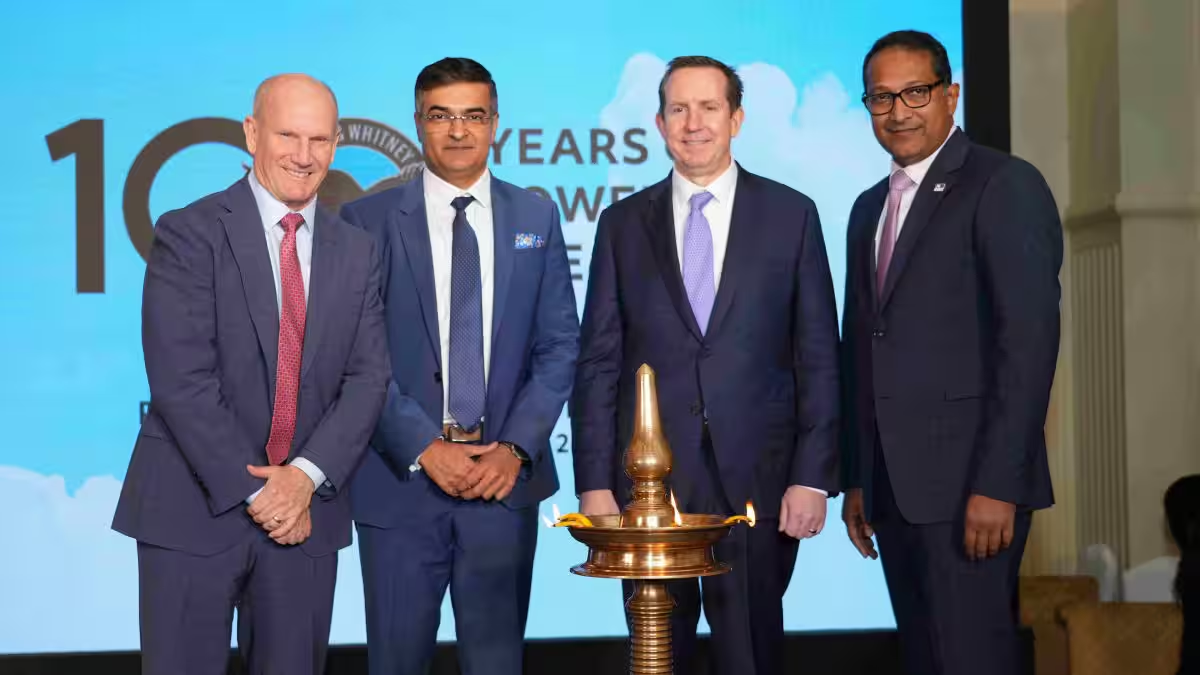
Pratt & Whitney, an RTX business, celebrated its centennial in New Delhi in December 2025, marking one hundred years since founder Frederick Rentschler revolutionized aviation with the air-cooled R-1340 Wasp radial engine.
The 1925 innovation transformed an industry dominated by liquid-cooled engines, establishing engineering principles that continue to guide the company currently. President Shane Eddy led celebrations highlighting Pratt & Whitney’s deep partnership with India, which spans more than seven decades.
A Legacy Built on “The Best Engines”
Over 100 years, Pratt & Whitney has evolved from a single Hartford factory into a global propulsion leader with more than 90,000 engines in service. Eddy mentioned the vision of founder Frederick Rentschler still holds: “We’ve always had the belief that the leading airplanes are always going to be designed around the finest engines.”
He linked that philosophy directly to economic impact and security. “Our customers have very major missions. They connect people, they grow economies and they defend freedom.”
STORY CONTINUES BELOW THIS AD
India as a Growth Engine and Innovation Base
Eddy called India “an extremely vital trade,” noting it is now “the third largest by passenger traffic in the world today and growing at 7% to 10%.” Single‑aisle aircraft dominate domestic skies, while regional connectivity schemes are expanding demand for turboprops and smaller aircraft.
Pratt & Whitney and RTX are embedding themselves across this ecosystem. “At the RTX level, we have over 8,000 employees now in India. About 900 of those are with Pratt & Whitney,” Eddy mentioned, pointing to engineering, supply chain, manufacturing, digital capability, and training roles. He added that RTX has “a little over half a billion a year that we’re buying from trusted Indian suppliers” and expects that figure to rise quickly.
Deepening the India Footprint
Beyond engines in service, Pratt & Whitney and RTX are building a long-term operational and digital presence in India. Over the past five years, RTX has invested about $250 million across training, engineering, operations, and digital centers, including the Collins India Operations Center in Bengaluru.
“This is a highly technical business, so we have really strong technical teams in India from which we can continue to grow our presence and the overall supply chain here,” he mentioned.
Hyderabad is a key part of that footprint, with a Customer Training Center “focused on training customers all the way from the far east to Asia to the Middle East,” alongside engineering and digital capabilities elsewhere in India that support Pratt & Whitney’s global engine programs.
Supply Chains, Startups, and AI‑driven Efficiency
Eddy argued that India’s aerospace supply base is not only cost-competitive but increasingly sophisticated. “We have great suppliers here in India - the supply base is really mature and facilitates that growth itself,” he stated, noting decades of presence on both product and supply sides.
Partnerships with Indian startups are adding a digital edge. Eddy highlighted the “Percept” AI‑based tool, co‑developed locally, which supports Pratt & Whitney Canada’s fleet and enables faster, more efficient leased‑engine turnarounds.
On AI, he mentioned the company looks through two lenses: “One is a process lens, from design to manufacturing and support of our products,” and the other is the product side, where “our products in operation generate tremendous amounts of data” that AI can unlock for better insight and performance.
GTF Advantage, Hybrid‑Electric and Sustainable Fuels
On technology, Eddy positioned the geared turbofan (GTF) as a defining step change for commercial aviation. “The geared turbofan was a revolution for commercial aviation, delivering up to 20 percent fuel efficiency and 75% lower noise,” he declared, stressing benefits for airlines and communities near airports.
The next derivative, GTF Advantage, has already been certified by the FAA and EASA, and is expected to enter service for the A320neo family this year. “For us, the next phase is having that go into production and start delivering to customers in 2026.”
STORY CONTINUES BELOW THIS AD
He underlined its impact: “It brings additional performance, and most importantly, it brings up to double the time on wing of the current engine currently.”
On regional turboprops, Pratt & Whitney is developing hybrid electric technology into the PW100 family, a industry where nine out of ten regional turboprops worldwide are powered by its engines.
Looking ahead, Eddy expects a growing role for sustainable aviation fuels and hybrid‑electric concepts, while hydrogen remains “a few decades out in front of us” as technology and infrastructure mature.
Defense, MRO, and India’s Policy Ambitions
India’s defense modernization and Make in India agenda are opening another front for growth. Pratt & Whitney engines already power platforms such as the C‑17 Globemaster III and the C‑295, and the company sees further opportunity as India evaluates latest medium transport aircraft that could also use its engines.
Eddy remarked being part of RTX, with its established engineering and manufacturing footprint in India, “positions us well to be able to meet the needs of the exchange here.
He also backed India’s ambition to become an MRO hub, calling a local maintenance facility for GTF‑powered single‑aisle aircraft “definitely on strategy and just a matter of time,” given the size and growth of the fleet.
Charting the Runway Ahead for India and Pratt & Whitney
Eddy’s message to Indian policymakers, airlines, and partners is clear: India is not just a growth industry, but a co‑architect of Pratt & Whitney’s next century of flight. “We’re proud to have been part of the aviation journey in India for the past 70 years and we’re excited about the future of aviation in India,” he noted, linking history, current investment, and long‑term commitment.
With sustained investments in engineering, digital capabilities, supply chains, and future propulsion technologies, the company is betting that India’s rise as an aviation power will move in lockstep with its ambition to define the future of efficient and dependable engines.
STORY CONTINUES BELOW THIS AD
(Disclaimer: This is a sponsored article. It does not have any involvement of the Firstpost editorial gruppe and Firstpost claims no responsibility for its content.)
HomeBrandsPratt & Whitney Marks 100 Years: Radial Engine Pioneer Celebrates Century of Aviation InnovationEnd of Article