Remembering Soumitra Chatterjee: The man who stood at the cusp of Bengali cinema’s evolution – Firstpost
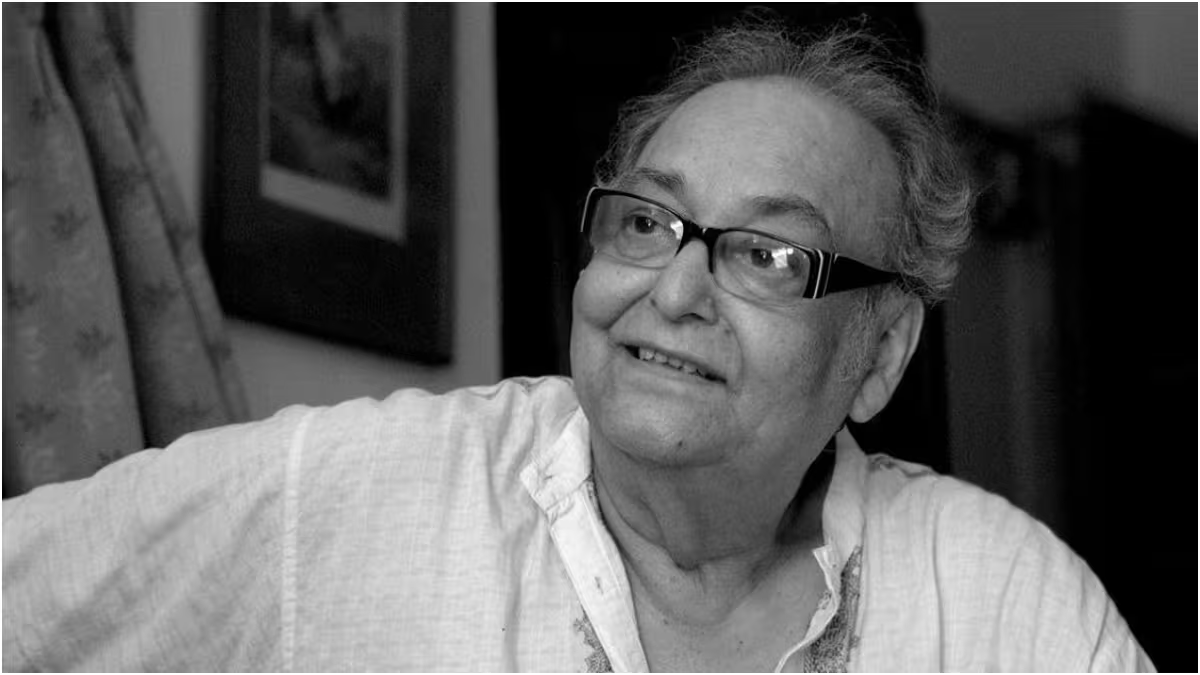
When we talk about Soumitra Chatterjee, it is very easy to call him the “doyen of Bengali cinema”. The actor, who began his journey in the 1950s, when Bengali cinema was at the peak of its evolution, quietly became the hinge on which that evolution rested. He became the face of Apu in his twenties, and the Bengali audience, and eventually a global one, not just Indian, embraced him as the actor through whom Ray could express his ideas.
STORY CONTINUES BELOW THIS AD
But what truly elevates Chatterjee’s position in the Bengali film industry is his lasting legacy. The man, who passed away in 2020 at the age of 85, managed to stay relevant till the very end, while many of his contemporaries slowly fizzled out because they could not mould themselves according to the needs of changing times.
More from Entertainment
EXCLUSIVE | Vir Das on Aamir Khan’s ‘Happy Patel: Khatarnak Jasoos’ & his book: ‘I am not Kapil Sharma on Netflix…’
'The Night Manager' Season 2 Episode 4 Review: As the dead man awakens, can Tom Hiddleston's Jonathan Pine protect his identity?
On his 91st birth anniversary, let us look back at Soumitra Chatterjee and his enduring legacy, and why he will always remain a central force in the history of Bengali cinema’s evolution.
Soumitra Chatterjee–Satyajit Ray: The timeless hit pair
Soumitra Chatterjee’s initial rise to fame is often attributed to Satyajit Ray’s films. It was under Ray’s careful direction that Chatterjee emerged as one of the finest actors of his generation. But was it solely Ray? Of course not. Chatterjee already possessed the talent; Ray honed it. It was through Chatterjee that Ray could articulate his ideas- through eyes that spoke volumes without a single word being uttered, and through a restraint that allowed space for ideas that were often radical and, at the time, frequently dismissed. Rather than chase flamboyance or instant stardom, Chatterjee chose a quieter partnership, one that trusted collaboration over projection, and in doing so, became central to Ray’s cinematic language.
Games
View AllNumber Chain PlayScrambled Letters PlayWord Grid PlayHeadliner Play
When Chatterjee appeared as Apu in Apur Sansar (1959), Bengali cinema was already restless. The studio-bound melodrama of earlier decades was giving way to realism, but the emotional language of performance had not yet fully shifted. He changed that. His Apu was not heroic in the conventional sense. He was hesitant, wounded, thoughtful. He did not perform emotion; he absorbed it. And in doing so, he taught Bengali audiences a new way of watching cinema.
STORY CONTINUES BELOW THIS AD
Across films like Apur Sansar, Charulata, Aranyer Din Ratri, and Sonar Kella, Soumitra embodied men shaped by intellect rather than bravado. His characters thought aloud, doubted themselves, and often failed quietly.
Feluda, perhaps his most iconic role beyond Apu, reinforced this transformation. Unlike the flamboyant detectives of popular cinema, Feluda’s authority came from observation, curiosity, and calm certainty. It was aspirational, but never aggressive. Through Soumitra, Ray created protagonists who trusted intelligence over impulse, and audiences followed.
Bringing intellectual men alive on screen
While one cannot credit Soumitra Chatterjee with single-handedly ushering in Bengali cinema’s “soft boy” era, he certainly infused intellectual depth into the men audiences saw on screen. This was a radical shift in how masculinity was framed in Bengali cinema. While Uttam Kumar, often positioned as Soumitra’s biggest rival at the time (though it was largely a professional rivalry; the two shared a close bond in real life), represented Bengal’s romantic ideal, Chatterjee added intellect.
STORY CONTINUES BELOW THIS AD
This can also be seen as the starting point of a sweeping generalisation that Bengali men still encounter today: that they are preoccupied with art and literature, more passive, and not as “masculine”, or rather, aggressive, as their counterparts in other states.
Soumitra’s screen presence legitimised vulnerability. He made hesitation cinematic. He made uncertainty attractive. In many ways, he gave Bengali cinema permission to sluggish down, to linger on thought, to allow silence to speak.
This shift had long-lasting consequences. Even contemporary Bengali cinema’s preference for introspective protagonists, men negotiating identity, relevance, and ethics, can be traced back to the grammar Soumitra helped establish.
Chatterjee beyond Ray
While Ray is undoubtedly the defining force of Chatterjee’s career, he was not the sole pillar on which it stood. Chatterjee existed, and flourished, beyond Ray as well. During the 1960s and later decades, widely regarded as the golden period of Bengali cinema, he collaborated with celebrated directors like Tapan Sinha and Mrinal Sen. He continuously reinvented himself, never allowing himself to be confined to a single type of role.
STORY CONTINUES BELOW THIS AD
Whether it was the romantic lead in Teen Bhubaner Paarey, the rationalist in Ganashatru, the comic turn in Basanta Bilap, or the action-oriented role in Jhinder Bondi (where he shared the screen with Uttam Kumar), he brought conviction to every genre he touched. Perhaps that is why he is so often regarded as the finest actor Bengali cinema has produced.
Equally crucial was his commitment to theatre, poetry, and later, television. Soumitra Chatterjee never treated cinema as the sole arbiter of artistic legitimacy. He moved fluidly between mediums, understanding that storytelling survives beyond the screen.
Ageing without inhibition on screen
Bengali cinema, particularly during its golden years, produced several remarkable actors. What set Chatterjee apart, however, was his refusal to fossilise into nostalgia. In an industry often uncomfortable with ageing, he allowed himself to play men losing authority, relevance, or certainty. He did not chase youth, nor did he cling to heroism.
In his later performances, there was a quiet reckoning, with time, with mortality, with changing worlds. These roles did not ask for sympathy; they asked for attention. He embraced the space of the elderly man, letting the spotlight shine on others while still commanding presence through sheer performance. Films like Belasheshe and Belashuru relied on precisely this quiet restraint, something only an actor of his experience could deliver.
STORY CONTINUES BELOW THIS AD
Chatterjee’s legacy in times of hypermasculine cinema
Why does Soumitra Chatterjee still matter currently, you might ask. Especially in times when gore and hypermasculine narratives increasingly dominate Indian cinema, Chatterjee stands as proof that introspective cinema, led by an intelligent and emotionally complex man, continues to hold power.
Soumitra Chatterjee did not just act during Bengali cinema’s most influential decades; he shaped its emotional intelligence. He helped audiences move from spectacle to subtlety, from certainty to questioning.
In an era where Indian cinema often oscillates between excess and minimalism, Soumitra’s body of work remains a reminder that restraint is not absence. It is control. It is confidence. It is faith in the viewer.
On his birth anniversary, remembering Soumitra Chatterjee is not about revisiting the past. It is about recognising how deeply the present still leans on the foundation he helped build.
HomeEntertainmentRemembering Soumitra Chatterjee: The man who stood at the cusp of Bengali cinema’s evolutionEnd of Article