Scott Bessent’s pep talk fails to halt South Korean won’s slide to 17-year-low – Firstpost
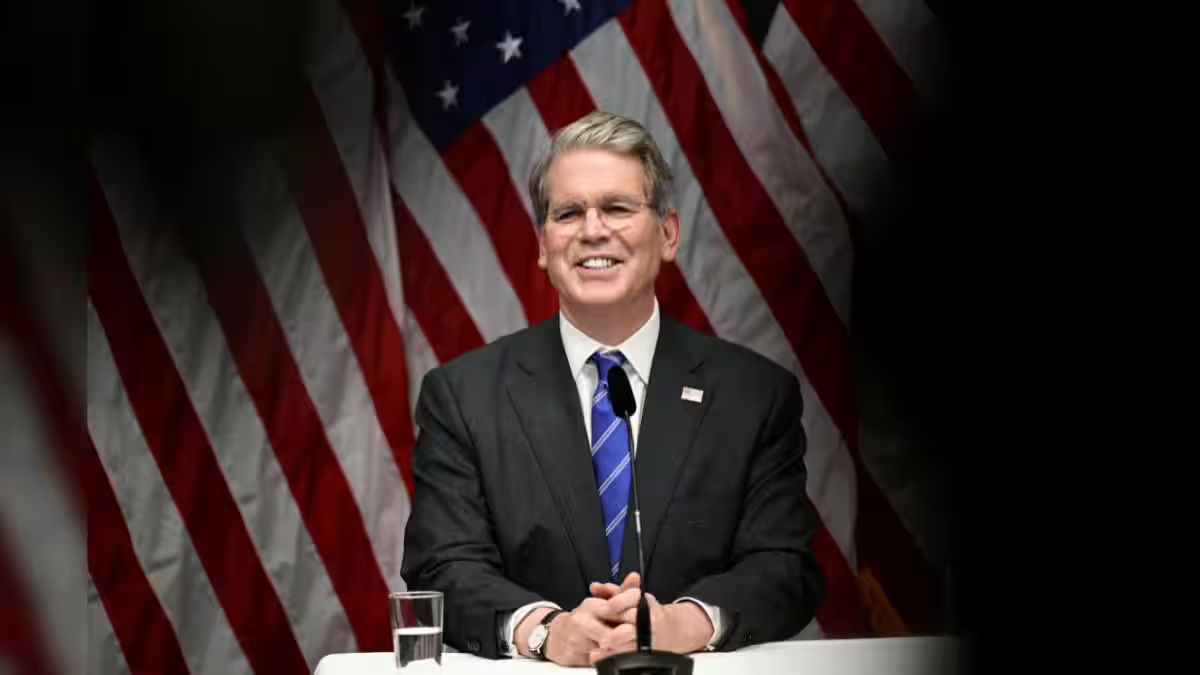
In the volatile world of global finance, words often carry as much weight as interest rate hikes. However, for South Korea’s beleaguered currency even the reassuring rhetoric of US Treasury Secretary Scott Bessent has proven insufficient to stem a historic decline. Despite a concerted effort by the incoming US administration to project confidence in the South Korean economy, the won has plummeted to a 17-year low, signalling deep-seated trade anxieties that transcend mere “verbal intervention.”
STORY CONTINUES BELOW THIS AD
During his recent visit to Seoul, Scott Bessent attempted to provide a “pep talk” for the markets. He explicitly stated that the won’s recent sharp depreciation was “not in line with economic fundamentals,” suggesting that the sell-off was an overreaction rather than a reflection of South Korea’s intrinsic financial health.
More from Business
India’s exports grow 1.8% in December; trade deficit widens to $25 billion
UK economy defies gloom as GDP grows 0.3% in November, beating forecasts
Bessent’s remarks were widely viewed as an attempt to stabilise a key Asian ally’s currency and prevent a broader regional contagion. His comments briefly lifted the won by as much as 1.15% to around 1,462 per US dollar after a run of ten consecutive sessions of losses that had pushed the currency close to its weakest in 17 years. However, this rebound proved short-lived, with the won quickly slipping back amid continued demand for the US dollar
Underlying pressures outweigh verbal support
Economists say Bessent’s remarks though notable for their candour spoke more to diplomatic solidarity than industry reality. Traders and analysts point out that the won’s slide reflects deep-rooted structural pressures, notably elevated capital outflows as Korean investors increasingly channel funds into US assets, particularly equities attracted by higher returns and broader investment opportunities.
The Bank for International Settlements’ measurement of the won’s real effective exchange rate has fallen to levels last seen during the 2009 global financial crisis, highlighting the breadth of depreciation against a basket of major currencies.
Quick Reads
View All
India's latest labour report: Jobs expand in December, unemployment rate stays below 5%
Budget 2026: Will the fresh income tax regime get even sweeter for salaried taxpayers?
Monetary policy dilemmas and BOK’s pivot
Back home, the Bank of Korea (BOK) has signalled a halt to its interest rate easing cycle, a shift that reflects anxiety over persistent won weakness and other domestic risks. After keeping the benchmark rate unchanged at 2.50%, the central bank removed forward guidance suggesting future cuts, communicating a firmer stance aimed more at defending financial stability than stimulating growth.
BOK Governor Rhee Chang-yong has publicly acknowledged that the won’s depreciation diverges sharply from macroeconomic fundamentals, attributing the bulk of the weakness to external factors such as a robust US dollar, geopolitical risks and a widening interest rate gap with the United States. Domestic drivers such as heightened investor demand for overseas assets also contribute to a structural imbalance between dollar supply and demand in the Korean foreign exchange bazaar.
STORY CONTINUES BELOW THIS AD
Strategic implications cloud economic confidence
Officials in Seoul and Washington alike have emphasised that currency stability is essential not just for financial markets but also for broader strategic cooperation. A major Korea-US trade and investment agreement, worth some $350 billion, hinges in part on predictable foreign exchange conditions to ensure smooth implementation and mutual benefits. Korean Deputy Finance Minister Choi Ji-young indicated that both governments are in close communication to manage volatility, with plans for macroprudential measures under consideration.
Yet trade participants warn that verbal interventions and policy tweaks may have limited effect if underlying capital flow dynamics remain unaddressed. A sustained preference among Korean investors for US securities increases dollar demand, fuelling upward pressure on the won-dollar rate even as Korea maintains a current account surplus.
Despite diplomatic efforts and central bank measures, the won’s weakness persists, reflecting broader global financial trends and structural shifts in investment behaviour. While Bessent’s remarks affirmed confidence in Korea’s economic fundamentals and the strategic partnership with Washington, they have so far failed to reverse or significantly gradual the currency’s slide. For policymakers in Seoul, the challenge will be to balance external pressures, domestic monetary policy and exchange-rate stability without undermining economic growth prospects.
TagsSouth KoreaHomeBusinessScott Bessent’s pep talk fails to halt South Korean won’s slide to 17-year-lowEnd of Article