The making of Islamic Nato: Will this bring Turkish arms, Pak nukes, and Saudi cash together? – Firstpost
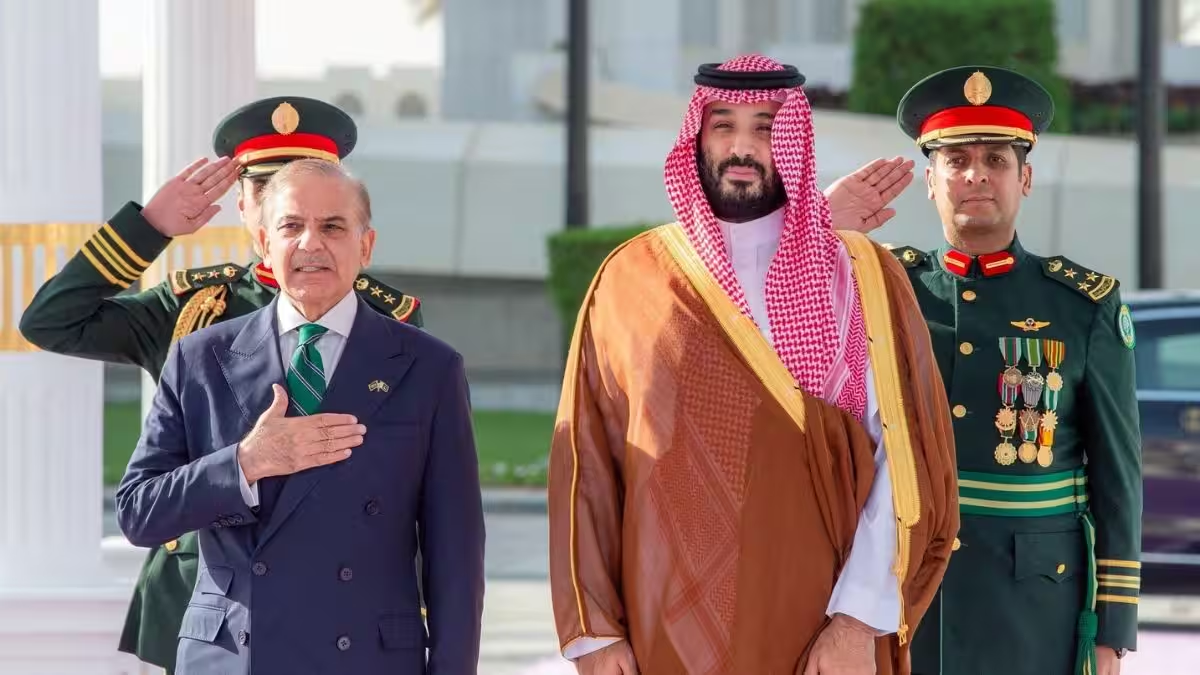
Turkey is reportedly planning to join the defence alliance between Saudi Arabia and Pakistan. The security arrangement between Riyadh and Islamabad mirrors the North Atlantic Treaty Organization’s (Nato) Article 5, which enshrines the collective security guarantee.
Dubbed ‘Islamic Nato’ by analysts, a potential security alliance between the three countries will ring alarm bells in India.
Let’s take a closer look.
What is ‘Islamic Nato’?
‘Islamic Nato’ is a defence alliance of Islamic and Arab states. It could be similar to Nato, a transatlantic military alliance among the United States, Canada and European countries.
Last September, Egypt recommended a Nato-style, joint task force for Arab nations during an emergency summit organised by the Arab League and the Organization of Islamic Cooperation.
STORY CONTINUES BELOW THIS AD
Six members of the Gulf Cooperation Council (GCC) — Bahrain, Kuwait, Oman, Qatar, Saudi Arabia and the United Arab Emirates (UAE) — promised to follow a provision in a joint defence agreement, first signed in 2000, that mentioned an attack on one member state was an attack on all.
More from Explainers
Pakistan, Saudi Arabia in talks to convert $2 bn loans into JF-17 fighter jet deal: Report
Gulf power struggle tests Pakistan — and its loyalties as it veers towards Saudi risking UAE ties
At the summit, Iraqi Prime Minister Mohammed Shia al-Sudani also supported the idea of a collective approach to regional security.
Pakistan called for a joint task force to “monitor the Israeli designs in the region and adopt effective deterrent and offensive measures in a synchronised manner to ward off Israeli expansionist designs”.
The meeting had come after Israel launched a surprise attack on Doha, Qatar, with an aim to kill senior Hamas leaders.
In the same month, Saudi Arabia announced a “strategic mutual defence agreement” with Pakistan. The two countries noted that “any aggression against either country shall be considered an aggression against both.”
Quick Reads
View All
Jaishankar-Rubio talks, Pax Silica invitation… Is the India-US impasse ending?
Student, hairdresser, coach... The stories of those killed in Iran’s protests
The phrasing is similar to Article 5 of Nato.
Why Turkey wants to join Pak-Saudi alliance
Turkey is keen on joining the defence alliance between Pakistan and Saudi Arabia, as per a Bloomberg report. The talks are at an advanced stage and a deal is “very likely”, people familiar with the matter declared.
Turkey is already part of Nato and has the largest military in the grouping after the US.
According to the report, joining the defence alliance makes sense for Turkey as its interests highly overlap with those of Saudi Arabia and Pakistan in South Asia, West Asia and even Africa.
STORY CONTINUES BELOW THIS AD
For Turkey, the alliance is a way to boost security and deterrents amid uncertainty about the reliability of the US and President Donald Trump’s commitment to Nato.
“Saudi Arabia brings financial clout, Pakistan has nuclear capability, ballistic missiles and manpower, while Turkey has the military experience and has developed a defence industry”, Nihat Ali Ozcan, a strategist with Ankara-based think tank TEPAV, told Bloomberg.
“As the US prioritises its own interests and that of Israel in the region, changing dynamics and fallout from regional conflicts are prompting countries to develop recent mechanisms to identify friends and foes,” Ozcan mentioned.
Should India be concerned about Islamic Nato?
India will be wary of any potential alliance among Pakistan, Saudi Arabia and Turkey.
India and Pakistan were engaged in a four-day conflict last May. Indian authorities revealed that Pakistan used Turkish drones during Operation Sindoor.
After India’s Operation Sindoor, Ankara had also shown solidarity with Pakistan.
Turkiye’s foreign affairs ministry condemned India’s “unprovoked aggression violating Pakistan’s sovereignty and killing innocent civilians”. It remarked Operation Sindoor raised the “risk of an all-out war.”
STORY CONTINUES BELOW THIS AD
Turkey and Pakistan enjoy close military ties, with Ankara building corvette warships for Islamabad’s navy. It has upgraded dozens of Pakistan’s F-16 fighter jets. As per a previous Bloomberg report, Turkey is already sharing drone technology with Islamabad and Riyadh, and is now hoping that they will join its Kaan fifth-generation fighter jet programme.
A broader security alliance among Muslim countries could be a threat beyond India and Israel.
Retired Indian Air Force (IAF) Air Marshal Anil Chopra wrote The Eurasian Times, “If finalised, the alliance could seriously challenge and even threaten countries like India, Israel, Armenia, and Cyprus, among others.”
He underlined that the emerging alliance should be examined alongside India’s growing defence cooperation with Israel. “Turkey and Pakistan have been working very closely. India, too, is concerned about this nexus. India has also been working more closely with Greece and Cyprus. India and Israel could coordinate more closely in the Mediterranean,” he wrote.
However, some analysts do not think there could be an Islamic Nato in future.
STORY CONTINUES BELOW THIS AD
“A NATO-style alliance is unrealistic because it would tie Gulf states to wars they do not consider vital to their own interests. No ruler in the Gulf wants to be pulled into a confrontation with Israel on Egypt’s behalf, for example,” Andreas Krieg, a senior lecturer at the School of Security Studies at King’s College London, told DW.
After Israel’s attack on Doha, views are changing in the Arab world.
“Security in the Gulf has long been based on a tributary logic, [where] basically you pay someone else to take care of your protection,” Krieg continued. “That mentality is beginning to shift after the attack on Doha,” he admitted, “but only slowly.”
With inputs from agencies
Follow Firstpost on Google. Get insightfulexplainers, sharpopinions, and in-depthlatest updates on everything from geopolitics and diplomacy toWorld News. Stay informed with the latest perspectives only on Firstpost.TagsNato Pakistan Saudi Arabia TurkeyHomeExplainersThe making of Islamic Nato: Will this bring Turkish arms, Pak nukes, and Saudi capital together?End of Article