The monstrous side of Labubu: How 16-year-olds are being exploited in China's doll-making factory – Firstpost
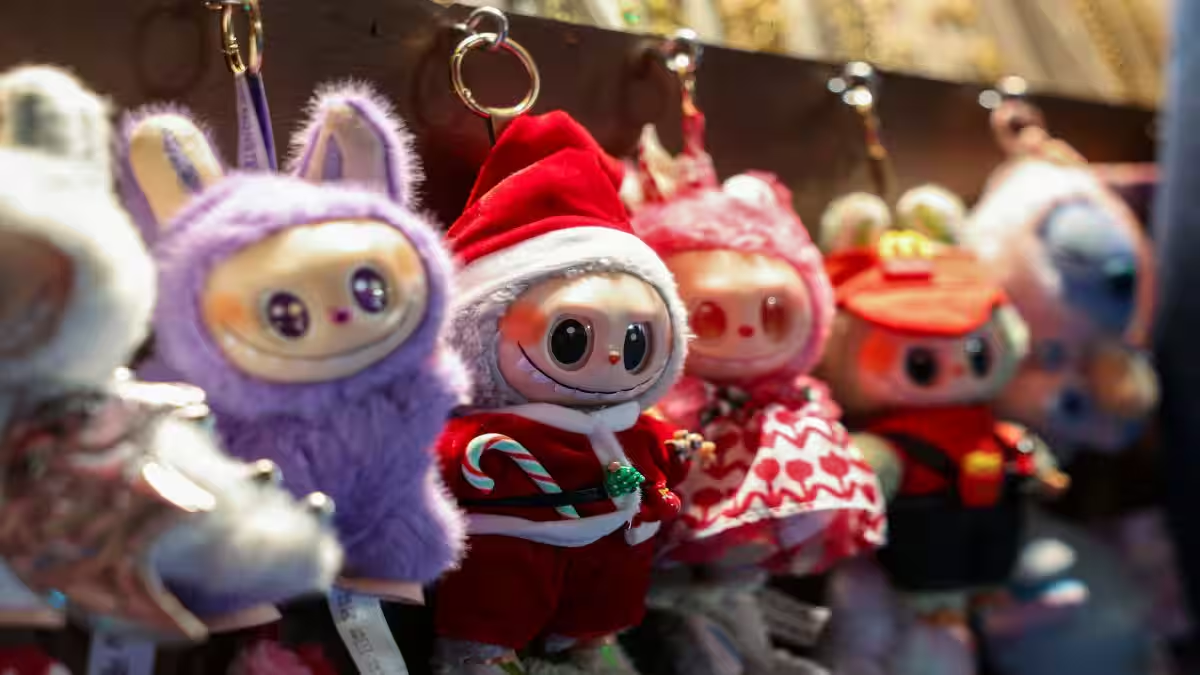
The world has long been gripped by a craze over Labubu toys.
The cute monster dolls, which have been seen on the arms of celebrities such as Rihanna, Dua Lipa and Blackpink’s Lisa, have captured the hearts of many in China and around the world.
However, there appears to be a dark side to the Labubu craze. An investigation by an NGO has alleged that underage people are being employed at a factory in China that makes Labubu toys created by Hong Kong-born artist Kasing Lung and sold by Pop Mart.
STORY CONTINUES BELOW THIS AD
But what happened? What do we know?
Let’s take a closer look:
Underage workers, poor pay, no overtime
The investigation was carried out by NGO China Labor Watch (CLW), a New York-based NGO. The CLW sent workers undercover to Shunjia Toys in China’s Jiangxi province. The factory, which is located in Ganzhou city, employs over 4,500 people.
The CLW, in its report, also reported the factory employed workers between the ages of 16 and 18. While this does not violate Chinese law, underage workers are supposed to be afforded certain protections when it comes to dangerous or strenuous work.
More from Explainers
From Lady Gaga to Dua Lipa: Celebrities who are Labubu lovers amid 2026's Mirumi trend
Comedian Bill Maher takes a dig at celebrities wearing pins at Golden Globes 2026: 'We're just here for show business today'
According to the CLW, researchers interviewed more than 50 employees, including three under the age of 18. All of them were working on Labubu toys. The factory workers were recruited through labour agencies and made to sign blank contracts.
“The underage workers also generally did not understand the nature of the contracts they signed, and had no clear concept of their legal status when asked,” CLW’s report stated.
Workers were instructed to write down their personal details on the contracts while leaving other items such as the type of job, the length of the contract, salary and insurance blank. “Workers were given no more than five minutes to complete the process and were told explicitly not to read or fill in other sections,” CLW mentioned.
Editor’s Picks1How Labubu dolls are helping push China’s soft power
2
Has the world had enough of Labubu dolls?
People look at Labubu dolls at the flagship store of Pop Mart in Shanghai, China. Reuters
The underage workers were placed on the normal assembly line and given no difference when it came to workload or production targets compared to regular workers. The probe also discovered employees were made to work overtime as punishment and had compensation for extra hours held back when they did not meet output targets.
STORY CONTINUES BELOW THIS AD
This was as workers were given lofty and impractical production targets. For example, a verein of 25 to 30 workers were expected to put together at least 4,000 Labubus a day. While overtime is limited to 36 hours under Chinese labour law, the NGO found those employed at these jobs put in over 100 extra hours per month. The investigation also found inadequate health and safety training and other labour rights violations at the factory.
“Labour conditions at a core supplier factory included low wages, weak labour protections, and indicators that may be associated with forced labour risks,” CLW founder Li Qiang told Nikkei Asia. “This raises concerns about consistency with Pop Mart’s publicly stated ESG and supply chain responsibility commitments.
“More broadly, it reflects a pattern in which ESG practices may serve investor-facing disclosure purposes without translating into meaningful improvements in factory-level labour conditions,” Li added.
What Pop Mart is saying
Pop Mart has responded to the claims.
“At Pop Mart, we take the welfare and safety of workers at our [original equipment manufacturers] factories very seriously. We conduct regular, standardised audits of our OEM supply chain partners, including annual independent third-party audits carried out by internationally recognised professional audit firms,” a spokesman noted.
STORY CONTINUES BELOW THIS AD
“We appreciate the information brought to our attention and are currently investigating the matter. Going forward, Pop Mart will continue to strengthen supply chain audit and oversight mechanisms. Should the findings be substantiated, we will firmly require the relevant partners to implement comprehensive corrective actions in accordance with local laws and regulations.”
The development comes as Pop Mart's year-on-year growth in the Americas increased over 1,200 [er cent in the third quarter of 2025. In the first half of 2025 alone, Labubu toys contributed $595 million (5,374.64 crore) in sales for Pop Mart. For the entire year, the toys generated sales worth around $850 million (Rs. 7,678.05 crore).
The Hong Kong-based firm last week reported it would expand its supply chain with local manufacturing partners in Mexico, Cambodia and Indonesia. However, there are hints that the Labubu craze is slowing down. The Labubus have also seen a rip-off emerge in the form of Lafufus.
STORY CONTINUES BELOW THIS AD
With inputs from agencies
Follow Firstpost on Google. Get insightfulexplainers, sharpopinions, and in-depthlatest headlines on everything from geopolitics and diplomacy toWorld News. Stay informed with the latest perspectives only on Firstpost.TagsChinaHomeExplainersThe monstrous side of Labubu: How 16-year-olds are being exploited in China's doll-making factoryEnd of Article