Trumpism and the way forward for India – Firstpost
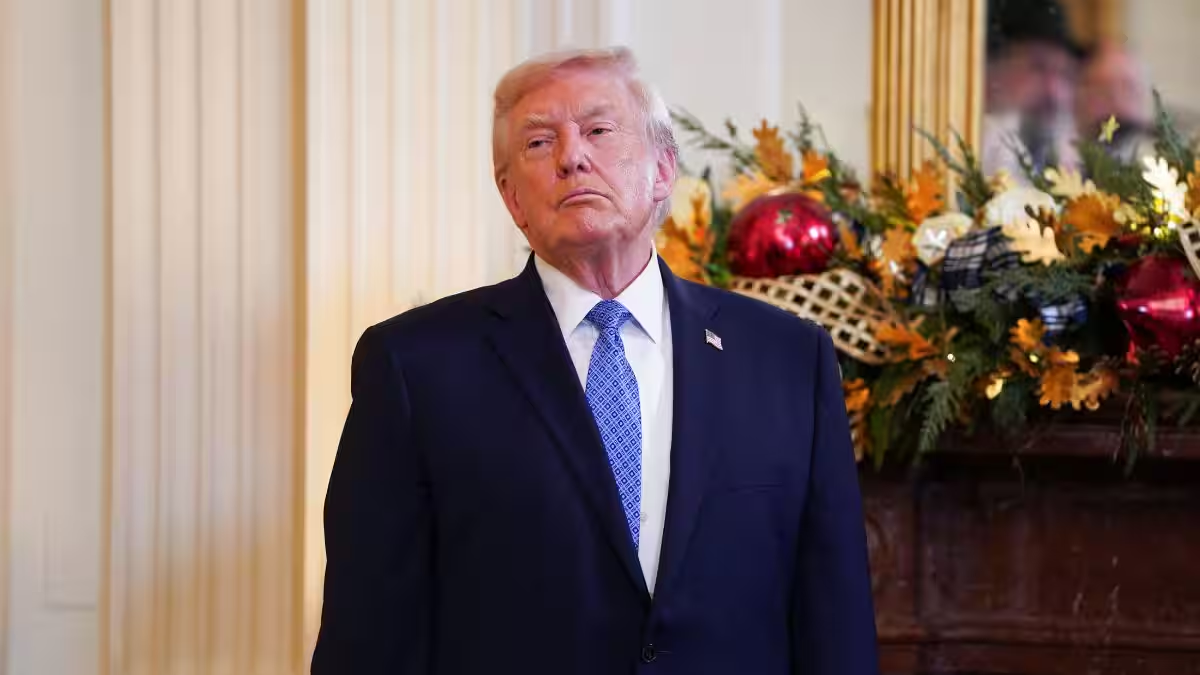
Indian-American Congressman Suhas Subramanyam recently stated that President Donald Trump has ‘completely messed up’ the India-US relationship, warning that deteriorating ties between the world’s two largest democracies are hurting both countries’ economic and strategic interests. What is the way forward for India under Trumpism?
Trumpism is described as a right-wing political ideology, movement, and communication style associated with US President Donald Trump and his political base. It is characterised by an “America First” agenda, which fuses elements of right-wing populism, economic nationalism, and neo-nationalism, often featuring illiberal and authoritarian leanings. It is also characterised by anti-globalism and a distrust of traditional institutions.
STORY CONTINUES BELOW THIS AD
Trumpism is linked to slogans like “Make America Great Again” and aims to challenge the liberal world order. Some of the core tenets and characteristics of Trumpism are prioritising nationalism and America First over international cooperation, populism, economic protectionism and anti-globalism, which means scepticism towards international organisations.
More from Opinion
How German Chancellor Merz’s India visit carries a strategic message
Why world should ignore Trump’s mockery of global leaders
There is an significant aspect which should not be overlooked. Trumpism is highly personality-driven, and a very major part of Trump’s personality is his huge ego. His ego is a central factor in his decision-making and his policies. In a 1995 New York Times opinion piece which he authored, Trump himself remarked that ego plays a major role in his life. The title of the article was ‘What My Ego Wants, My Ego Gets’. Trump discussed the role of his ego in his business transactions.
There can be no doubt that Trump’s ego plays a large role in shaping his approach and policies as the President of the United States of America, which is perhaps the most powerful position in the world. Many observers, including mental health professionals, have described President Trump as displaying traits consistent with egotism, which is a personality trait marked by a sense of self-importance and an excessive need for self-admiration. His behaviour is characterised by inflated self-esteem, self-centredness, and a tendency to talk about himself too much, often viewing himself as superior or better than others.
Quick Reads
View All
Why world should ignore Trump’s mockery of global leaders
How German Chancellor Merz’s India visit carries a strategic message
Trump’s behaviour is also characterised by an extreme intolerance for criticism. His typical response to criticism involves lashing out, blaming others, or attempting to discredit the source of the criticism. Trump frequently uses personal insults and derogatory nicknames to belittle critics, whether they are political opponents, journalists, or even fellow Republicans. He often blames others (such as the “fake headlines media”, the “deep state”, or previous administrations) for problems or negative outcomes to deflect attention from his own actions.
STORY CONTINUES BELOW THIS AD
Trump has often attempted to silence dissent by threatening legal action against media organisations, revoking press credentials, and surrounding himself with loyal individuals who are unlikely to challenge him.
Trump rarely admits mistakes and instead makes excuses, rationalises his actions, and vehemently denies having made certain statements, even when there is video or audio evidence to the contrary.
Analysts suggest Trump is “notoriously thin-skinned” and reacts with anger or rage to perceived challenges to his authority or self-image, often responding disproportionately to the original criticism.
Thus, a craving for admiration and loyalty is a key aspect of Trump’s presidential style. Trump needs constant admiration, and this has an effect on all his interactions. Playing to Trump’s ego is often seen as advantageous for those who deal with him, leading not just his own cabinet members but also foreign leaders to offer him praise and unwavering support. World leaders have massaged Trump’s ego to manage diplomatic relations. His ego-driven decision-making has influenced major global events, such as trade negotiations and alliances.
STORY CONTINUES BELOW THIS AD
Leaders like Nato Secretary General Mark Rutte publicly referred to Trump as “Daddy” in a jocular but calculated manner and sent private, fawning texts predicting “BIG” success at summits, which Trump then made public. Multiple leaders, including Israeli Prime Minister Benjamin Netanyahu and officials from Pakistan, nominated Trump for the Nobel Peace Prize, knowing his desire for the award, in an effort to curry favour.
When Prime Minister Keir Starmer of the UK paid a visit to the White House in February 2025, he brought a letter tucked in his jacket pocket. It was a formal invitation from King Charles III for a rare second state visit. Starmer presented it to Trump with rhetorical flourish in the Oval Office, saying, “This is really special. This has never happened before. So this is a very special letter.” Trump was very flattered.
Trump’s ego-driven decision-making has influenced major global events, such as trade negotiations and alliances. If his ego is hurt, he becomes very vengeful. I think India is discovering this grim and upset reality about Trump. During Donald Trump’s first term (2017-2021), India-US relations were marked by a high-profile personal chemistry between Prime Minister Narendra Modi and President Trump and significant advancements in defence and strategic cooperation despite persistent friction over trade and immigration. The period was highlighted by massive joint rallies: the “Howdy Modi” event in Houston (2019) and the “Namaste Trump” rally in Ahmedabad (2020), which showcased a unique personal rapport between the two leaders.
STORY CONTINUES BELOW THIS AD
Not surprisingly, the India-US relationship thrived in Trump’s first term. The defence partnership was the strongest pillar of the relationship, with India being elevated to a major defence partner. Key defence pacts were signed to enhance military interoperability, including the Comcasa (2018) for secure communications and the Beca (2020) for sharing geospatial intelligence.
The relationship was cemented by a shared concern over China’s growing influence. The Trump administration revived the Quad (US, India, Japan, and Australia) and renamed the Pacific Command as the Indo-Pacific Command to signal a broader strategic focus on a partnership with India. A Strategic Energy Partnership was launched in 2018, making the US a significant supplier of crude oil and LNG to India.
The first Trump administration (2017-2021) was widely characterised by a “tough” and often confrontational stance toward Pakistan, marked by significant aid cuts and public rebukes over terrorism.
Trump famously began 2018 with a tweet accusing Pakistan of giving the US “nothing but lies & deceit” while providing “safe haven to the terrorists we hunt in Afghanistan”. In January 2018, the Trump administration suspended nearly $1.3 billion in annual security assistance. The US adopted a tougher stance on Pakistan-based terrorism, supporting the designation of Jaish-e-Mohammad chief Masood Azhar as a global terrorist and backing Pakistan’s “grey-listing” by the FATF. However, the relationship shifted toward tactical cooperation by 2019 to facilitate the US withdrawal from Afghanistan.
STORY CONTINUES BELOW THIS AD
In Trump’s second term, things are quite different. The India-US relationship is currently defined by sharp economic friction and a significant recalibration of strategic priorities. The starkest departure from the first term is the use of high tariffs as a central policy tool. Trade relations between India and the United States have reached a point of acute tension due to a series of steep tariffs imposed and threatened by President Trump. Trump has frequently labelled India a “trade abuser” and the “king of tariffs”, publicly calling India’s economy “dead” or “one-sided”.
There have been several instances where PM Modi’s refusal to massage Trump’s ego reportedly “hurt” or frustrated Trump’s personal ambitions and public image. First, in September 2024, during the US presidential election campaign, Trump publicly stated that PM Modi would be meeting with him during his US visit.
However, despite PM Modi’s three-day visit to the United States from September 21 to 23, no meeting between the two leaders took place. The Indian Ministry of External Affairs (MEA) and the Prime Minister’s Office (PMO) were reportedly surprised by the claim, as no such meeting had been included in the official itinerary.
STORY CONTINUES BELOW THIS AD
Second, following a ceasefire between India and Pakistan in 2025 (linked to “Operation Sindoor”), Trump repeatedly claimed credit for de-escalating the conflict, as he wanted to bolster his case for a Nobel Peace Prize. Modi flatly rejected this, stating the ceasefire was settled directly between the two nations without US mediation.
Third, when Modi went to Canada for the G7 Meeting in June 2025, he declined an invitation from President Trump for a Washington stopover on his way back from the G7 Meeting. Modi himself remarked, “The President of the United States called me, saying, ‘Since you are in Canada, please come over. We will have a meal and talk’.”
PM Modi said that he declined President Trump’s invitation as he did not want to miss his scheduled visit to the “land of Lord Jagannath” (Odisha). However, insiders say that Pakistan’s Army Chief Asim Munir was going to meet Trump over lunch, and PM Modi reportedly feared a “photo trap” where Trump might engineer a staged handshake between Modi and Munir to use as a publicity prop for his pitch to get the Nobel Peace Prize.
STORY CONTINUES BELOW THIS AD
In April 2025, the Trump administration imposed a 25 per cent baseline reciprocal tariff on Indian goods to address trade deficits. In August 2025, Trump put an additional 25 per cent punitive penalty specifically for India’s continued purchase of Russian crude oil. These tariffs heavily affect labour-intensive industries such as textiles, gems and jewellery, pharmaceuticals, auto parts, and seafood. Nearly 55 per cent of India’s annual exports to the US (valued at approximately $87 billion) are directly threatened.
A pivotal ruling is expected regarding the legality of Trump’s use of the International Emergency Economic Powers Act (IEEPA) to bypass Congress in levying these broad-based tariffs. A ruling against the administration could provide immediate relief to Indian exporters, though White House officials have signalled they have “other tools” to reimpose duties if necessary.
India’s Ministry of External Affairs criticised the US tariffs as “unfair, unjustified, and unreasonable”. India mentioned that its energy sourcing is guided by the need to secure affordable fuel for its 1.4 billion citizens and is a matter of strategic autonomy. This criticism has further annoyed Trump, who has threatened further tariffs.
Recently, in early January 2026, President Trump gave the green light for the Russia Sanctions Bill proposed by Republican Senator Lindsey Graham. The legislation authorises the US President to impose secondary tariffs of up to 500 per cent on any country that continues to purchase Russian petroleum or uranium products. This bill explicitly targets China, India and Brazil. A vote in the US Senate is possible soon. This has placed India’s $85 billion export industry to the US at risk of becoming commercially unviable.
The Trump administration’s H-1B policies have negatively impacted India by disrupting the Indian IT industry’s business model, limiting opportunities for Indian professionals and students, and potentially slowing India’s economic growth. The primary mechanism of this impact is the increased cost and stricter eligibility criteria for the visa, which Indian nationals largely dominate.
The H-1B visa changes, particularly the steep $100,000 fee for innovative applications, directly challenge the business model of Indian IT giants like Tata Consultancy Services, Infosys and Wipro, which have historically deployed large numbers of Indian engineers in the US. The innovative fee, a massive increase from the previous $1,000-$5,000 range, significantly raises the cost of sending employees to the US, eroding their profit margins.
Indian nationals make up over 70 per cent of all H-1B visa recipients, making them the most affected demographic group by the policy changes. The prohibitive costs and stricter eligibility criteria (favouring higher salaries) mean fewer opportunities for entry- to mid-level Indian professionals and recent Stem graduates from US universities to secure H-1B sponsorships. India’s tech sector contributes significantly to its GDP (around 7 per cent), with the US accounting for a large portion of tech exports.
While the tariffs and high H1B visa fees have caused acute diplomatic tension, many US experts believe the long-term trajectory remains unchanged because Washington still views India as an essential counterweight to China in the Indo-Pacific. They argue that the core geopolitical reasons for engagement are overwhelming, as Washington views partnering with India as critical to sustaining its own long-term leadership and successfully navigating competition with China. In late 2025, the two nations signed an expansive fresh defence framework to strengthen their “Major Defence Partnership" over the next decade. However, Trump’s ego hindernis will continue to be an obstacle.
As things stand, the relationship between Trump and Modi is characterised by a “blow hot, blow cold” dynamic. While both continue to profess a “very fine relationship”, significant policy friction—particularly over trade and energy—has led to public disagreements and reports of personal tension. Their personal chemistry appears to have eroded.
Recent statements from the Trump administration suggest that a significant trade deal with India collapsed due to a lack of direct personal communication between the two leaders, rather than a policy disagreement.
US Commerce Secretary Howard Lutnick publicly declared in an interview that a nearly finalised trade deal stalled in late 2025 because PM Modi did not personally call President Trump to close it. Lutnick stated that while the deal was “all set up”, the Indian side appeared “uncomfortable” making the final call, which Trump viewed as a necessary step for finalising agreements.
The US applied a “staircase” model to these negotiations, rewarding countries that acted quickly. The UK finalised a deal first, followed by Indonesia, the Philippines, and Vietnam. Lutnick remarked that because India missed its specific “three Fridays” window, the previous favourable terms offered are no longer available.
The Spokesman of India’s Ministry of External Affairs (MEA) rejected the US Commerce Secretary’s remarks as “not accurate” and mentioned that PM Modi and Trump had spoken on the phone eight times last year, covering “different aspects of our wide-ranging partnership”. However, the phone call issue which US Commerce Secretary Howard Lutnick spoke about is a bit different from how the MEA spokesman has explained it.
While Modi and Trump may have spoken eight times, Lutnick is saying that PM Modi did not call Trump to request him to close the trade deal. Lutnick reported in his interview that the US side wanted PM Modi to call Trump when the deal was nearing finalisation. He reported, “India’s reluctance to set up the phone call between Modi and Trump meant the agreement ran into trouble.”
In other words, the US side wanted PM Modi to massage Trump’s ego for securing the deal, but PM Modi did not make the call. Of course, many people in India feel that deal or no deal, Modi did the correct thing by refusing to massage Trump’s ego.
Summing up, there are currently very massive challenges in India-US relations due to economic friction and Trump’s transactional foreign policy approach. Donald Trump’s ego will continue to be a primary driver, making his foreign policy highly personal, transactional, and unpredictable. This represents a significant departure from the institutional, rules-based approach of previous US administrations. The highly personal and transactional nature of Trump’s foreign policy also makes the relationship susceptible to sudden shifts based on Trump’s whims or immediate domestic political considerations, making long-term planning difficult for India. The relationship has soured over the implementation of 50 per cent tariffs on Indian goods and general aggressive trade policies, which have caused economic friction.
The US is considering 500 per cent tariffs on countries doing business with Russia, but India has continued to import Russian crude, highlighting a conflict in priorities that clashes with US pressures. Strategic cooperation in defence remains fine, and both governments maintain that the relationship is too key to be entirely derailed. The future trajectory of relations will depend heavily on how both nations manage their divergent economic and foreign policy priorities.
(The writer is a retired Indian diplomat and had previously served as Ambassador in Kuwait and Morocco and as Consul General in New York. Views expressed in the above piece are personal and solely those of the author. They do not necessarily reflect Firstpost’s views.)
HomeOpinionTrumpism and the way forward for IndiaEnd of Article