Ukraine to Venezuela: India’s geopolitical strategy amidst global turbulence – Firstpost
The world is going through extraordinary and unprecedented changes. Change is the order of nature, but the transformations that the world has witnessed over the last few years have been qualitatively and quantitatively different in nature, scope and pace than those experienced in any similar previous period.
Some of the most significant changes over the last several years include the collapse of bipolarity, the transient rise of unipolarity, the upswing in multipolarity signalled by the ascent of China and other emerging economies like India, Brazil, Indonesia, African nations, etc, decline in multilateralism, surge in terrorism, weaponisation of interdependence with economic ties becoming tools for coercion (trade wars, sanctions), and the emergence of technology as power, with competition for dominance in AI, semiconductors, rare earth minerals and magnets, and 5G becoming central to national power, etc.
STORY CONTINUES BELOW THIS AD
In essence, the world has moved from a predictable, albeit tense, Cold War bipolarity to a fluid, contested system defined by rising powers, intertwined economies, technological competition, and challenges to traditional state power.
More from Opinion
‘Arise, awake’: Why Swami Vivekananda matters to Gen Z
Iran at the brink: Is the Islamic Republic losing control?
In a somewhat more proximate time frame, the world and India have witnessed the onslaught of the Covid-19 pandemic in 2020, which devastated several countries around the globe; the departure of US and NATO forces from Afghanistan in 2021; the political and economic crisis in Sri Lanka in 2022; the unexpected aggression by Russia against Ukraine in February 2022 and its continuation for close to four years with no end in sight; the violent change of government in Bangladesh in August 2024; the onset and continuation of the Israel-Hamas conflict since October 2023; the changeover of government in the Maldives by an ostensibly anti-India dispensation in November 2023; and many more, with the latest being the American military exercise against Venezuela on January 3, 2026.
For India, the biggest challenge has been the Trumpian shock, if not disruption, to the steadily expanding and growing ties between India and the US over the last 25 years. India has been able to effectively deal with the challenges that have come its way through the use of policies based on Vasudhaiva Kutumbakam (The World Is One Family), multi-alignment and strategic autonomy.
Quick Reads
View All
Iran at the brink: Is the Islamic Republic losing control?
Germany and India at 75: Significance of Chancellor Merz’s Delhi visit
India’s Economic Rise
India has been successful in implementing these strategies because of two fundamental advantages it has been endowed with.
One, India’s economy has grown significantly over the last 11 years. When Prime Minister Narendra Modi-led government came to power in 2014, India’s economy was the 10th largest in the world. Today it is the 4th largest, with prognosis to emerge as the third largest by 2027. Today India is the fastest growing major economy, with its GDP growth registering impressive figures of 8.2 per cent and 7.8 per cent over the last two quarters. India is expected to grow from a $4 trillion economy currently to $10 trillion by 2035.
STORY CONTINUES BELOW THIS AD
India’s increased economic capacity has helped it in multiple ways. It has been able to provide a better standard of living to its people. It has been able to improve its infrastructure, both physical and social, in terms of health, education, roads, highways, ports, airports, etc. It has also been able to apportion a larger quantum of funds towards its military preparedness, moving in the direction of increasingly becoming aatmanirbhar (self-sufficient) in defence preparedness, improving and expanding its roads, tunnels, bridges, etc, infrastructure in the border areas to safeguard and ensure its security and territorial integrity.
Also, it has increased India’s capacity to play a much more active role in global affairs and lend a helping hand in times of need to its strategic partners. During the Covid-19 pandemic, India went out of its way to supply medicines and vaccines, both Covishield and Covaxin, to its strategic partners, particularly from the Global South. India provided the necessary medicines, most of them gratis, to more than 150 countries, and supplied more than 300 million vaccine doses under its Vaccine Maitri (Vaccine Friendship) initiative to more than 100 countries. Because of its economic heft and capability, India could come to the assistance of Sri Lanka to the tune of $4.5 billion when the latter’s coffers were empty in 2022, and to the support of Afghanistan, the Maldives, etc, when these countries had their backs to the wall. This has also enabled India to emerge as the First Responder in times of need and when calamities like earthquakes, floods, etc., have struck in our neighbourhood and beyond.
STORY CONTINUES BELOW THIS AD
The Leadership Advantage
The second significant contributor to India’s evolution as a major global power in recent years is the bold, decisive and visionary leadership of Prime Minister Narendra Modi. This has stood India in positive stead in successfully dealing with the challenging and difficult times that it has faced, both internally and externally, over the last several years. India was able to provide the underprivileged sections of its society with adequate food rations while confronting the scourge of the Covid-19 pandemic. This government support continues even now, providing a cushion to about 800 million citizens for their nutrition as they deal with the recent challenges and problems that they are required to contend with.
While firmly and decisively dealing with the continuing challenges, PM Modi has provided an aspirational objective of attaining Viksit Bharat 2047 (Developed India 2047) by the time India celebrates the centenary of its independence in 2047. It is expected that if India were to grow at 8-9 per cent per annum, its economy would reach $30 trillion by that date, which would enable its people to have a much higher standard of living than at present. For this, India will need to become a technological leader. To achieve this, India is focusing in a substantial way on advancing in AI, quantum computing, robotics, semiconductors, etc., to stay ahead in the march of global technological leadership.
On the external front, India, under PM Modi, has categorically stated that it will go to any extent to safeguard and protect the security and wellbeing of its people and the territorial integrity of its borders. The firm action taken by India against the intrusions by China in the Eastern Ladakh area in 2014, in the Doklam sector of Bhutan in 2017, and in the Galwan region of Ladakh in 2020 has sent out a strong and clear message to China that India will no longer tolerate the practice of salami slicing that China has resorted to in the past. On the western front, by resorting to surgical strikes (2016), air strikes on the Balakot camp (2019) and Op Sindoor (2025), India has made it abundantly clear that it will not succumb to the threat of terrorism, of nuclear blackmail, and that every cross-border act of terror will be treated as an act of war.
STORY CONTINUES BELOW THIS AD
India has also stood firm against the coercive tactics of US President Donald Trump to reduce its tariffs on agricultural products like dairy items (milk, cream, yoghurt, cheese), GMOs, cereals, pulses and oilseeds, sugar, onions and almonds, etc., to protect the livelihoods of its farmers and ensure food security. It has also refused to be coerced into acknowledging that Donald Trump had any role to play in the cessation of hostilities in Op Sindoor on 10 May 2025. India’s consistent stance has been that India agreed to the ceasefire when Pakistan begged it to do so after the latter’s airfields and other strategic assets were decisively demolished on 10 May 2025.
In the context of the Russia-Ukraine conflict, India has made it clear that it is in favour of a negotiated settlement through dialogue and diplomacy. It has, however, not wilted under Western, particularly US, pressure to stop importing oil at concessional rates from Russia in order to safeguard its national interests to provide energy at affordable rates to its 1.4 billion nationals.
STORY CONTINUES BELOW THIS AD
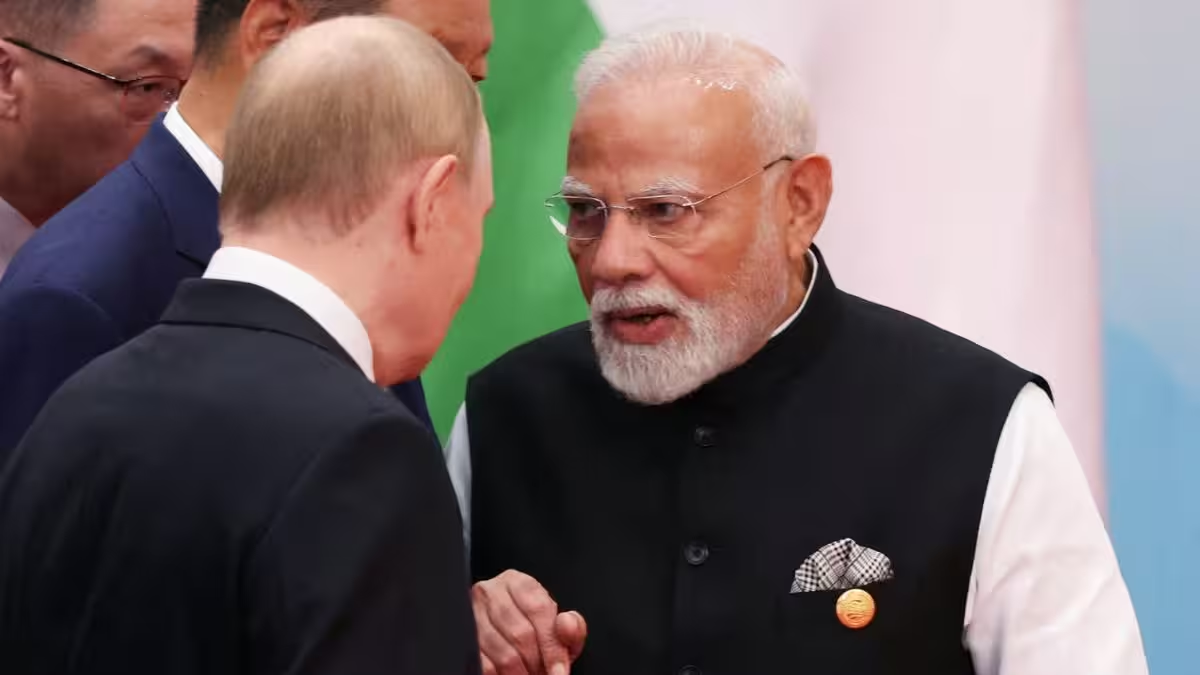
India demonstrated its strategic autonomy by PM Modi visiting Russia twice in 2024, attending the SCO Summit in Tianjin, China, in September 2025, and extending a warm and enthusiastic welcome to Russian President Vladimir Putin to India for the 23rd India–Russia Annual Summit in December 2025, taking the relations to a novel high by declaring to provide a quantum jump to bilateral trade, defence and technological cooperation. In parallel to this, India announced that European Commission President Ursula von der Leyen and the President of the European Council, António Costa, will be the Chief Guests at India’s Republic Day celebrations in January 2026. This is a vivid demonstration of India’s policy of multi-alignment.
The Path of Vasudhaiva Kutumbakam
While delivering his first address to the UN General Assembly session in September 2014, immediately after assumption of power, Prime Minister Narendra Modi invoked the spirit of Vasudhaiva Kutumbakam as the guiding philosophy of India’s foreign policy. This principle has continued to inform all of India’s policy actions, particularly its ‘Neighbourhood First’ Policy, by which it has sought to reach out unilaterally and non-reciprocally to its neighbouring countries. This has yielded rich dividends in deepening trust and expanding its ties with most of its neighbours, including Sri Lanka, the Maldives, Bhutan, Nepal, Bangladesh (till July 2024), Afghanistan, etc.
The fact that India’s relations with some countries like Pakistan and Bangladesh (from August 2024) have been rocky and tense is not for want of trying by India but because of the internal domestic politics of those countries. With China also, India went out of its way to have normal and stable ties and to realise the full potential of their bilateral relations as two large economies and ancient civilisations.
STORY CONTINUES BELOW THIS AD
However, China’s inexplicable aggressive policies in 2020 leading to the Galwan conflict led to a hiatus and standoff for more than four years. India steadfastly held its ground, not succumbing to Chinese pressure of deploying 50,000–60,000 troops in the border areas, contrary to agreements signed between the two countries. A bilateral meeting between PM Modi and Chinese President Xi Jinping in October 2024 in Kazan, Russia began the gradual process of normalisation of bilateral ties. India has consistently maintained that bilateral ties can improve only on the basis of the three mutuals: mutual sensitivity, mutual respect and mutual interest.
India’s policy of Vasudhaiva Kutumbakam witnessed its fullest expression during India’s chairmanship of the G20 in 2023. India not only adopted the motto of ‘One Earth, One Family, One Future’ for its presidency but also made sure that all decisions and results emanating from the deliberations among the G20 members and the invited guest countries fully reflected this commitment. This became obvious on the first day of the Summit itself, when India announced the decision of the G20 membership to invite the African Union (AU), a grouping of 54 African countries, as the 21st member of the G20. This issue had been on the back burner of the G20 deliberations for the last several years, but it fell upon India, with its commitment to the interests of the Global South, to bring this to fruition.
STORY CONTINUES BELOW THIS AD
In addition, to focus on the interests, concerns, aspirations and challenges of the developing countries, PM Modi organised the first Voice of the Global South Summit (VOGSS) within a few weeks of taking over charge of the G20. About 125 developing countries at the level of Presidents, Vice Presidents, PMs and Ministers participated in this virtual Summit. All their concerns, including food and energy security, debt relief, women’s empowerment, infrastructure financing, functioning of the MDBs, economic instability, climate vulnerability, and a lack of representation in global governance institutions, were taken on board in discussions and the final outcome enshrined in the New Delhi Leaders’ Declaration in September 2023.
India organised the second VOGSS in November 2023 to inform the members of the Global South about the decisions of the G20 and how their concerns and aspirations had been fully reflected in the final document adopted by the G20 member states. India has continued to articulate the concerns and ambitions of the Global South by holding the third VOGSS in August 2024, and raising the problems and challenges faced by the developing world in all multilateral and plurilateral fora.
Multi-Alignment and Strategic Autonomy
India’s policies of multi-alignment and strategic autonomy are two sides of the same coin. Both are supported by India’s active diplomatic profile, and greater economic, political, strategic, military and human capacity. In addition to these elements of hard power, which India has continued to strengthen over the last more than a decade, India has also expanded its soft power through greater popularisation of yoga (177 countries co-sponsored India’s resolution to declare 21 June as the International Day of Yoga in 2014), Indian dance, music, culture, Bollywood films, Ayurveda, traditional medicine, democratic values, cuisine, spiritual heritage (Hinduism, Buddhism), development cooperation, a strong and active diaspora, etc.
In the current-day conflicts, India is one of the very few countries, if not the only country, to have superb relations with both the West (USA, EU, Japan, Australia) and the main protagonist, Ukraine, as well as Russia, and also with Israel as well as Palestine, Iran and other West Asian countries. In the context of the Russia–Ukraine conflict, India has stated categorically that its policy is not of neutrality. It stands on the side of peace and wants an end to the conflict as quickly as possible on the basis of dialogue and diplomacy. India has strongly articulated this stance, as the continuation of the conflict has a harmful impact in the areas of increasing debt, food and energy security, etc, on developing countries. It has stated clearly that disputes can never be solved on the battlefield but only at the negotiating table.
Some analysts commit the serious error of equating multi-alignment with transactionalism. Nothing could be further from the truth. The two concepts represent fundamentally different approaches to international relations and cooperation. While both involve engaging multiple partners, multi-alignment is a strategic approach to build diverse, long-term geopolitical and economic resilience by engaging various global powers (US, Russia, China, EU) based on shared interests, aiming for strategic autonomy and navigating a multipolar world.
Transactionalism, on the other hand, focuses more narrowly on quick, bilateral, short-term deals for immediate gains, often degrading complex multi-alignment for simpler, self-interested transactions, a pattern that could be associated with recent US foreign policy positions. Multi-alignment seeks broad, deep engagement across issues (energy, defence, trade), not just single deals, making it more complex and non-transactional.
The key objective of multi-alignment for India is strategic autonomy, leading to reduced geopolitical risk and broader influence in a multipolar world. It embodies proactive, complex, issue-specific cooperation with multiple, often competing, global poles (US, China, Russia, EU). For example, India partnering with Russia on energy/arms and strategic manoeuvrability, while engaging with the US on trade, defence and tech, and collaborating with Europe on climate, technology and markets falls squarely under this policy of multi-alignment. Multi-alignment is not just about hedging options; it is about actively shaping relationships for national interest on a long-term basis, moving beyond ideological constraints.
Multi-alignment acknowledges the complex, interconnected nature of global issues (trade, climate, technology, security), requiring broad engagement, while transactionalism favours transient, short-term bilateral deals. Multi-alignment is a nuanced geopolitical, long-term strategy for rising powers like India to navigate great power competition without choosing sides, whereas transactionalism can be seen as a short-term, self-interested approach to foreign policy. Transactionalism represents a rejection of shared, multilaterally accepted norms: it tends to downplay long-term partnerships and international rules in favour of specific, one-off deals.
India’s multi-alignment strategy is supreme illustrated by India’s expanding and robust ties with Europe, Japan, Australia, etc. (the US has not been included in the list on account of the considerable stress brought into this relationship by President Trump’s trade and strategic policies over the last six months since June 2025) on the one hand, and the time-tested and trusted relations with Russia (and normalising relations with China) on the other. This is also evident from India’s membership of the BRICS on one side and the Quad on the other; from India’s ties with the SCO members on the one hand and the regular and constant invitation to PM Modi to participate in the G7 meetings for the last seven years since 2019 on the other. The West, particularly the US, wants India to disengage itself from Russia in energy and defence-related deals. It needs to understand that India is a determined and committed partner of the West, and that a strong and independent India is a better strategic ally than a subservient one.
Major Challenges
India’s most formidable geopolitical challenge in the immediate future and long term is the aggressive stance of China as it seeks to emerge as the unipolar power in Asia and to reduce India to a subordinate status. Its border dispute with India, its military, intelligence, strategic and economic support to Pakistan, the Tibet issue, its weaponisation of its critical minerals and supply chains, and the creation of a necklace of pearls around India to contain its rise are significant challenges.
The threat emanating from Pakistan is of comparatively lesser significance. India is well equipped to deal with it effectively. India will, however, have to keep a close watch on Pakistan’s machinations as its Army Chief, Asim Munir, and its political leadership would have been made even more reckless and adventurous than in the past by the excessive and exorbitant support and praise heaped on them by President Trump.
Bangladesh has emerged as a potent challenge in recent months in areas of border security, rising Islamist extremism, increasing minority attacks, and shifting geopolitical alignments, particularly its growing ties with Pakistan, Turkey and China, against India’s interests. India is pursuing a balanced strategy that prioritises diplomacy, security enhancements, and economic leverage while eschewing escalation.
India needs to deploy advanced surveillance like drones and AI-monitored fencing along the 4,000 km-plus border to curb infiltration, smuggling, and terror threats from radical groups. It should leverage Bangladesh’s trade dependencies by conditioning connectivity projects on stability commitments. Bangladesh needs to adopt a balanced foreign policy, keep a lid on insurgency and extremism, and do more to curb cross-border smuggling and illegal migration. Assuaging Indian security concerns will be paramount for putting the relationship on the right track, and making it a source of stability in the years ahead.
One of the most unexpected and vexing problems to have emerged in recent months is India’s relations with the US, which had been cruising along on a steady upward trajectory since 2000. While India was among the most enthusiastic to welcome Trump’s second incarnation based on its experience of dealing with him in his first term, India-US relations suddenly and unexpectedly plummeted in June 2025. For decades, the United States and India have built a steadily deepening partnership, forged by shared strategic interests, economic ties, and growing defence cooperation.
Recent actions by the Trump administration have jeopardised the hard-earned trust by actions and rhetoric that cut deeper than the usual strains in the US-India relationship. The Trump administration’s 50 per cent tariff on goods from India, President Donald Trump’s claiming credit for achieving a ceasefire between India and Pakistan, and a controversial meeting with the Pakistani army chief in the Oval Office with a strong outreach to Pakistan, serve to fundamentally erode trust built over decades, and play into India’s deepest historic reservations about the reliability of the relationship. At a moment when the US-India partnership is more essential than ever, this breach takes on added significance.
India has stood firm in the face of Trump’s provocative rhetoric and bullying tactics. It is expected that bilateral ties, which are characterised as a ‘comprehensive global strategic partnership’, will stabilise in the coming months. It is encouraging that, barring the issues of trade and Pakistan, bilateral ties in the area of defence, military exercises, exchange of delegations, etc, have been proceeding seamlessly. It is in the mutual interest of both countries, as well as in the interest of peace, security and stability in the Indo-Pacific, to have robust, stable and dynamic ties between the two countries.
While India continues to negotiate on all outstanding issues with the US in superb faith, it is hoped that this realisation will dawn, sooner rather than later, on President Trump also, who will start working towards normalising relations between the two countries. It is not certain whether Trump’s policies will continue to govern India-US ties only during the current term of his administration, or whether similar policies will inform US attitudes towards India after 2029 also. While working towards optimum results in bilateral India-US relations, India will have to insulate itself against outcomes which might not be ideal from its perspective.
Conclusion
To contend with the geopolitical and geo-economic challenges that confront India under the current global strategic, security and economic architecture, the most imperative requirement is to maintain India’s consistent technological and economic growth at 8-9 per cent per annum so that India reaches a respectable figure of $30 trillion by the time it celebrates the centenary of its independence in 2047. This will not only guide it to provide a better standard of living to its people but also make adequate funds available to significantly enhance its defence preparedness and improve its infrastructure in the border areas as well as throughout the country.
The United States will continue to be India’s most significant economic, defence and technological partner for the foreseeable future. The level of trust that had been steadily growing and strengthening has been deeply eroded and will take a long time to recover and be restored. In the meantime, it will be incumbent upon India to diversify away from the US in the area of markets, defence supplies, and critical and emergent technologies. Some of the most attractive partners in this sphere would be the EU, with which India is on the verge of concluding an FTA; the UK, with which India has recently finalised an FTA; and Japan, Australia, Africa, ASEAN and other like-minded countries.
India’s partnership with Russia is also very vital and needs to be nurtured, notwithstanding the fact that its suitability as a massive exchange, or source of cutting-edge technology (except in the area of defence), is somewhat limited and questionable.
In addition to new initiatives like the ‘Neighbourhood First’ Policy, which has yielded rich dividends in terms of expanding and strengthening relations with its neighbours, PM Modi has launched several fresh initiatives. Some of the most significant of these are the ‘Engage West’ policy to reach out to the countries in West Asia; the ‘C5 plus India’ to deepen and enhance relations with our extended neighbourhood of Central Asia; as well as the ‘Act East Policy’ to raise and revitalise ties with ASEAN member states and those of Far East Asia.
India has paid special attention to relations with Africa and Latin America, which are emerging as modern centres of economic and technological dynamism. Several novel embassies have been established on the African and South American continents as also in Central and Eastern Europe, making up for years of neglect of these regions. Significantly, India’s senior leadership has invested considerable political capital in reaching out to these regions by visiting these countries often and also welcoming their leaders and ministers to India.
India’s global power and influence has expanded significantly over the last decade. It will continue to grow in the coming years. As India has successfully and effectively confronted the several grey and black swan events that it has encountered in recent years, it can look with hope, confidence and determination to deal with any fresh challenges that come its way in the coming months and years.
The writer is executive council member, Manohar Parrikar Institute for Defence Studies and Analyses, president, Institute of Global Studies, Distinguished Fellow, Ananta Aspen Centre, and former Ambassador of India to Kazakhstan, Sweden and Latvia. Views expressed in the above piece are personal and solely that of the author. They do not necessarily reflect Firstpost’s views.
HomeOpinionUkraine to Venezuela: India’s geopolitical strategy amidst global turbulenceEnd of Article