What weapons and military force could Trump use against Iran? – Firstpost
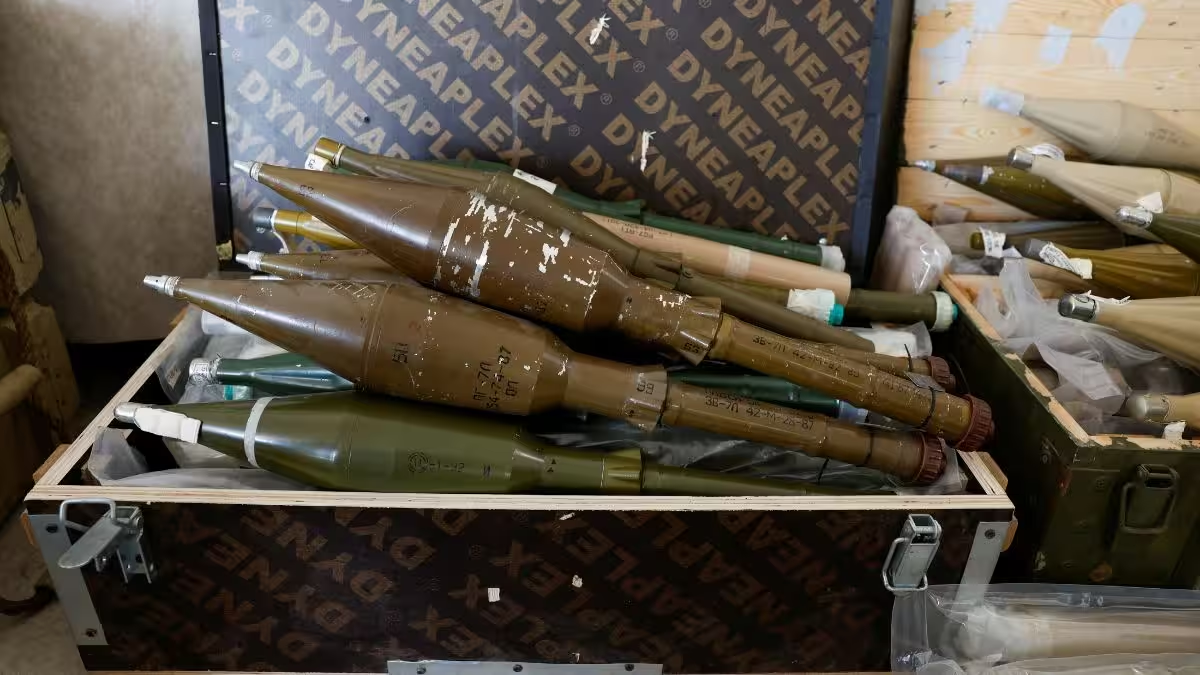
The United States’ posture towards Iran is hardening as protests take a violent turn in the West Asian country where thousands across the country are challenging the clerical establishment that has ruled since the 1979 Islamic revolution.
Initially sparked by worsening economic conditions, the demonstrations have evolved into a broader political confrontation, prompting warnings from US President Donald Trump that Washington could intervene militarily if the Iranian authorities continue their violent crackdown.
STORY CONTINUES BELOW THIS AD
On January 13, Trump addressed Iranian demonstrators directly on his Truth Social platform, writing, “Iranian Patriots, KEEP PROTESTING TAKE OVER YOUR INSTITUTIONS!!! Save the names of the killers and abusers. They will pay a giant price. I have cancelled all meetings with Iranian Officials until the senseless killing of protesters STOPS. HELP IS ON ITS WAY. MIGA!!! PRESIDENT DONALD J. TRUMP”
More from Explainers
Power, law and empire: Seismic implications of American military operation in Venezuela
Denmark warns US over Greenland. But can its armed forces really fend off invasion?
The phrase “MIGA” refers to “Make Iran Great Again,” echoing Trump’s long-standing political slogan. However, the president did not clarify what form this promised assistance might take.
Earlier this month, Trump had already hinted at potential military action, stating that if Iran “violently kills peaceful protesters, which is their custom, the United States of America will come to their rescue,” adding, “We are locked and loaded and ready to go.”
What military presence does the US have in West Asia?
Despite the sharp rhetoric, the US military footprint in the region is currently smaller than it was during the 12-day war last year.
In June 2025, the USS Gerald Ford — the world’s largest aircraft carrier — sailed from Norfolk, Virginia, to the Mediterranean, signalling Washington’s readiness to project power.
Editor’s Picks1Why fall of Ayatollah would neither mean liberalism nor revival of Zoroastrianism for Iran
2
Iran at the brink: Is the Islamic Republic losing control?
The carrier has since been reassigned to the Caribbean under US Southern Command’s Operation Southern Spear, which has been building off the coast of Latin America since November 2025.
Its accompanying strike group vessels have also largely left the Mediterranean.
According to an October 2025 analysis by the Center for Strategic and International Studies (CSIS), the USS Gerald Ford would require roughly 10 days to travel from the Caribbean back to the Mediterranean at an average speed of 20 knots (37 km/h or 23 mph).
STORY CONTINUES BELOW THIS AD
From there, it would likely take an additional week to reach the Persian Gulf and Iran’s coastline.
Similarly, a Patriot air defence unit that had been redeployed from South Korea to the US Central Command (CENTCOM) area in March 2025 to reinforce missile defences against Iran and Houthi threats returned to the Korean Peninsula on October 30, 2025, for equipment upgrades.
Even so, the United States continues to operate a wide network of military facilities across the region. It maintains sites at at least 19 locations in West Asia, including eight permanent bases in Bahrain, Egypt, Iraq, Jordan, Kuwait, Qatar, Saudi Arabia, and the United Arab Emirates.
One of the most critical of these is Al Udeid Air Base in Qatar, the largest US military installation in the region, housing around 10,000 troops.
According to unnamed diplomats cited by Reuters, some personnel were instructed to leave the base by Wednesday evening, though the reason for the move remains unclear.
STORY CONTINUES BELOW THIS AD
The development has heightened concerns about a possible US strike and the risk of Iranian retaliation.
What can we learn from the 2025 US strikes on Iran’s nuclear sites?
The Trump administration frequently points to last year’s bombing of Iranian nuclear facilities as a major military success. In 2025, US Air Force B-2 stealth bombers carried out long-range missions to strike multiple Iranian nuclear installations.
Fourteen of the world’s largest conventional bombs were dropped, and the operation was completed without any US casualties or aircraft losses, including among the fighter jets, refuelling tankers, and support planes that took part.
Those attacks were narrowly focused on nuclear targets. A recent operation aimed at supporting Iranian protesters would likely look very different, analysts say.
Rather than concentrating on enrichment plants, any future strikes would probably focus on command centres linked to the Islamic Revolutionary Guard Corps (IRGC), the Basij militia, and Iranian police forces — the institutions most directly involved in suppressing the protests.
However, many of these facilities are located in densely populated areas, increasing the likelihood of civilian casualties.
Analysts warn that such losses could undermine US objectives, strengthening Tehran’s propaganda efforts and alienating Iranians who want reform but do not want foreign bombs falling on their cities.
STORY CONTINUES BELOW THIS AD
Speaking to CNN, Peter Layton, a visiting fellow at the Griffith Asia Institute in Australia, acknowledged the risks but remarked Washington still has a broad range of potential targets.
He noted that Iran’s senior leadership could be vulnerable, particularly as Tehran has already learned from Israeli operations that killed high-ranking Iranian military figures and nuclear scientists last year.
What options does Trump have to strike Iran now?
While B-2 bombers spearheaded the 2025 nuclear strikes, analysts believe other weapons could be better suited for a more diverse target set.
One option is the Tomahawk cruise missile, which can be launched from US Navy submarines and surface ships positioned far from Iranian shores, reducing the danger to American personnel.
Another is the Joint Air-to-Surface Standoff Missile (JASSM), which carries a 1,000-pound penetrating warhead and has a range of up to 620 miles (1,000 kilometres). JASSMs can be fired from a wide array of US aircraft, including F-15, F-16, and F-35 fighters, B-1, B-2, and B-52 bombers, as well as Navy F/A-18 jets.
Unmanned drones could also play a role, analysts say, offering surveillance and strike capabilities with lower risk to US pilots.
STORY CONTINUES BELOW THIS AD
However, the absence of a US aircraft carrier in the region limits Washington’s immediate options. As of Monday, the nearest carrier, the USS Abraham Lincoln, was operating thousands of miles away in the South China Sea.
This means any near-term airstrikes would likely originate from US air bases in the Persian Gulf or from more distant locations.
During last year’s B-2 missions, the stealth bombers flew nonstop from Missouri to Iran with multiple aerial refuelling operations. Other US aircraft capable of carrying JASSMs can also refuel mid-air.
Analysts say that increased movement of tanker aircraft, as well as the repositioning of strike platforms like the B-1 bomber or F-15 Strike Eagle closer to Iran, could signal preparations for an imminent operation.
Layton believes that if the Trump administration does act, it will seek a highly visible and rapid outcome. “The administration is attracted to theater. This means dramatic, media-attracting, head-turning events,” he declared.
He added that any strike would likely be brief, echoing the short duration of last year’s nuclear facility attacks. “The administration likes short-duration raids that involve the lowest risk to the US forces involved.”
STORY CONTINUES BELOW THIS AD
One possible option, according to Layton, would be targeting Iran’s oil infrastructure in the Persian Gulf. “The easiest and safest target set,” he remarked.
“It would damage Iran economically for the medium to long term. Some drama in large plumes of smoke and easy for external media to cover.”
How can Trump use AI-driven cyber warfare against Iran?
Beyond physical weapons, the US has also expanded its use of cyber and electronic warfare tools. US Central Command has focused on disrupting Iran’s digital counter-insurgency systems, including through electronic jamming to protect Starlink satellite signals.
This would help protesters and opposition groups maintain communication during government-imposed internet shutdowns.
Cyber operations could also target Iran’s integrated air defence networks and drone command-and-control systems, limiting Tehran’s ability to respond with its own “swarm” drone tactics.
The US has strengthened its regional missile defence network with Patriot and THAAD (Terminal High Altitude Area Defence) batteries stationed in Israel and Qatar.
These systems are linked to an air defence coordination cell at Al Udeid Air Base, which uses AI-driven tracking to intercept Iranian ballistic missiles.
If Washington were to launch strikes aimed at protecting Iranian protesters from state violence, it could also deploy AGM-158 JASSM-ER missiles from B-52 bombers or B-21 Raider prototypes.
STORY CONTINUES BELOW THIS AD
These weapons allow for “standoff” attacks that hit targets from beyond the reach of Iran’s surface-to-air missiles.
With any inputs from agencies
Follow Firstpost on Google. Get insightfulexplainers, sharpopinions, and in-depthlatest reports on everything from geopolitics and diplomacy toWorld News. Stay informed with the latest perspectives only on Firstpost.TagsDefence Donald Trump Iran United States of AmericaHomeExplainersWhat weapons and military force could Trump use against Iran?End of Article