Why Dhaka should revisit China’s sinister role in the 1971 war – Firstpost
As Dhaka’s winter air cools, the political temperature is beginning to boil. The state funeral of Khaleda Zia and Tarique Rehman’s assumption of Bangladesh Nationalist Party (BNP) leadership have garnered reactions from actors across the board. With the announcement of the national elections on February 12, 2026, Bangladesh finds itself at a historical crossroads that mirrors the seismic shifts of 1970. But while the ghosts of 1971—Pakistan, India, the US and the USSR—remain ever-present, a once-silent player from the liberation era has moved to the centre of the board.
STORY CONTINUES BELOW THIS AD
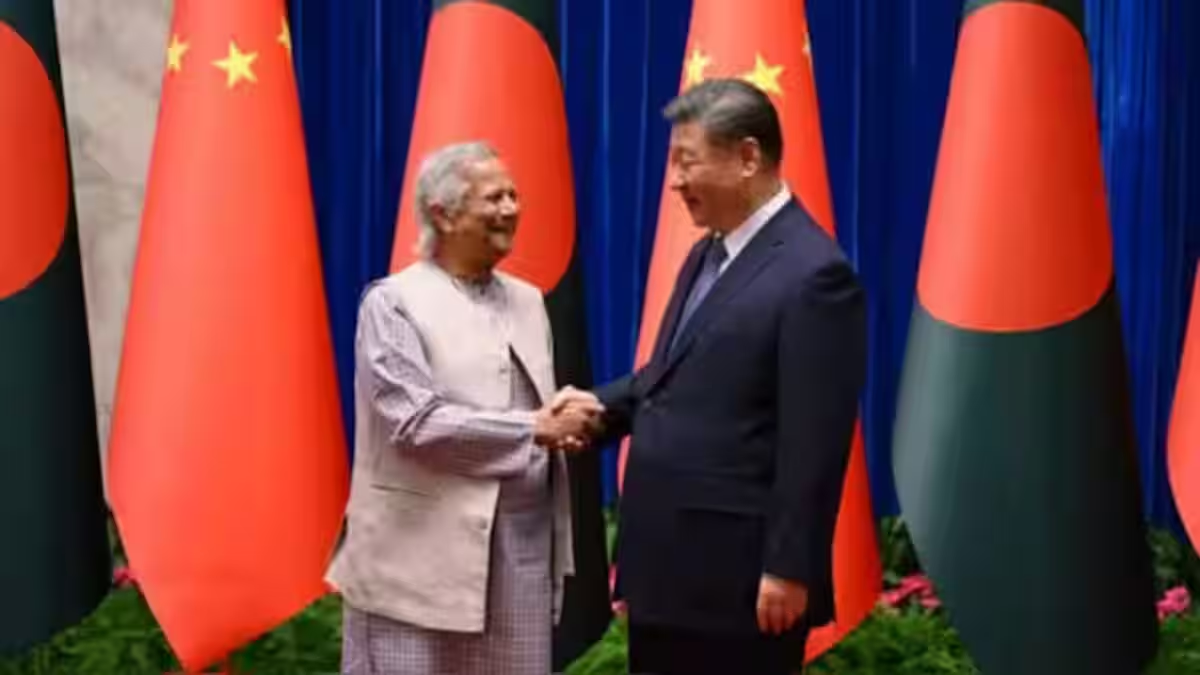
China, which once viewed the birth of Bangladesh through the cold lens of Pakistan’s “internal affairs”, now stands as the nation’s largest trading partner and primary arms supplier, forcing a sobering re-evaluation of how “realpolitik” shapes a nation’s sovereignty. Often left as the postscript in the Bangladesh Liberation War story, it receives front-page treatment in the contemporary discourses. The Chinese role, stakes, and reactions to this election are worth a look.
More from Opinion
How German Chancellor Merz’s India visit carries a strategic message
Why world should ignore Trump’s mockery of global leaders
As Dhaka navigates this shift, it faces a strategic warning. The Bhagavad Gita states: “स्मृतिभ्रंशाद् बुद्धिनाशो बुद्धिनाशात् प्रणश्यति,” meaning, “…from the setback of memory comes the destruction of collective wisdom; and from the destruction of wisdom, one loses sovereignty and perishes.” In the context of 2026, this “loss of memory” cautions against the danger of overlooking the historical phases of Sino-Bangladesh relations—a history defined not by brotherhood, but by brutal realpolitik.
Notably, unlike most other regional actors, China recognised Bangladesh only in 1975. This delay was a testament to ‘realpolitik’—the US-China rapprochement facilitated by Pakistan taking precedence over the humanitarian reality of a genocide. Like a chessboard, every piece impacts the overall picture, making it essential to understand how each piece characteristically moves.
Quick Reads
View All
Trumpism and the way forward for India
Why world should ignore Trump’s mockery of global leaders
Amidst the evolving regional dynamics at the behest of the 2024 uprising and the forthcoming elections, the history of Sino-Bangladesh relations warrants a reevaluation. For understanding’s sake, this may be divided into four phases: the Pre-War/Early Phase (until Nov ‘71), the Escalation Phase (Aug-Nov ‘71), the War Phase (until 16 Dec ‘71), and the Post-War Phase (1972-75).
STORY CONTINUES BELOW THIS AD
The pre-war phase occurred in the shadows of March 25, 1971, which is observed as Genocide Day in independent Bangladesh. It marks the day the Pakistan Army launched Operation Searchlight in the whole of East Pakistan, killing millions of unarmed Bengali speakers. The Dhaka University was one of the prime targets where both Muslim and non-Muslim residents and academics lost their lives.
In April that year, Chinese Premier Zhou Enlai sent a letter to President Yahya Khan pledging Chinese support if Pakistan came under “foreign aggression”, referring to a possible Indian intervention following the brutalities. He was quoted as saying, “The unification of Pakistan and the unity of the people of East and West Pakistan are basic guarantees for Pakistan to attain prosperity and strength. The Chinese Government holds that what is happening in Pakistan at present as purely an internal affair of Pakistan, which can only be settled by the Pakistani people, and which brooks no foreign interference whatever.”
STORY CONTINUES BELOW THIS AD
Moreover, China provided an approximately $20 million interest-free loan in May 1971 to stabilise Pakistan in addition to 200 military experts to West Pakistan to train them in guerrilla warfare, as per independent reports. Throughout the buildup of the war, China maintained that it was strictly Pakistan’s “internal affair”. While staying silent on the genocide, in a recorded interaction with Henry Kissinger, Zhou referred to the developments as attempts aimed at the “subversion of the Pakistani Government”.
The following phase occurred in parallel with the Ping-Pong Diplomacy and the US-China Rapprochement, which was essentially facilitated by Pakistan. Amidst this, in November 1971, Zulfikar Ali Bhutto visited Beijing, where he received assurances and support from the Chinese CCP administration.
When full-scale war erupted in December, China’s role shifted from silent supporter to active diplomatic antagonist. Having just entered the UN in October 1971, China used its maiden influence to block discussions on Bangladesh’s recognition. It was famously likened to India’s intervention in the 1930s, like the Japanese creation of Manchukuo. Though the Indo-Soviet Friendship Treaty deterred a physical Chinese military intervention, the diplomatic volleys from Beijing were designed to delegitimise the Mukti Bahini’s struggle.
STORY CONTINUES BELOW THIS AD
However, due to the Indo-Soviet Friendship Treaty, it refrained from any physical intervention in the war against India. While the Mukti Bahini won the war, along with the support of Indian troops, on 16 December 1971, recognition from China did not come until 1975. This intervening postwar period can be viewed as the final phase of examining the Chinese role in the war.
During this postwar phase, China exercised its first-ever veto in the UN Security Council, blocking Dhaka’s application for membership on the grounds that such admission would violate the UN Charter. The recognition came in only after Sheikh Mujib’s assassination in August 1975.
Seven decades later, the present picture looks far removed from the 1970s. The world has come a long way, and so has Dhaka, internally as well as externally. Over the past seven decades, Dhaka has evolved from a fledgling state into a regional powerhouse, lifting millions out of poverty, achieving notable per capita growth, and asserting its strategic vitality. The future of Bangladesh deserves to keep moving in that direction.
STORY CONTINUES BELOW THIS AD
However, as unfavourable statements regarding Indian interests in its northeastern regions were raised in an audience with the Chinese, along with ongoing unstable and unsafe conditions for minorities in the country, New Delhi views its eastern boundaries with concern. The arrest of minority leaders, about 258 reported incidents of violence in the first half of 2025, and a recent case from Mymensingh have added to these concerns.
While the chess pieces of 1971 were moved by the cold logic of the Cold War, the board of 2026 involves a Dhaka that is no longer a pawn but a pivotal player. Yet, the shadows of the past—specifically China’s initial resistance to Bengali sovereignty—offer a sobering lesson in ‘realpolitik’ that remains relevant even today. Moreover, a country that was born of an independent spirit against majoritarian oppression and brutalities in a neighbourhood that largely failed to acknowledge its pain shall not recede back to its horrific past.
STORY CONTINUES BELOW THIS AD
As relations and regional alignments evolve in the current geopolitical climate, Dhaka may want to exercise caution and engage rationally in regional politics. As Chanakya Niti (attributed to Chanakya) rightly points out, “कः कालः कानि मित्राणि को देशः कौ व्ययागमौ । कश्चाहं का च मे शक्तिरिति चिन्त्यं मुहुर्मुहुः ॥” One must keep reflecting one’s strengths and threats, friends and foes, surroundings and self, and act while making rational choices. For Dhaka, the challenge of the 2026 elections is to exercise rational, multi-vector diplomacy without becoming a pawn in a larger “Great Game”.
(Tejusvi Shukla is a Research Associate at Chanakya University, Bengaluru. Views expressed in the above piece are personal and solely those of the author. They do not necessarily reflect Firstpost’s views.)
HomeOpinionWhy Dhaka should revisit China’s sinister role in the 1971 warEnd of Article