Why dismantling Ayatollah’s theocracy in Iran may not be easy – Firstpost
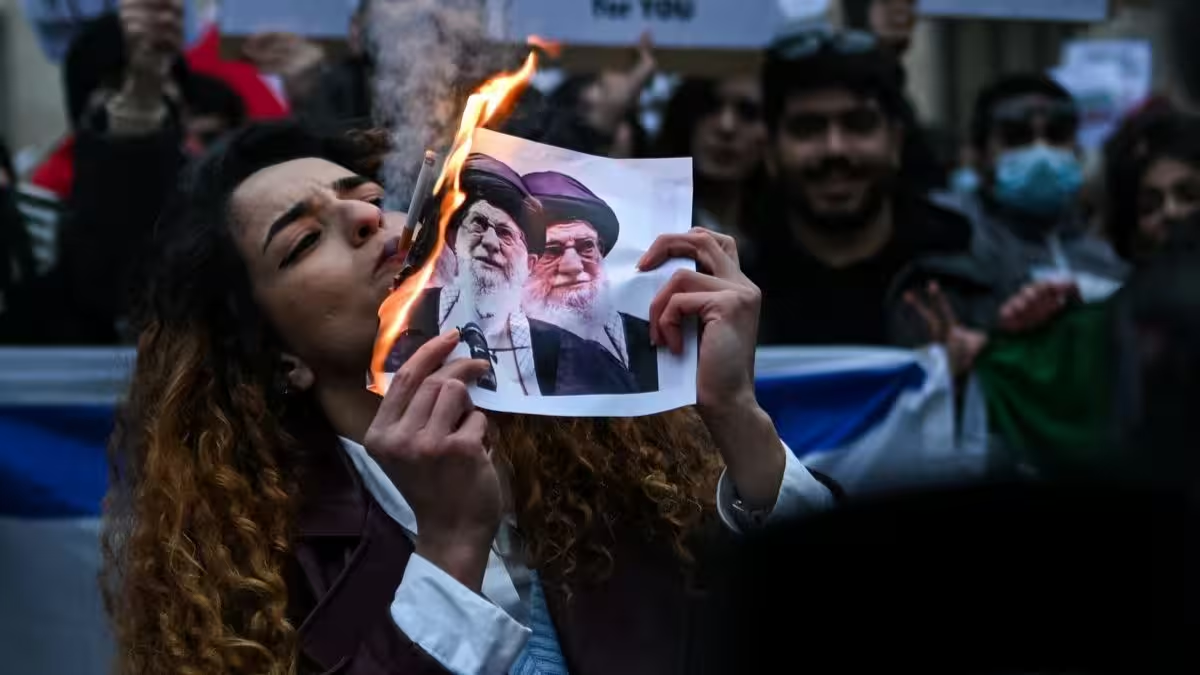
The Iranian government has been faced with waves of public protests over the recent years. In 2019, there were mass protests against the rise of gasoline prices. Again in 2022, the widespread demonstrations were led by the women’s groups as a sequel to the death of Mahsa Amini while in the custody of Iran’s morality police.
The ongoing protests which erupted towards the end of December last year have been far more complex and serious for Iran’s theologic regime since it came into power in 1979. The spark was angst against economic hardships evident from hyperinflation hovering around 45 per cent, eroding citizens’ living standards across the board.
STORY CONTINUES BELOW THIS AD
Further, the collapse of the currency – the rial reached around 1.5 million to a US dollar – significantly worsened the inflation, leading to social unrest. The multiple sanctions imposed by the US and EU, coupled with the mismanagement by the authoritarian regime, led to Iran’s economic meltdown. The rising unemployment has alienated the youth from the local administration.
More from Opinion
Why US midterm elections in 2026 spell trouble for Trump
How Chabahar is India’s first test of strategic resolve in 2026
The current protests expanded rapidly, manifesting broader discontentment with the Islamic Republic’s political system and spreading to all 31 provinces of Iran. The internet shut down on January 8, alongside serious disruption of telephone services, resulting in a total blackout that set the stage for the brutal crackdown by the state security forces, especially the Islamic Revolutionary Guards Corps (IRGC).
Excessive use of force and firing at the unarmed protesters resulted in heavy casualties. While exact figures of those killed are not available, as per the US-based Human Rights News Agency, the estimated death toll stands over 3500, including security personnel, and around 17500 have been taken into custody. After a fortnight of the nationwide demonstrations, the Iranian officials have claimed that there are signs of relative calm, with security forces patrolling the streets.
Quick Reads
View All
How India-EU ties gain renewed relevance in a turbulent world
In a world of ‘might is right’: Could Japan, South Korea go nuclear?
Ayatollah Ali Khamenei, the 86-year-old cleric who has been at the helm since 1989, having succeeded the Islamic Republic’s ‘founding father’, Ayatollah Khomeini, is known for taking a hard stand to put down any kind of dissent, a strategy that has ensured the survival of the regime.
In the wake of protests, Khamenei has sounded defiant, labelling the protesters as terrorists – playing to the American and European tune. He went on to claim the regime’s legitimacy, recalling the sacrifices made during the 1979 revolution. The Iranian authorities have organised counter protests in support of the regime as a show of force.
STORY CONTINUES BELOW THIS AD
By employing overwhelming force, the clerics may have succeeded in gaining temporary respite, but the theocratic regime has definitely been shaken up, evident from the groundswell of support for the movement. The merchant community, which had developed a working understanding with the administration, has been hit hard due to the economic turmoil and is estranged from the current dispensation.
The IRGC delving into commercial activities has also hurt the interests of traders. Even the student groups who played a key role in the 1979 revolt are alienated from the authorities due to the lack of opportunities and political clampdown by way of moral policing.
US President Donald Trump has been weighing a range of potential responses against Iran, including cyberattacks and direct strikes. On January 13, Trump doubled down on his threat of intervention, telling the Iranian protesters that “help is on its way”. He further wrote on social media, “Iranian patriots, keep protesting – take over your institutions, save the names of the killers and abusers. They will pay a substantial rate.” Without explaining what type of support was on the way, Trump added, “I have cancelled all meetings with Iranian officials until the senseless killings stop.” Even Israel remains on high alert following a recent phone call between Prime Minister Benjamin Netanyahu and US Secretary of State Marco Rubio.
STORY CONTINUES BELOW THIS AD
Simultaneously, Trump has imposed 25 per cent tariffs on Iran’s trading partners with immediate effect. This will further add to Tehran’s economic woes and affect countries like Turkey, China and the UAE, which have deep economic ties with Iran. There will be minimal impact on India, as bilateral trade with Iran is barely $1.7 billion. However, India has stakes in the Chabahar port, on which the US has waived sanctions till April 2026. The strategic value of the port notwithstanding, India has only invested a few hundred million dollars into the project, which should not be the cause of undue concerns.
Inside Iran, President Pezeshkian struck a somewhat reconciliatory tone when he noted, “People have concerns; we should sit with them, and if it is our duty, we should resolve their concerns. But the higher duty is not to allow a group of rioters to come and destroy the entire society.” The Iranian head of the judiciary has stated that it will take swift and exemplary action against the rioters and there will be no leniency.
STORY CONTINUES BELOW THIS AD
As a sequel to the warning by Iran’s parliament speaker Mohammad Bagher Qalibaf that in the event of a military attack by the US or Israel, “both the occupied territories and centres of the US military and shipping will be our legitimate targets”, the US had withdrawn some personnel from the key bases. It appeared that American military intervention was imminent.
However, as per the latest reports, US aircraft which had been moved out of Al Udeid air base in Qatar were gradually returning, and the security warning level at the base has also been lowered. This came after Trump noted that Iran’s crackdown on the protesters was easing and there were no current plans for large-scale executions; the anticipated figure was around 800. The Iranian foreign minister also mentioned that there was no move to hang the 26-year-old man (Erfan Solatani) arrested during the protests. Trump appears to have adopted a wait-and-see posture.
STORY CONTINUES BELOW THIS AD
Given the current situation, although Iran’s protests exhibit intense public discontent, they lack unified leadership and a clear plan for post-regime governance. There is a section of people who have expressed support for Reza Pahlavi, son of former ruler Shah, deposed in 1979. This does not imply that protesters follow a foreign agenda or that they want the US or Israel to intervene.
Moreover, Iran’s leadership has recalibrated and backtracked on the planned executions due to both domestic outrage and global pressure. However, the authorities retain the capacity to repress and remain unwilling to compromise.
Given the current dynamics, the Islamic regime for now appears to be well entrenched with no visible signs of cracks, and the end of the road is not yet in sight. However, in the opaque systems, developments are sudden without prior indications. Unless there are serious ruptures in the security forces – the IRGC, who answer only to supreme leader Khamenei, and the Basij (paramilitary force) – the ongoing movement risks either being brutally suppressed or settling into a long-drawn cycle of unrest and turmoil, possibly a prolonged stalemate, adding to the regional instability.
STORY CONTINUES BELOW THIS AD
(The writer is a war veteran, former assistant chief and currently professor of geostrategy & international relations. Views expressed in the above piece are personal and solely those of the author. They do not necessarily reflect Firstpost’s views.)
TagsIranHomeOpinionWhy dismantling Ayatollah’s theocracy in Iran may not be easyEnd of Article