Why is Trump threatening Cuba after Venezuela? – Firstpost
Following Washington’s military intervention in Venezuela and the capture of long-time Venezuelan leader Nicolas Maduro, the United States’ relationship with Cuba has entered a sharply confrontational phase.
US President Donald Trump on Sunday publicly warned Havana that its access to Venezuelan oil and financial support is over, while urging the Communist-run island to “make a deal” with Washington.
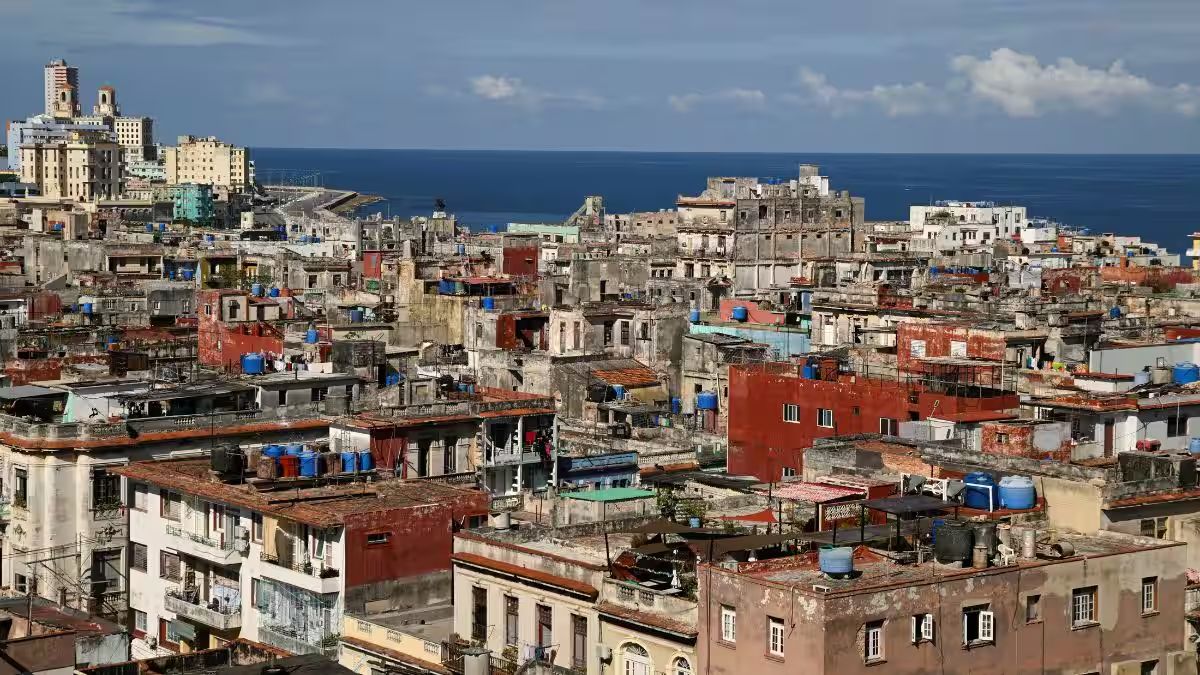
The developments come at a time when Cuba is facing its most severe economic crisis in decades, marked by widespread power outages, fuel shortages, food scarcity, and a historic surge in emigration.
STORY CONTINUES BELOW THIS AD
With Venezuela no longer able to supply subsidised crude, Cuba’s already fragile economy faces latest pressure.
How Cuba’s Venezuelan oil support came to an end
For years, Venezuela has been Cuba’s most significant energy partner, supplying crude oil and refined fuel that helped keep the island’s power plants, transport networks, and industries running.
In return, Cuba provided security assistance to successive Venezuelan governments.
That arrangement was disrupted after US forces captured Maduro earlier this month during a military operation that also involved the seizure of Venezuelan oil tankers. Since then, shipping data shows that no fuel cargoes have departed Venezuelan ports for Cuba.
More from Explainers
Trump urges Cuba to make deal with US, warns of end to oil and funds
Trump has set his sights on Greenland, Colombia and beyond. That’s why expansionism is the Word of the Week
Trump confirmed the policy shift in a series of social media posts, declaring that Cuba would no longer receive oil or funds linked to Venezuela’s energy sector.
“THERE WILL BE NO MORE OIL OR MONEY GOING TO CUBA - ZERO! I strongly suggest they make a deal, BEFORE IT IS TOO LATE,” Trump wrote on Truth Social.
He also highlighted the historical ties between Havana and Caracas, saying, “Cuba lived, for many years, on large amounts of OIL and MONEY from Venezuela.”
At the same time, Washington and Venezuela’s interim government, led by President Delcy Rodríguez, have been negotiating a major energy agreement.
Editor’s Picks1Why six-decade-long American embargo on Cuba must end now
The proposed $2 billion deal would allow the United States to import up to 50 million barrels of Venezuelan oil, with proceeds placed in US Treasury-supervised accounts.
Trump has portrayed the removal of Maduro as a turning point for Venezuela’s security situation. In another social media post, he argued that US military power had replaced foreign influence in the country.
STORY CONTINUES BELOW THIS AD
“Venezuela doesn’t need protection anymore from the thugs and extortionists who held them hostage for so many years. Venezuela now has the United States of America, the most powerful military in the World (by far!), to protect them, and protect them we will.”
Cuba’s sudden setback of Venezuelan oil has created immediate challenges.
Last year, the Latin American nation supplied around 26,500 barrels per day to the island, covering roughly half of Cuba’s fuel deficit. Even though Venezuela’s refining capacity has declined in recent years, it remained Cuba’s largest energy provider.
Mexico has since emerged as a limited alternative supplier. Mexican President Claudia Sheinbaum stated her country had not significantly increased shipment volumes, but that recent political changes had made Mexico an “important supplier” of crude to Cuba.
However, the scale of these deliveries remains tiny compared to what Venezuela previously provided.
How Cuba was hit during Maduro’s capture
Cuba confirmed that 32 members of its armed forces and intelligence agencies were killed during the US operation in Venezuela.
The personnel had been stationed in Caracas under a bilateral agreement focused on security and defence, although the Cuban government did not disclose the specific nature of their mission.
STORY CONTINUES BELOW THIS AD
Cuban officials rejected claims that the country had received financial or material compensation for its overseas security services. Foreign Minister Bruno Rodríguez mentioned Havana had the right to import fuel from any suppliers willing to export it, and denied that Cuba had benefited financially from its involvement in Venezuela.
The deaths of Cuban personnel, along with Trump’s warning about cutting off oil supplies, triggered strong reactions from President Miguel Díaz-Canel. In a post on X, he criticised what he described as the US tendency to commercialise global affairs.
“Those who turn everything into a business, even human lives, have no moral authority to point the finger at Cuba in any way, absolutely in any way,” Díaz-Canel reported.
He also defended Cuba’s political system, arguing that external criticism was driven by frustration over the country’s ideological independence.
“Those who hysterically accuse our nation now do so out of rage at this people’s sovereign decision to choose their political model,” he wrote.
STORY CONTINUES BELOW THIS AD
Addressing domestic shortages, Díaz-Canel blamed long-standing US restrictions. “Those who blame the Revolution for the severe economic shortages we suffer should be ashamed to keep quiet,” he remarked, referring to what he called “draconian measures” imposed by Washington.
In another post, the Cuban leader directly rejected Trump’s call for Havana to make a deal with the United States. “Cuba is a free, independent, and sovereign nation. Nobody dictates what we do,” Díaz-Canel wrote.
He added a warning about national defence, “Cuba does not attack; it has been attacked by the US for 66 years, and it does not threaten; it prepares, ready to defend the homeland to the last drop of blood.”
The Cuban government has estimated that US sanctions cost the country more than $7.5 billion between March 2024 and February 2025. Officials argue that restrictions on trade, finance, and energy imports have worsened shortages across the island.
Trump, however, has suggested that Cuba’s economic problems will deepen without Venezuelan support. “It’s going down,” he said. “It’s going down for the count.”
STORY CONTINUES BELOW THIS AD
How Cuba’s economy has been faring
Even before the collapse of Venezuelan oil shipments, Cuba was struggling with severe power outages, fuel scarcity, and declining public services.
Across much of the island, electricity is unavailable for large parts of the day, while Havana has experienced rolling blackouts that disrupt businesses, transport, and household life.
Shortages of food, medicine, and fuel have placed additional pressure on Cuban families. Supermarket shelves are often empty, petrol stations face long queues, and hospitals have reported difficulties obtaining essential supplies.
The impact of these conditions has contributed to a record-breaking wave of emigration over the past five years, with most Cubans heading to the United States in search of economic stability.
Despite the growing hardship, US intelligence assessments suggest that while Cuba’s economy is under severe strain, the situation may not yet support claims that the government is on the verge of collapse.
According to sources familiar with classified reports, speaking to Reuters, key sectors such as agriculture and tourism have been weakened by power outages and trade restrictions, but Havana still retains control over major state institutions.
STORY CONTINUES BELOW THIS AD
The potential failure of Venezuelan fuel, however, is expected to make governance more difficult for Díaz-Canel’s administration. Without stable energy imports, Cuba’s power grid, transport network, and industrial output face further disruption.
How Trump is pressuring Cuba
Trump’s warning to Cuba reflects a broader effort by his administration to assert US influence across Latin America and the Caribbean. Top officials, including US Secretary of State Marco Rubio, have openly stated that the intervention in Venezuela could have consequences for Havana.
Rubio, whose parents fled Cuba during the Batista era in the 1950s, has been one of the administration’s most vocal critics of the Cuban government.
Following the operation that captured Maduro, he reported, “If I lived in Havana and I was in the government, I would be concerned. At least a little bit.”
He has also highlighted Cuba’s role in supporting Venezuelan leadership, noting that some of those guarding Maduro during the raid were Cuban personnel.
Trump escalated the rhetoric by responding to a social media post suggesting Rubio could one day become Cuba’s leader. “Sounds great to me,” Trump wrote.
Rubio currently serves as secretary of state, acting national security adviser, and acting national archivist, and previously held the role of USAID administrator.
STORY CONTINUES BELOW THIS AD
Rubio has become a popular subject for internet memes suggesting he could be appointed to almost any vacant position, from foreign leadership roles to domestic government posts.
Addressing unrelated rumours about joining the Miami Dolphins’ management, Rubio mentioned, “I do not normally respond to online rumors but feel the need to do so at this moment I will not be a candidate for the currently vacant HC and GM positions with the Miami Dolphins.”
“My focus must remain on global events and also the precious archives of the United States of America.”
Former US National Security Adviser Jake Sullivan previously questioned whether Rubio could manage multiple senior roles simultaneously, calling the idea “ludicrous.”
Republican lawmakers have largely backed Trump’s hardline stance on Cuba. Florida Congressman Mario Díaz-Balart remarked the Cuban government was nearing the end of its rule after “decades of misery, tragedy, and pain.”
The administration’s regional focus has also extended to security warnings for US citizens in Venezuela.
The State Department recently urged Americans to leave the country immediately after reports emerged that armed pro-regime militias, known as colectivos, were setting up roadblocks and searching vehicles for US nationals or supporters.
“US citizens in Venezuela should remain vigilant and exercise caution when travelling by road,” the alert said.
It also advised Americans to depart now that some international flights had resumed.
Venezuela’s foreign ministry dismissed the warning, calling it exaggerated and politically motivated. “Venezuela is in absolute calm, peace, and stability,” the ministry declared.
“All populated centres, communication routes, checkpoints, and security devices are functioning normally.”
The ministry added that the government remained “the sole guarantor of the legitimate monopoly of force and the tranquility of the Venezuelan people.”
Where this leaves Cuba
With Venezuelan supplies halted, Cuba now relies more heavily on imported crude and fuel purchased on the open exchange, as well as smaller shipments from Mexico.
However, these alternatives are more expensive and less reliable than the long-term arrangement with Caracas.
Cuba’s domestic refining capacity has also declined, limiting its ability to process crude efficiently. This has increased dependence on refined fuel imports, which are harder to secure under US sanctions.
The defeat of Venezuelan energy support affects not just electricity generation but also transportation, agriculture, and manufacturing. Power outages disrupt irrigation systems, food distribution, and industrial production, compounding existing shortages.
The latest standoff comes after more than six decades of strained relations between Washington and Havana. Since Fidel Castro’s 1959 revolution, the two countries have clashed over ideology, regional influence, and human rights.
Also Watch:
With inputs from agencies
Follow Firstpost on Google. Get insightfulexplainers, sharpopinions, and in-depthlatest reports on everything from geopolitics and diplomacy toWorld News. Stay informed with the latest perspectives only on Firstpost.Tagscrude oil Donald Trump Latin America VenezuelaHomeExplainers'It's going down': After Venezuela, why is Trump threatening Cuba?End of Article