Word of the Week: American Expansionism – Firstpost
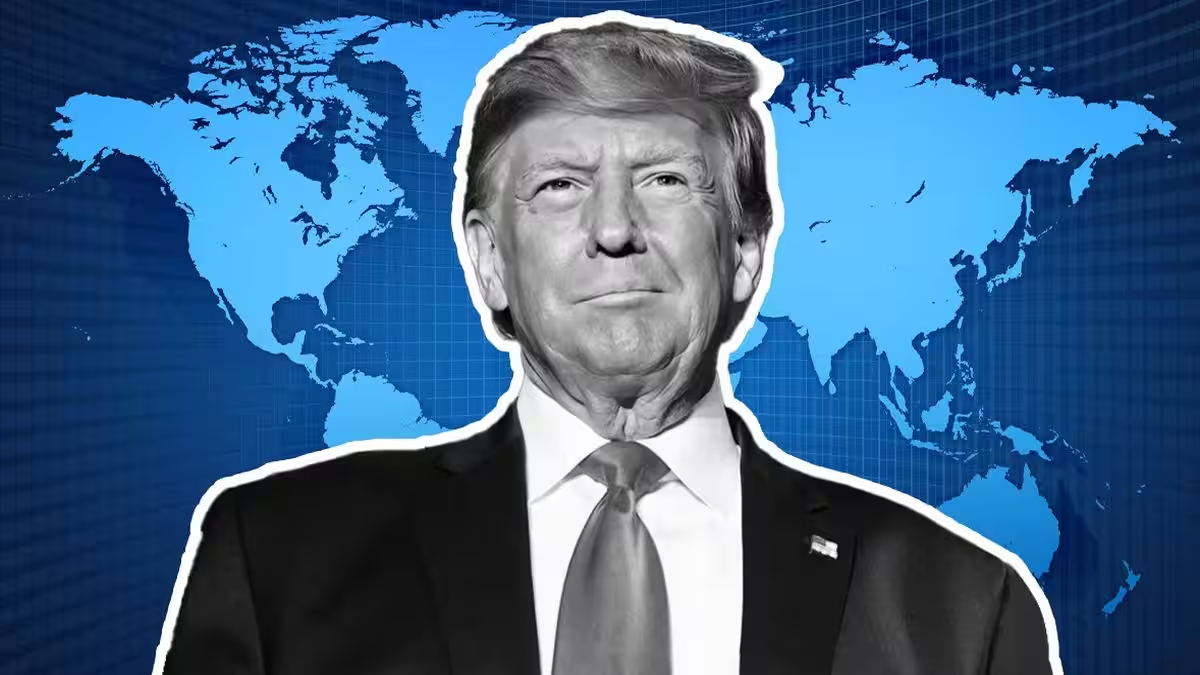
When Donald Trump took charge of the White House in January 2025 for a second time, he noted in his swearing-in speech, “The United States will once again consider itself a growing nation, one that increases our wealth, expands our territory, builds our cities, raises our expectations and carries our flag into fresh and beautiful horizons.”
Who would have thought that these words would come back to haunt us now. Because in the week gone by, Trump has revived his vision for a larger United States of America; he has not only captured Venezuela’s Nicolas Maduro but also announced that the country’s oil reserves would be managed by Washington indefinitely. If that wasn’t enough, he revived his demand for the takeover of Greenland, as well as issued threats to several other governments — including those of Colombia, Cuba, Mexico and Iran.
STORY CONTINUES BELOW THIS AD
It’s for this reason, we can’t assist but choose ‘expansionism’ as Firstpost’s ‘Word of the Week’. As you sit back and unwind this weekend, we take a closer look at Trump’s expanded vision for his country.
More from Explainers
Will India have to pay 500% tariff for purchasing Russian oil?
Trump says Venezuela will turn over 30-40 million barrels of oil to US
The etymology of expansionism
A simple glance at the dictionary describes expansionism as the policy or practice of increasing the amount of land ruled by a nation, or the business performed by a company.
It is mentioned that almost every part of the world has experienced expansionism. In ancient times, before the concepts of nation and state-building came about, the concept of expansionism was linked to the notion of ‘might is right’ — that means the more area you hold, the more powerful you are.
Past expansionist campaigns across the world
Historically, the world has seen several expansionist campaigns. There was the religious Caliphate expansionisms. In the 15th and 16th centuries, the Ottoman Empire entered a period of expansion.
In the years to follow, as nation states began to evolve, we witnessed Benito Mussolini create a New Roman Empire; Italy invaded Italy invaded Ethiopia as early as 1935, Albania in early 1938, and later Greece. Similarly, Germany witnessed Lebensraum, policy of Nazi Germany that involved expanding German territories to the east to provide land and material resources for the German people, while driving out Jewish and Slavic people.
Editor’s Picks1When the US tried to buy Greenland in the past and failed
2
Can the US really ‘run’ Venezuela and cash in on its oil riches?
The US is no stranger to expansionism campaigns driven by the Manifest Destiny. This phrase was first coined by newspaper editor John O’Sullivan in 1845, articulating the belief in America’s divinely destined mission to expand into lands in North America where indigenous people and Mexicans lived.
Justifying the US’ annexation of Texas and the acquisition of the Oregon Territory, he asserted “our manifest destiny to overspread the continent allotted by Providence for the free development of our yearly multiplying millions.” What he simply meant was that the United States possessed a right granted by God to take territory in the West and install its values and system of government.
STORY CONTINUES BELOW THIS AD
And with the Manifest Destiny as its guiding light, the US continued its westward expansionism. This saw Washington annex Hawaii in 1898 and the outbreak of the Spanish War in April 1898. The Spanish war ended in December 1898, when Spain and the United States signed a peace treaty in Paris, which declared Cuba an independent territory, ceded Puerto Rico and Guam to the United States, and allowed for the Philippines to be purchased for $20 million.
At the turn of the 20th Century, ideas of American expansionism declined, making way for interventionist tactics.
Trump’s revival of American expansionism
It’s only when Donald Trump came to power for his second term, last January, that he revitalised America’s expansionist campaign. He renamed the Gulf of Mexico as Gulf of America; he also expressed his desire to make Canada the 51st state of America as well as issues threats to take control of the Panama Canal.
And in the week gone by, he stepped it up further. He sent in US forces into Venezuela, in what has been dubbed as Operation Absolute Resolve, in the wee hours of January 3 and captured its President Nicolas Maduro. The Venezuelan leader was brought to the US and now faces a trial on charges of narco-terrorism, cocaine importation conspiracy, possession of machine guns and destructive devices and conspiracy to possess machine guns and destructive devices.
STORY CONTINUES BELOW THIS AD
Speaking to the media after the capture of Maduro, Trump mentioned that America would control the oil exports of the oil-rich nation “indefinitely” and that American oil firms would rebuild the nation’s decaying oil infrastructure and revive its flagging production.
But that’s not all. In the days after the Venezuela operation, Trump set his sights on the western hemisphere.
The day after Operation Absolute Resolve in Venezuela, Trump threatened the Colombian President, Gustavo Petro. The South American country is “run by a sick man who likes making cocaine and selling it to the United States,” Trump told reporters on Air Force One, en route to Washington from his long holiday at Mar-a-Lago. “He’s not going to be doing it very long, let me tell you.” Questioned in the same press conference on whether the US might launch an operation within Colombia, Trump replied, “Sounds positive to me.”
He also predicted that Cuba “looks like it is ready to fall,” since it has long been heavily reliant on oil from Venezuela. He stated that the US would “have to do something” about Mexico, too, because the government has been unable to curtail the cartels or prevent drugs from pouring across the border.
STORY CONTINUES BELOW THIS ADPeople take part in a march in Nuuk, Greenland against Trump’s ambition to takeover the semi-autonomous territory. File image/AP
And looking for fresh acquisitions, he turned his attention to Greenland — the mineral-rich, semi-autonomous region of Denmark. The US president told reporters. “Greenland is covered with Russian and Chinese ships all over the place.” He added, “We need Greenland from the standpoint of national security.”
The White House later added that Trump is actively discussing the purchase of Greenland with his verein, saying he preferred diplomacy but would not rule out military action. “That’s something that’s currently being actively discussed by the president and his national security verein,” Press Secretary Karoline Leavitt stated when asked about a possible US offer to buy the territory from Denmark.
“His mannschaft is currently talking about what a potential purchase would look like.”
Meanwhile, US Secretary of State Marco Rubio, it’s reported, told lawmakers that Trump plans to buy Greenland rather than invade it. Either way, neither is Greenland content, nor is Denmark and nor are Trump’s European allies.
STORY CONTINUES BELOW THIS AD
And Trump’s expansionism doesn’t stop at Latin America and Greenland. He’s extended his ambitions all the way to Iran, noting on social media that US forces were “locked and loaded” and ready to intervene if Iran “violently kills peaceful protesters, which is their custom”.
The remarks come as Iran has plunged into turmoil, as protests have turned more powerful than ever. On Thursday, Trump even reiterated this warning, letting the Iranian government know “if they start killing people” then “we are going to hit them very hard”.
“I have let them know that if they start killing people, which they tend to do during their riots - they have lots of riots - if they do it, we are going to hit them very hard,” Trump remarked in an interview with conservative radio host Hugh Hewitt. “We’re watching it very closely,” he added of the situation. “They know, and they have been told very strongly, even more strongly than I am speaking to you right now, that if they do that they are going to have to pay hell.”
STORY CONTINUES BELOW THIS AD
We don’t know where Trump’s expansionism campaign will go next. But we are here to track it.
Follow Firstpost on Google. Get insightfulexplainers, sharpopinions, and in-depthlatest reports on everything from geopolitics and diplomacy toWorld News. Stay informed with the latest perspectives only on Firstpost.TagsDonald Trump United States of America Word of the weekHomeExplainersTrump has set his sights on Greenland, Colombia and beyond. That’s why expansionism is the Word of the WeekEnd of Article