Word of the Week: Davos – Firstpost
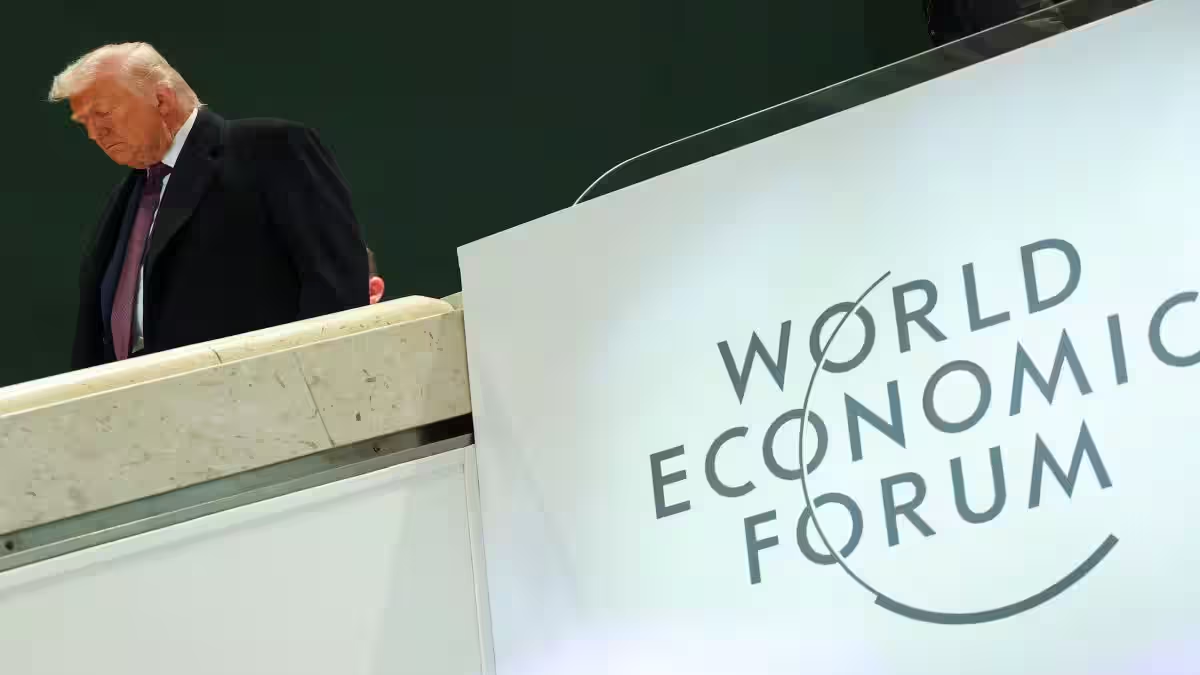
Every year, political leaders, businessmen, activists and journalists from across the globe converge in the Swiss Alps, at a ski resort, to discuss the issues plaguing the world and discuss the future direction of life on our planet.
Welcome to the annual meeting of the World Economic Forum (WEF) in the Swiss town of Davos that is held each year since 1971.
This year, this annual conference — held from January 19 to 23 — garnered a whole lot of attention across the globe.
STORY CONTINUES BELOW THIS AD
Why?
There was Canadian Prime Minister Mark Carney’s electrifying 17-minute speech that is now being hailed as a landmark declaration of a ‘new world order’. One academic has called it a “moment of global clarity”. For former US President Jimmy Carter’s speechwriter, it was a “speech for the history books.” One noted Canadian journalist has already christened it the “Carney doctrine.”
More from Explainers
‘What the hell happened?’ Trump takes swipe at Macron’s sunglasses in Davos speech
All about the ₹70,000 Henry Jullien sunglasses that Macron wore at Davos
But that’s not all. There was also French President Emmanuel Macron in his blue aviator glasses who told the audience that there’s a “shift towards a world without rules”.
But most of all, this Davos summit won’t be forgotten for a while as it was where Donald Trump complained and ranted against his European allies over his demand for Greenland, and then had a ‘Taco’ moment. Also, it’s where Trump’s ‘superfans’ gathered and joined the American leader in the unveiling of the controversial ‘Board of Peace’.
It’s for these reasons that we, at Firstpost, select Davos to be our Word of the Week. This minor but popular ski resort in the Swiss mountains is where the world’s attention was, with international newsrooms and op-ed desks far away taking note of every word being spoken and every action being judged.
Editor’s Picks1Davos 2026 begins today: Explore the Alpine gem beyond the World Economic Forum
2
Now Trump seen with purple bruise at Davos. Why do these marks keep appearing?
Beginnings of the World Economic Forum
The WEF was founded back in 1971 by Klaus Schwab, a Swiss-German economist and professor, in a bid to foster global cooperation on political, social, and economic issues.
The aim of the international not-for-profit organisation was to bring together the public and private sectors to brainstorm solutions to these global problems, something which remains one of its founding principles and speaks to its mission statement: “Committed to improving the state of the world.”
The first meeting of WEF was held in Davos five decades ago and has been the centre of its annual gathering every year since with the resort’s name even becoming the common shorthand for the event.
STORY CONTINUES BELOW THIS AD
Since then, the annual conference has become a venue where the who’s who of the world unite. Past events have seen Prime Minister Narendra Modi and climate activist Greta Thunberg in attendance. One will also get to see CEOs from the biggest companies in the world, like Sundar Pichai from Google, Satya Nadella from Microsoft, and Tim Cook from Apple.
Importance of Davos
But why is the Davos conference so key? Despite criticisms of the meet being a talking shop for the world’s rich and powerful, Davos has provided a platform for discussion and debate on a scale unlike any other. Think about it — this year, Davos hosted close to 3,000 leaders from more than 130 countries, reflecting a diverse mix of sectors, industries, governments and generations. This includes 400 political leaders attending, including nearly 65 heads of state and government and six leaders from the G7. They were joined by almost 850 top global chief executives and chairpersons, along with nearly 100 unicorns and technology pioneers.
And Davos has had seen some significant outcomes in the past. In 1988, an agreement signed at the meeting, known as the Davos Declaration, was credited with helping Turkey and Greece step back from the brink of an armed conflict. In 2000, the Global Alliance for Vaccines and Immunisation (Gavi) was launched at Davos and has since improved access to vaccines for millions.
This year’s headline-grabbing Davos
This year’s WEF conference — from January 19 to 23 — was expected to create fireworks, and it didn’t disappoint.
The geopolitics around this year’s event was particularly complex: Donald Trump has upended the world order with his aggressive tariff policy. Moreover, buoyed by the success of the strikes on Venezuela and the capture of Nicolas Maduro, the American leader had stepped up his demand for Greenland, even threatening to impose tariffs on eight European nations for blocking his acquisition attempts.
STORY CONTINUES BELOW THIS ADFrance’s President Emmanuel Macron wears sunglasses as he meets with Serbia’s President Aleksandar Vucic meet at the 56th annual World Economic Forum (WEF) meeting in Davos, Switzerland. Reuters
And it was amidst this backdrop, that world leaders and businessmen converged at Davos. First up, was France’s Emmanuel Macron, who not only grabbed eyeballs for his evocative speech during which he reported ‘we prefer respect over bullies’ but also for his blue aviators that he donned indoors. The reflective Top Gun-style aviator sunglasses, with a price tag of €659 euros ($770), also led to speculation over his marriage as well as mockery from his counterparts — we are looking at you, Mr Trump.
This year’s Davos summit also saw the return of US President Donald Trump after six years. And on Wednesday, he took the podium from where he alternately praised and threatened European allies and repeated his demands for ownership of Greenland. While he pledged not to use force to seize the semiautonomous Danish territory, he mocked European leaders and lashed out Nato.
And after a bombastic speech, which was littered with false claims, Trump backed away from his threat to impose tariffs on European countries, saying he had reached “the framework of a future deal” on Greenland with the Nato secretary general. In other words, Trump began to defuse a global crisis of his own making.
STORY CONTINUES BELOW THIS AD
The following day, the conveners at Davos gave Trump centre stage again for the unveiling of his Board of Peace, which the White House has touted as a tool to resolve global conflicts with a scope rivaling that of the United Nations. Leaders or top officials from 19 other countries stood behind Trump for the ceremony as he signed the entity’s founding charter.
But despite all the hype and hoopla, Trump isn’t the one who made the biggest impact. That distinction belongs to Canadian Prime Minister Mark Carney, whose speech on Tuesday was widely viewed as the defining moment of the week.
The former banker, who has had a history of standing up to the American president since coming to office, delivered an address that squarely confronted the world wrought by Trump’s presidency. He urged his Davos counterparts to “live the truth” and “stop invoking the rules-based international order as though it still functions as advertised.”
STORY CONTINUES BELOW THIS AD
He urged his counterparts to move on, stating: “Middle powers must act together, because if we’re not at the table, we’re on the menu,” he mentioned. “In a world of great-power rivalry, the countries in between have a choice: compete with each other for favour or combine to create a third path with impact.”
The speech got the world talking; even Trump took a note of it in his own address — he noted, “Canada lives because of the United States. Remember that Mark, the next time you make your statements.”
And it’s for these reasons and more that even after the curtains have come down on yet another edition of Davos, this year’s event will remain etched in our minds for a long time to come.
Follow Firstpost on Google. Get insightfulexplainers, sharpopinions, and in-depthlatest updates on everything from geopolitics and diplomacy toWorld News. Stay informed with the latest perspectives only on Firstpost.TagsDonald Trump Emmanuel Macron Word of the weekHomeExplainersThe Word of the Week is Davos. Trump, Carney, Macron tell us whyEnd of Article