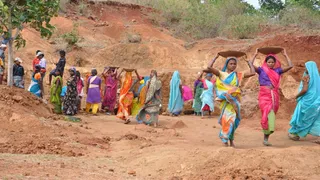
Updated: Sat, 13 Dec 2025 05:31 (IST) The Union Cabinet on Friday approved the bill to change the name of Mahatma Gandhi National Rural Employment Guarantee Scheme (MNREGA) and increase the number of working days…Read more MNREGA has become ‘Pujya Bapu Gramin PTI, New Delhi’ (pic) The Union Cabinet on Friday approved a bill to change the name of Mahatma Gandhi National Rural Employment Guarantee Scheme (MNREGA) change and increase the number of working days. According to sources, the name of this scheme will now be changed to ‘Pujya Bapu Gramin Rojgar Yojana’ and under this the number of working days will also be increased from 100 days to 125 days. Currently 100 days employment guarantee is given. The objective of MNREGA or NREGA is to increase life security of families in rural areas. Under this, an eligible family gets a service guarantee of at least 100 days in a financial year. This scheme was implemented in 2005. Remove Ads Read Only News The National Rural Employment Guarantee Act 2005 (NREGA), later renamed as the Mahatma Gandhi National Rural Employment Guarantee (MGNREGA), is a labor law and social security measure aimed at guaranteeing the “right to work”. The objective is to increase livelihood security in rural areas. Preparations for reforming MNREGA It has been almost two decades since the MNREGA scheme was started. Over time, many shortcomings and inconsistencies in the plan emerged. In view of these challenges, the Central Government is seriously considering comprehensive reforms in the entire structure of MNREGA at the top level. According to sources, along with the change in the structure of the scheme, there is also discussion about its change. But according to news agency Pretr, the Cabinet has approved changing the name of MNREGA and increasing the working days under it. The biggest problem is that wages are not paid on time. The need for improvement in the scheme is felt for many reasons. Despite the statutory right to 100 days of service, only about seven percent of the families in the country get a full 100 days of service. Not paying wages on time emerged as the biggest problem. Due to banking irregularities and administrative delays, payment is not made within 15 days and the delay compensation is also negligible. In many states, cases of withdrawal of wages worth crores of rupees by making fake job cards have come to light. Irregularities have increased in the digital attendance system due to photo and data duplication, incorrect uploading and technical errors. In such a situation, many states have been forced to temporarily stop digital attendance and adopt manual verification. Lack of budget, poor audit, apart from this many works done under MNREGA are not in accordance with the real needs of the villages. In some areas, the quality of work was found to be poor or work was left incomplete. Budget constraints, weak audits and lax monitoring at the local level have also contributed to the problems. With a view to removing all these inconsistencies and making the scheme more efficient, transparent and in line with future needs, the government is now considering a comprehensive restructuring. Important changes were also made in the financial structure. In the same order, important changes in the financial structure of the scheme have also been made recently. To face future water crisis, the Center has set a target to build one million new water harvesting structures across the country next year. It will be implemented with public participation and funds available under MNREGA. 65 percent of MNREGA funds in dark zone districts most affected by water crisis, 40 percent in yellow zone and 30 percent in normal districts have been made mandatory only for water conservation structures.