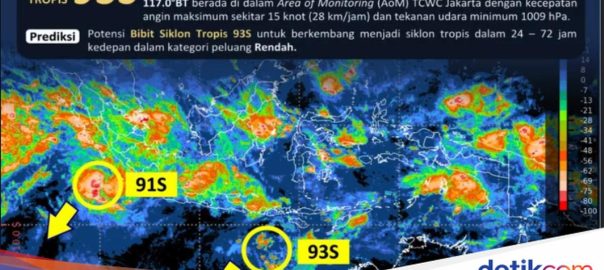
Jakarta – The Meteorology, Climatology and Geophysics Agency (BMKG) has detected the seeds of tropical cyclone 93S in the Indian Ocean. BMKG called on local governments and communities in Bali, West Nusa Tenggara (NTB), East Nusa Tenggara (NTT) and Java to raise awareness of the impact of the 93S cyclone seed. “BMKG calls on local governments and communities in Bali, NTB, NTT and Javanese waters to raise awareness of the potential for heavy rains, floods, landslides and high waves as a result of the seeding of tropical cyclone 93S. Regional governments are asked to immediately prepare emergency mitigation measures, including the readiness of routes to the evacuation and evacuation of the town, and the measures to evacuate. and volunteers,” BMKG Deputy for Meteorology, Guswanto, told journalists on Saturday (13/12/2025). Guswanto asked local governments in potentially affected areas to actively disseminate official BMKG information to the public, not wait for disaster to strike. He also appealed to people in areas prone to flooding and landslides to increase their vigilance and avoid activities around rivers, cliffs and beaches. PAGE TO CONTINUE CONTENT BMKG also explained a number of mitigations to be prepared by local governments and communities in Bali and Java. Consider the following: 1. Regional Government – Establish and activate disaster preparedness posts in vulnerable areas. – Prepare evacuation routes and refugee camps safe from floods and landslides. – Ensure that coordination between agencies (BPBD, village officials, volunteers, TNI-Polri) is going well. 2. Community – Avoid activities at sea during high wave warnings. – Keep valuables and important documents in a safe place. Teuku Faisal Fathani, head of BMKG, previously disclosed the indirect impact of tropical cyclone seed 93S which has resulted in moderate to heavy intensity rains in a number of areas in the next few days. The affected areas include Bali, NTB and NTT. Apart from that, high waves in the medium category (1.25-2.5 m) have the potential to occur in the Indian Ocean south of East Java to NTT, the waters south of East Java and the southern part of the Bali-Lombok-Alas Strait. Based on the results of BMKG analysis, the maximum wind speed around the system currently reaches 15 knots (28 km/h) with a minimum pressure of 1009 hPa. This observation shows that the convective clouds around 93S are not well organized, so the system strengthening process is predicted to occur slowly within 24 hours. (fas/yangs)