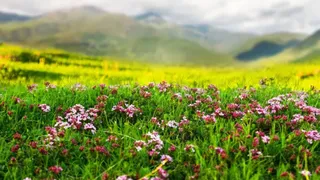
Dialogue Partner, Jagran Gopeshwar. The world famous Valley of Flowers is closed to tourists during the winter. This time a total of 15924 Indian and foreign tourists visited the valley. Which includes 416 foreign tourists. This is the highest number of foreign tourists to date. The park administration earned a revenue of Rs 3328050 lakh. The Valley of Flowers, located in Jyotirmath development block of Chamoli district, opens for tourists on June 1. While on October 31, it is closed to tourists for the winter season. This year, 15,508 Indian and 416 foreign tourists came to the Valley of Flowers. However, there has been a decline in the number of Indian tourists this year compared to last year. The maximum number of tourists who visited the Valley of Flowers was 20830 in the year 2022, of which the number of foreign tourists was 280. A total of 13161 tourists arrived in 2023, which included 401 foreign tourists. While in 2024, 19401 tourists visited the Valley of Flowers which included 330 foreign tourists. In the case of foreign tourists, this time the highest number was recorded at 416. This is the highest number of foreign tourists who have reached the Valley of Flowers so far. To make the celebration of the closure of the Valley of Flowers memorable for tourists, local businessmen and citizens together with the Forest Department visited the Valley of Flowers on the last day. During this time, the garbage was also brought back to the valley. After returning from the Valley of Flowers, the National Park Administration closed the main gate at Ghangaria and closed the entrance to the Valley of Flowers for the winter. It is noteworthy that the doors of Hemkund Sahib and Lokpal Laxman Temple were already closed on October 10. Now that the Valley of Flowers has also been closed to tourists, there is silence in Bhundar Valley. Hotel, dhaba, horse, mule and dandi kandi operators have also returned here. Tourists and pilgrims are not allowed to stay overnight in Hemkund Sahib Lokpal Laxman Temple and Valley of Flowers. Hence their base camp is only Ghangaria. In winter, the whole area is covered with snow. Entry of ordinary people is not allowed in this area. Only forest department personnel come here on patrol from time to time. This area is also sensitive as it is the natural habitat of rare animals, including musk deer. In such a situation, patrolling of the forest department is increased during winter. Local people of Bhundar also returned to Pulna village near Govindghat for winter stay. Sub Divisional Forest Officer Suman said that the Valley of Flowers is closed for tourists for winter. This time most foreign tourists reached the valley. Said that the patrolling of forest personnel will continue with the entry of tourists being restricted in this area during the winter season. This is a special Valley of Flowers. Spread over 87.5 square km, more than five hundred species of flowers bloom at different times in the Valley of Flowers. Due to the blooming of different types of flowers, the valley is colored in blue, yellow, red, purple and other colors. The Valley of Flowers opens on June 1 and remains open to tourists until October 31. The valley attracts tourists as different species of flowers bloom at different times. The Valley of Flowers was discovered in 1931 by the British mountaineer French Smith. It was told that while returning from Kamet Aarohan, he lost the way and reached the Valley of Flowers. After Frans Smith came face to face with the Valley of Flowers, he wrote a book called Valley of Flowers, then the country and the world learned about this valley. Seeing the importance of the Valley of Flowers, it was given National Park status in 1982 and World Heritage status in 2005 by UNESCO. There is also a Bhojpatra forest in the valley. To reach the Valley of Flowers, one has to travel from Rishikesh on Badrinath highway and reach Govindghat beyond Jyotirmath. Ghangharia can be reached by walking 14 km from here.