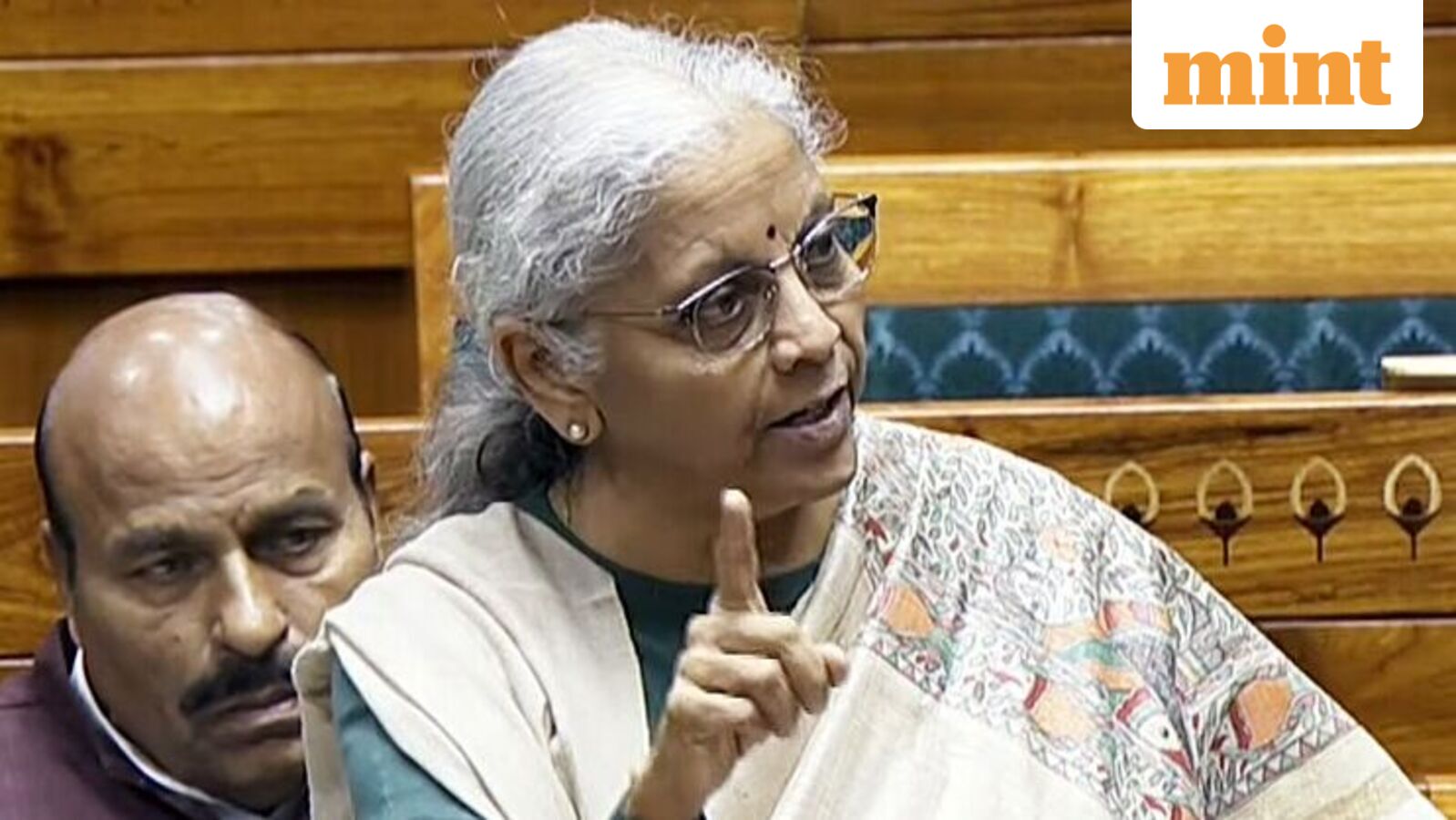
NEW DELHI: The debate over the quality of India’s national income accounts is “ill-informed” as the ‘C’ rating assigned by the International Monetary Fund (IMF) reflects the use of the 2011-12 base year for GDP estimation rather than any broader data deficiencies, Finance Minister Nirmala Sitharaman said on Wednesday. A new base year will be adopted from February 27, 2026, she added. Responding to the Lok Sabha debate on the Central Excise (Amendment) Bill, 2025, the minister said the IMF has recognized India’s macroeconomic stability and resilience and has forecast 6.6% economic growth for 2025-2026. IMF has not questioned India’s growth figures, Sitharaman said, adding that there is “no misleading data”. Her comments came after the opposition Congress party flagged the IMF’s data adequacy assessment of India’s national accounts following the release of the 8.2% gross domestic product (GDP) growth figure for the second quarter. The IMF’s assessment was part of the annual country report released on 26 November. The report noted that despite external headwinds, India’s growth is expected to remain strong, supported by favorable domestic conditions. “Under the baseline assumption of extended 50% US rates, real GDP is projected to grow at 6.6% in FY2025/26 before moderating to 6.2% in FY2026/27,” the IMF said. Sitharaman clarified the IMF’s assessment after Nationalist Congress Party MP Supriya Sule raised the issue during the debate. The Lok Sabha on Wednesday passed the Central Excise (Amendment) Bill, 2025. “The debate was very ill-informed. Most of the IMF’s report focuses on India’s overall healthy economic performance,” the minister said. She explained that the IMF classifies data adequacy as A, B, C or D. A indicates that data are sufficient for surveillance; B reflects some shortcomings but generally adequate; C means deficiencies may somewhat impede oversight—the assessment given to India’s national accounts—and D indicates serious deficiencies. The IMF report also recognizes growth in private consumption, macroeconomic stability and the resilience of the Indian economy as key drivers for growth, Sitharaman said. It also noted that “inflation is well below the RBI’s tolerance band of 2-6% and is expected to be 4.3% for this year,” Sitharaman said. “The C rating was based on an outdated base year, which is 2011-12. But the Government of India is now changing it and from next year we will have 2022-23 as the base year. From February 27, 2026, it will come into effect,” the minister said. On that date, the Ministry of Statistics and Program Implementation will release the second estimates of GDP for FY26 and the quarterly GDP estimates for the December quarter of FY26. On November 28, opposition leader Jairam Ramesh said in a social media post, “It is ironic that the quarterly GDP figures were released very soon after an IMF report gave India’s national accounts statistics the second lowest grade of C in its annual assessment of the Indian economy.” Central Excise (Amendment) Bill, 2025 Sitharaman said the excise duty to be levied on tobacco and tobacco products under the Central Excise (Amendment) Bill, 2025 will flow into the Centre’s divisible pool of taxes, which is shared with states. She noted that the Center reduced excise duty on tobacco at the time of the GST rollout in 2017 to facilitate the levy of the Goods and Services Tax (GST) compensation, the proceeds of which were used to offset states’ revenue losses in the initial years of GST. The compensation money was to be collected for five years until 2022, but its collection continued because the GST Council extended it until the funds borrowed to compensate states during the pandemic were repaid, she said. The Center has ceded certain excise rights to the GST Board for the introduction of the compensation rebate, and now that the excise duty is being discontinued, the excise duty is being transferred back to the Centre, the minister explained. “It is not a new law; it is not an additional tax; it is not something that the Center takes away… It comes back to the Centre, to be collected as excise duty, which goes to the divisible pool. It is going to be redistributed again,” the minister said, adding that 41% of the Centre’s divisible pool of tax revenue goes to the states under the Finance Commission. She explained that it is not a cess but excise duty. “Obviously, we don’t want cigarettes to be affordable,” Sitharaman said, adding that price or tax should act as a deterrent to tobacco use. Tax incidence on cigarettes is about 53% of the retail price in India, lower than in countries like the UK and Australia, she noted. NCP MP Supriya Sule urged the government to address the problem of surrogate advertising by tobacco manufacturers. Some parliamentarians said tougher measures such as bans on tobacco use were needed, while others warned that higher excise duties would hurt tobacco farmers. Sitharaman said tobacco farmers should be gradually shifted to alternative crops. Such efforts were made earlier and continue under the current government, she said, in response to concerns that excise duty hikes would affect farmers involved in tobacco cultivation and bidi rolling. Abdul Rashid Sheikh, an independent MP from Jammu and Kashmir, said high taxes do not effectively curb substance abuse and argued that only a total ban works. He also urged the government to “make India free from addictions.” “What will happen to tobacco farmers in Maharashtra? Excise duty will hit the procurement price of people involved in bidi roll. Their income will be affected as demand falls. Does the government want to generate revenue by taking from farmers’ pockets? Tobacco and bidi are mostly consumed by the poor and the less educated people in Mahbaarpu Patil. “If you really care about public health, ban it,” said Patil.