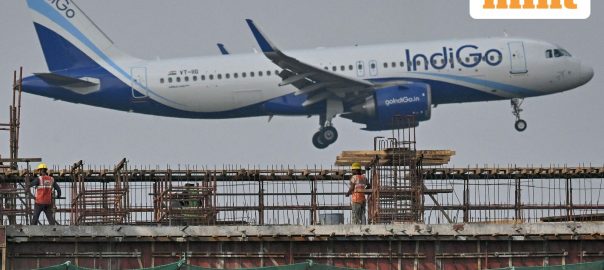
Copyright © HT Digital Streams Limited All rights reserved. Dipali Banka 4 min read Dec 12, 2025, 06:00 IST Indigo shares have fallen about 17% since the start of the month, Photo: AFP Summary Five market analysts Mint spoke to said a further erosion of the share price is unlikely once the stock joins the Sensex on December 22, although the airline’s revenue could fall in the last quarter. Shares of InterGlobe Aviation Ltd, which runs IndiGo, are unlikely to stage a major recovery once the stock joins the Sensex on December 22 as investors await clarity on regulatory overhang, but its inclusion in the benchmark index could provide downside protection, several analysts told Mint. Indigo shares have fallen about 17% since the start of the month, after the airline canceled more than 4,500 flights last week due to an acute crew shortage stemming from its failure to adapt to new, stricter flight duty time limitations (FDTL) rules for pilots. Following this, the civil aviation regulator ordered India’s largest airline to cut its winter schedule by 10%. The stock’s price-to-earnings ratio was 25.5 on December 11, compared with 30.8 on December 1 and 32.7 on August 20, when it hit a record high of ₹6155.50. However, five market analysts said further erosion of the share price was unlikely, even though the airline expects revenue to fall in the December quarter due to last week’s cancellations. Inclusion in the Sensex typically increases demand for a share, as passive funds that track the index and other mutual funds look to include it in their portfolios, pushing the share price higher. On November 21, BSE Index Services, a Bombay Stock Exchange subsidiary, announced that InterGlobe Aviation will replace Tata Motors Passenger Vehicles Ltd in the Sensex with 30 shares on December 22. Sensex privilege While Indigo shares may not get a Sensex boost, its inclusion in the index should at least provide support on the downside, said Nirav Karkera, head of research at Fisdom, a Bengaluru-based wealth management firm. “Investors will still be cautious because the regulatory overhang is not gone. But index investors cannot pick and choose; they buy the basket, and that automatically brings flow to the stock,” Karkera added. “The day of the Sensex rebalancing could bring an inflow of $315 million into the counter,” said Abhilash Pagaria, head of Nuvama Alternative & Quantitative Research. He added that while a 2-3% rise on or before the day of inclusion was possible, fundamental issues would overtake the stock sooner or later. After last week’s chaos, the Directorate General of Civil Aviation sent the airline a show-cause notice, seeking an explanation from CEO Pieter Elbers and COO Isidre Porqueras for the disruption, and ordered an investigation. It cut 10% of the airline’s nearly 2,145 daily domestic flights from the winter schedule and on Wednesday formed an eight-member team to monitor IndiGo’s day-to-day operations, including two officials stationed at the airline’s Gurugram headquarters. Analysts at JMF Financial and ICRA, a ratings agency, speculated whether there could be leadership changes at the airlines, further increasing uncertainty among investors. ‘Aviation growth story intact’ Anil R, senior analyst at Geojit Investments Ltd said: “Overall, the inclusion should provide support, even if it is not a sharp rebound after IndiGo’s recent correction, which has already priced in most of the operational issues in the short term. But investors can remain cautious on regulatory developments. [Nonetheless] the stock’s inclusion in the Sensex may still bring some fund flow.” Jinesh Joshi, aerospace analyst at PL Capital, a Mumbai-based financial services group, said: “It is difficult to comment on whether the stock will see a rally after its inclusion in the Sensex due to the regulatory uncertainty that keeps investors on the fence. However, there could be some inflows to support the stock.” Gagan Dixit, senior vice president, aerospace, at Elara Securities, echoed their views. “Index inclusion usually brings support as funds tracking the benchmark need to buy, but in the near term, the stock will still move along with the regulatory noise. He added: “However, over a longer period, money managers such as mutual funds and pension funds will look at the FY28 outlook, which looks unchanged. There is value here as India’s aviation demand growth story is intact.” On Wednesday, IndiGo said it expects a revenue decline in the December quarter and cut its guidance. He now expects passenger growth to fall into the ‘mid-single digit’ range, compared with management’s November 4 guidance of, at best, “modest growth” in the December quarter. IndiGo said it expects “high single to early double-digit growth (%)” in capacity, compared to management’s earlier guidance of “high-teens growth”. Analysts at JP Morgan said in a note dated November 5: “Indigo’s domestic airfares for 3QFY26TD are flat y-o-y, while select international routes post double-digit growth; fuel costs up 6% QoQ, and a weak INR likely to depress non-fuel CASK.” Cost per available seat kilometer (CASK) is an important airline industry metric that measures the operating costs required to fly one seat – occupied or empty – over one kilometre. Airlines try to minimize these costs to increase profitability. Get all the corporate news and updates on Live Mint. Download the Mint News app to get daily market updates and live business news. more topics #IndiGo #indigo crisis #BSE sensex Read next story