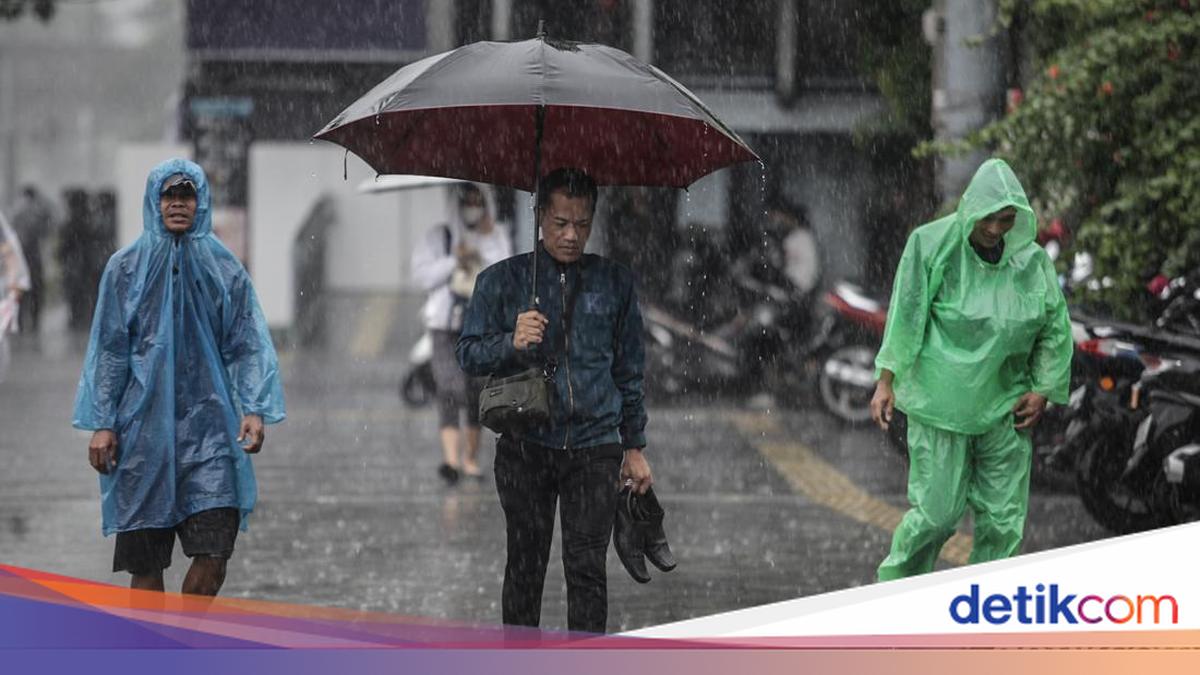
Jakarta – The Meteorology, Climatology and Geophysics Agency (BMKG) transmits the latest weather conditions and potential hydrometeorological disasters during Christmas and New Year (Nataru). This is important to know to increase preparedness. Quoting the official BMKG website, the head of BMKG, Teuku Faisal Fathani, emphasized that the type of disasters that dominate are extreme rain, strong winds and other phenomena such as destructive lightning, tornadoes, hail and limited visibility that often disrupt flights and shipping. “The trend continues to increase. West Java leads the frequency of extreme rain and strong winds, followed by Central Java and East Java. This should be our general concern,” said Faisal (1/12). Scroll TO CONTINUE CONTENT For the period 2nd week of December 2025 to early January 2026, BMKG estimates: The Asian Monsoon is starting to become active, increasing rainfall in Indonesia. The occurrence of the Madden Julian Oscillation atmospheric anomaly, Kelvin waves and the Rossby equator causing extreme rain. The presence of the Siberian cold front also increases the intensity of the rain. Tropical cyclone seeds have the potential to grow in the southern region of Indonesia. Areas to be aware of the formation of cyclone seeds include Bengkulu, Lampung, Banten, DKI Jakarta, Java – Bali, NTB, NTT, Maluku, South and Central Papua. BMKG reminded that although Indonesia is generally not in the path of cyclones, weather anomalies can change this pattern, such as Cyclone Senyar which some time ago caused widespread damage and extreme rain of more than 380mm/day in Aceh. Apart from that, on December 28 – January 10, almost all areas of Java, Bali, NTT, NTB, and parts of South Sulawesi and South Papua have the potential to experience high to very high rainfall (300-500 mm per month). You should also be aware of the potential for tidal flooding on the coasts of Jakarta, Banten and Pantura, West Java, especially due to the perigee and full moon phases in mid-December. There is a weather modification operation. To support the acceleration of emergency handling and logistics distribution, BMKG together with BNPB conducts Weather Modification Operations (OMC) at three airports, namely Sultan Iskandar Muda (Aceh), Kualanamu (North Sumatra), and the Airport in Padang. Operations are carried out to reduce rain in unaffected areas, or to prevent rain in disaster prone zones, using NACL or Calcium Oxide seeding. “OMC can only be carried out if the governor sets an emergency alert status. Without that, the operation cannot be carried out because the costs and risks are very high,” he explained. BMKG emphasized that tropical cyclones can be predicted up to eight days in advance. Early warnings were sent repeatedly during Cyclone Senyar. BMKG preparations for Nataru: Regional governments can actively consult with the BMKG center, immediately hold coordination meetings with Forkopimda and strengthen the early response system before the Christmas holidays. BMKG also opened national command posts at various ports and airports and prepared supporting applications such as weather radar, DWT for roads and Inawis for sea monitoring. Faisal concluded his presentation by inviting all stakeholders to maximize early warning to early action. “This meeting is important so that we have alert preparedness, alert to safety. Early warning leads to early action to zero casualties,” he concluded. (squeeze/squeeze)